%20(1).png)
Business development automation for B2B growth in 2026
Learn how business development automation helps B2B sales teams scale prospecting, qualify leads faster, and drive 10-30% more revenue without replacing your reps.
Most sales leaders assume automation means replacing their reps with bots. That assumption is costing you pipeline. Business development automation is not about removing humans from the equation but about combining technology with human oversight to manage prospecting, lead qualification, and pipeline management at a scale no team can match manually. This article breaks down exactly what that means, where automation delivers real value, where it falls short, and how to build a system that actually works for complex B2B organizations.
Table of Contents
- Defining business development automation in B2B
- Key benefits for B2B sales organizations
- What should and should not be automated?
- Pitfalls, misconceptions, and human-in-the-loop
- Technology stack and implementation best practices
- Real-world applications and outcomes
- How Uman powers business development automation
- Frequently asked questions
Key Takeaways
PointDetailsHybrid automation prevailsCombining AI with human expertise yields far better results than full automation in B2B business development.Automate the right tasksFocus automation on repetitive work like research, outreach, and scheduling—retain human control for complex interactions.Integrated stacks deliver valueSuccessful automation relies on unified technology—CRMs, AI, and orchestration tools working together.Measure outcomes, not activityTrack ROI by pipeline growth and conversion rates rather than just process counts or emails sent.
Defining business development automation in B2B
Business development automation is the use of technology to handle repeatable, data-driven tasks across the sales pipeline so your team can focus on work that requires judgment and relationships. It is not a single tool. It is a coordinated layer of systems working together.
In practice, this covers a wide range of activities:
- Outbound prospecting: Identifying and enriching target accounts using AI-driven data sources
- Lead qualification: Scoring and routing inbound and outbound leads based on fit criteria
- Outreach sequencing: Sending personalized, timed messages across email and LinkedIn
- CRM updates: Logging activity, updating deal stages, and flagging stale opportunities automatically
- Meeting scheduling: Eliminating back-and-forth by automating calendar coordination
The key distinction is that AI-powered workflows handle the repetitive and data-heavy steps, while humans stay in the loop for context, strategy, and relationship-building. As one framework puts it, AI and workflow tools handle repetitive prospecting and data tasks while keeping humans responsible for strategy.
“The goal of automation is not to remove the human from business development. It is to remove the friction that stops humans from doing their best work.”
For teams managing broad service portfolios, this matters even more. Automating prospecting frees your reps to spend time on the accounts most likely to convert, rather than manually researching hundreds of companies each week. And qualifying B2B leads with AI-assisted scoring means your pipeline reflects real opportunity, not wishful thinking.
Key benefits for B2B sales organizations
The business case for automation is not theoretical. Sales organizations that implement it well see measurable gains across coverage, speed, and accuracy.
Here is what changes when you automate the right activities:
- Increased lead coverage: Automated prospecting tools can scan and qualify thousands of accounts simultaneously, far beyond what any team can do manually
- Faster qualification cycles: AI scoring reduces the time from first contact to qualified opportunity, compressing weeks into days
- Predictable pipeline growth: Consistent outreach sequences and follow-up cadences mean fewer deals fall through the cracks
- Fewer manual errors: Automated CRM updates and data enrichment reduce the risk of outdated or missing information skewing your forecast
Stat to know: Automation boosts sales productivity and enables teams to focus on high-value tasks while streamlining repetitive work, directly translating to more selling time per rep.
For complex B2B organizations, the compounding effect is significant. When your reps are not spending hours on research and admin, they can run more meaningful conversations per week. Improving prospecting outcomes becomes a structural advantage rather than a one-off initiative. The teams that automate intelligently do not just work faster. They work on better opportunities.

What should and should not be automated?
Not every business development task belongs in an automation workflow. Getting this wrong is one of the most common mistakes sales leaders make when rolling out new tools.
TaskAutomate?WhyAccount research and data enrichmentYesHigh volume, rule-based, time-consumingLead scoring and routingYesConsistent criteria, scalableOutreach sequencingYesRepeatable, trackable, optimizableMeeting schedulingYesEliminates friction, saves timeDiscovery calls and demosNoRequires listening, adapting, building trustProposal customizationNoNeeds deep context and strategic judgmentContract negotiationNoRelationship-dependent, high stakesStakeholder mapping for complex dealsPartialAI can suggest; human must validate
The pattern is clear. Automate tasks that are high-volume, rule-based, and data-driven. Keep humans in control of anything that requires nuance, empathy, or strategic thinking. Automating business development works best when it amplifies what your reps are already good at, not when it tries to replace the parts of selling that actually require a person.

For sales leaders, the practical guidance is straightforward: automate research and scheduling, reserve nuanced conversations for humans, and always monitor duplicate and saturation rates in your outreach.
Pro Tip: Before automating any step, map the process manually first. If you cannot describe the decision logic clearly, automation will make it worse, not better. Garbage in, garbage out applies to every workflow you build.
Hybrid models consistently outperform full automation. A rep who uses AI to prepare for a call, identify cross-sell angles, and draft a follow-up email is more effective than one doing it all manually or one relying entirely on bots.
Pitfalls, misconceptions, and human-in-the-loop
The biggest misconception in business development automation is that more automation equals better results. It does not. Over-automation is a real and costly failure mode.
Here are the most common pitfalls to avoid:
- Over-automation of outreach: Sending too many automated messages too quickly makes your brand look robotic and damages deliverability. Conversion rates collapse when prospects feel like a number.
- Poor data quality at the source: Automation amplifies whatever data you feed it. If your CRM is full of outdated contacts or incomplete account records, your automated workflows will produce noise, not pipeline.
- Scope creep in automation logic: Starting with one simple workflow and gradually adding exceptions until the system is unmanageable. Keep automation rules tight and review them regularly.
- Ignoring edge cases: Most AI failures happen not in the common scenarios but in the 20% of situations the model was not trained to handle. Those edge cases require human judgment.
- No clear ownership: Automation without accountability breaks down fast. Someone on your team must own each workflow, monitor its performance, and intervene when it misfires.
“Over-automation can cause robotic outreach and collapse conversions; best-in-class systems keep humans responsible for judgment, exceptions, and data quality.”
The research on AI productivity limits reinforces this point. AI non-determinism and structural uncertainty mean that humans are not optional in complex sales processes. They are essential. Before you expand your automation footprint, take an honest look at your current state with an AI readiness assessment to identify where your data and processes are actually ready to support it.
Technology stack and implementation best practices
Building an automation stack that delivers consistent results requires more than picking the right tools. It requires a deliberate approach to integration, governance, and measurement.
The core components of an effective B2B automation stack look like this:
LayerFunctionExamplesCRMCentral data store, pipeline trackingSalesforce, HubSpot, DynamicsAI enrichmentAccount and contact data, scoringClay, Apollo, CognismWorkflow orchestrationSequence management, routing logicOutreach, Salesloft, n8nSales enablementContent delivery, guided workflowsUmanAnalyticsOutcome tracking, attributionTableau, native CRM reporting
Implementation works best in phases. Start with a process audit to identify which tasks consume the most time with the least strategic value. Then run a focused pilot on one workflow, measure the outcome, and iterate before scaling. Integrated stacks combining CRM, AI APIs, and orchestration tools outperform point solutions, and starting with audits and pilots is the proven path to sustainable results.
Pro Tip: Do not measure success by emails sent or tasks completed. Measure it by pipeline generated, conversion rates, and revenue influenced. Activity metrics are easy to game. Outcome metrics tell you whether automation is actually working.
Governance matters too. Business-IT alignment and strong data governance ensure ethical, successful deployments with hybrid models performing best. That means setting clear rules about data usage, defining who can modify automation logic, and building in regular review cycles. For enterprise B2B organizations, this is not optional. It is what separates a scalable system from a fragile one.
When evaluating platforms, look for solutions that integrate cleanly with your existing CRM and document management systems. Choosing the right platform means prioritizing governance and workflow depth over feature count. And if prospect discovery is a priority, purpose-built tools for prospect discovery automation can dramatically reduce the time your team spends building target lists.
Real-world applications and outcomes
The gap between automation theory and automation results is where most organizations get stuck. The teams that close that gap share a few common traits: they start with clear use cases, they keep humans accountable for outcomes, and they treat their data as a strategic asset.
Here is what effective automation looks like in practice across B2B organizations:
- Global IT services firm: Automated account research and outreach sequencing reduced prep time per rep by several hours per week, allowing the team to cover 40% more target accounts without adding headcount
- Complex portfolio sales team: AI-assisted cross-sell identification surfaced relevant service combinations that reps had previously missed, directly increasing average deal size
- New hire onboarding: Guided workflows and centralized knowledge cut ramp-up time significantly, with new reps reaching full productivity faster than the previous cohort
- CRM hygiene: Automated logging and data enrichment improved forecast accuracy by reducing stale and incomplete records across the pipeline
The Akkodis case study illustrates how a complex IT services organization used structured automation to bring consistency to a large, distributed sales team managing a broad portfolio. The results were not just efficiency gains. They were strategic improvements in how the team identified and pursued the right opportunities.
Research on hybrid automation models confirms what practitioners already know: optimists see automation amplifying human expertise and transforming outcomes, while hybrid models consistently show tangible wins over both full automation and fully manual approaches. The lesson is not to automate everything. It is to automate the right things and let your people do the rest better.
How Uman powers business development automation
If you are ready to move from principles to practice, Uman is built specifically for the kind of complex B2B sales environment this article describes. It acts as a centralized sales brain that connects your service portfolio, your customer data, and your sales workflows into a single governed layer.
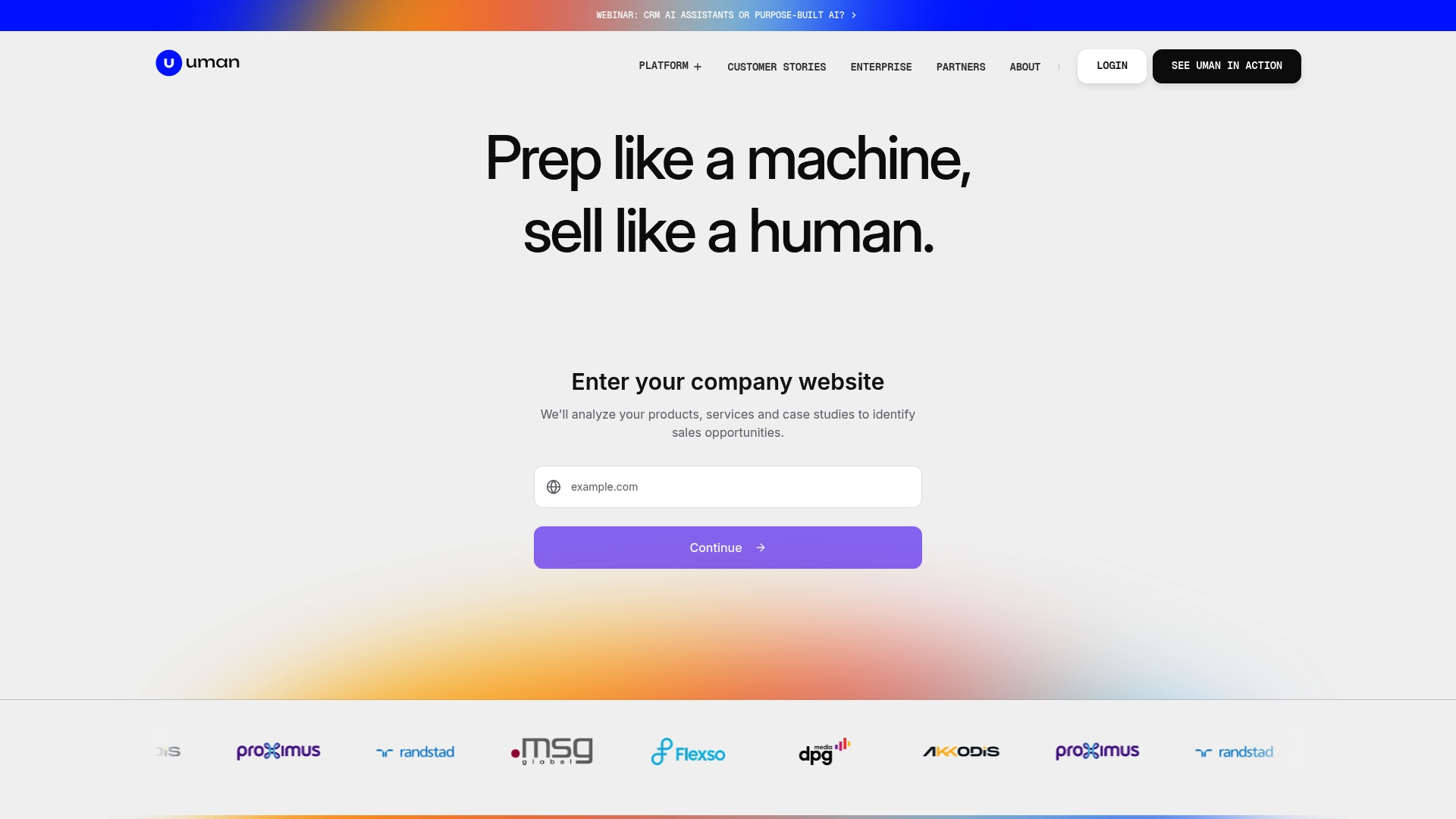
The Uman platform covers the full automation lifecycle: from prospect discovery and personalized outreach to deal qualification and CRM updates. It integrates with your existing CRM and document management systems, so you are not rebuilding your stack from scratch. Smart account management surfaces cross-sell and upsell opportunities your team would otherwise miss, while deal execution tools reduce the prep time and admin burden that slows down your pipeline. Uman is ISO 27001:2022 certified and GDPR compliant, which matters when you are handling sensitive enterprise data at scale.
Frequently asked questions
How is business development automation different from sales automation?
Business development automation spans prospecting to pipeline management, covering the full lifecycle from identifying target accounts to qualifying opportunities, while sales automation typically focuses on closing activities and repeatable post-qualification steps.
Does business development automation replace salespeople?
No. AI non-determinism and edge cases mean humans are essential for oversight, complex conversations, and high-stakes decisions that automation cannot reliably handle.
What are the biggest risks of automating business development?
Over-automation, poor data quality, and missing human oversight are the top risks. Over-automation and poor process documentation are the most common failure points that hurt conversion rates and damage brand reputation.
Which business development tasks deliver the highest ROI when automated?
Research, lead enrichment, scheduling, and outreach sequencing produce the fastest gains. Automating research and scheduling while keeping nuanced discussions human is the formula that consistently delivers the strongest return.
How do you measure success in business development automation?
Track pipeline growth and lead conversion rates, not emails sent or tasks logged. Measuring business outcomes over activity counts is the best practice that separates teams getting real value from those just running busy workflows.
Recommended
Prep like a machine, sell like a human
Let AI handle the research and prep work — you focus on building relationships and closing deals.