TL;DR:
- Centralized sales knowledge improves consistency, reduces ramp-up time, and boosts revenue.
- Effective organization and governance are more critical than volume in maintaining useful content.
- AI enhances knowledge access but depends on well-structured, up-to-date data for maximum benefit.
Fragmented sales knowledge is expensive. When your reps hunt through outdated decks, rely on tribal knowledge, or send inconsistent messaging to prospects, deals stall and revenue leaks. For complex B2B organizations managing broad service portfolios, this problem compounds fast. A single misaligned pitch can cost a six-figure opportunity. This guide walks you through the full process of centralizing your sales knowledge, from auditing existing content to deploying AI-powered search and measuring real business impact. If you want your team to sell with confidence and consistency, the answer starts with how you manage what they know.
Table of Contents
- Understanding the problem: Why centralization matters
- Laying the groundwork: Organizing your sales content
- Building your central knowledge hub: Tools, structures, and governance
- Supercharging knowledge access: Smart search, AI, and adoption tactics
- Measuring success: Results, insights, and continuous improvement
- Our perspective: Why structure trumps volume in sales knowledge
- Start centralizing sales knowledge with Uman
- Frequently asked questions
Key Takeaways
| Point | Details |
|---|---|
| Centralization solves fragmentation | Bringing all sales resources into one system eliminates inefficiency and inconsistent messaging. |
| Taxonomy and governance are critical | Organizing with clear tags and ownership ensures your knowledge base stays useful and current. |
| AI boosts, but quality is key | Artificial intelligence improves discovery only when data is structured and up to date. |
| Ongoing improvement drives ROI | Measuring usage and updating content regularly ensures your investment keeps delivering value. |
Understanding the problem: Why centralization matters
Most sales teams do not have a knowledge problem. They have a knowledge access problem. Information exists, but it lives in email threads, personal drives, outdated SharePoint folders, and the heads of your top performers. When a new rep needs to prepare for a complex deal, they spend hours piecing together a picture that a senior colleague could sketch in minutes.
The consequences are measurable and serious:
- Inconsistent messaging across reps damages brand credibility and confuses buyers
- Longer ramp-up times for new hires, often stretching six months or more in complex B2B environments
- Missed cross-sell opportunities because reps simply do not know the full portfolio
- Wasted prep time that pulls sellers away from actual selling
- Outdated content reaching prospects, creating compliance and accuracy risks
“Knowledge silos do not just slow teams down. They actively undermine trust with buyers who expect every interaction to reflect the same level of expertise.”
The financial case for fixing this is strong. Improved sales effectiveness and data quality through a unified platform can yield a 236% ROI, according to a Forrester Total Economic Impact study. That is not a marginal improvement. It is a structural shift in how revenue gets generated.
The key mindset shift is treating your sales knowledge centralization effort as a living system, not a one-time project. Content decays. Markets shift. New services launch. If your knowledge base is static, it becomes a liability faster than you expect. Organizations that treat their knowledge infrastructure the way product teams treat software, with versioning, ownership, and regular releases, consistently outperform those that treat it as a filing cabinet.
Avoiding content governance pitfalls means resisting the urge to set up a system and walk away. The organizations that see the biggest gains are the ones that build governance into the process from day one, not as an afterthought.
Now that you understand what is at stake, it is critical to see what the centralization process involves.
Laying the groundwork: Organizing your sales content
Before you choose a platform or deploy AI, you need to know what you are working with. Most organizations are surprised by what a content audit reveals: duplicate assets, conflicting versions of the same pitch deck, and entire product lines with zero supporting materials.
Here is a practical approach to getting organized:
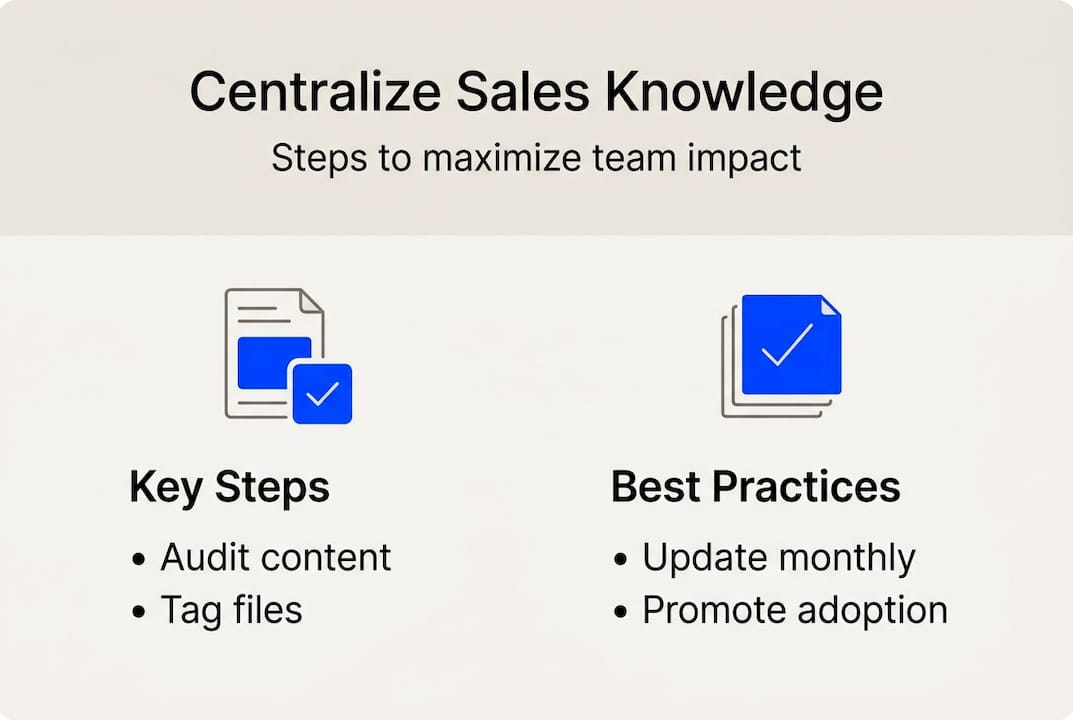
- Inventory every knowledge asset across all storage locations, including CRM attachments, email templates, shared drives, and presentation libraries
- Categorize by type, such as case studies, battle cards, pricing guides, onboarding materials, and objection-handling scripts
- Assess quality and relevance, marking each asset as current, needs update, or retire
- Assign ownership so every piece of content has a named person responsible for keeping it accurate
- Apply a consistent taxonomy, tagging each asset by buyer persona, industry vertical, sales stage, and pain point
Tagging is where most teams underinvest. A well-tagged library is searchable, filterable, and AI-ready. A poorly tagged one is just a digital junk drawer.
| Tagging dimension | Example values | Why it matters |
|---|---|---|
| Buyer persona | CTO, Sales Director, CFO | Surfaces role-relevant content fast |
| Industry vertical | IT Services, Logistics, Telecom | Enables industry-specific personalization |
| Sales stage | Prospecting, Discovery, Proposal | Matches content to deal moment |
| Pain point | Ramp-up time, Messaging inconsistency | Connects content to buyer need |
As robust taxonomy and metadata practices show, tagging by persona, industry, and stage is what makes AI-enhanced search and recommendations actually work. Quarterly audits then keep the library from drifting back into chaos.

Pro Tip: Incentivize knowledge sharing by recognizing contributors in team meetings or internal communications. When reps see that sharing a winning email template or a sharp objection response gets acknowledged, contribution rates climb quickly.
Reviewing sales content audit steps before you start will save you from common structural mistakes. You can also use an AI readiness assessment to gauge whether your content foundation is solid enough to support intelligent tooling. For broader organizational readiness tips, external frameworks can help you align stakeholders before the technical work begins.
With your materials sorted and assigned proper taxonomy, it is time to build the actual system.
Building your central knowledge hub: Tools, structures, and governance
Choosing a platform is only part of the equation. The more important decision is how you govern what goes into it and how it stays current.
When evaluating platforms, look for these core capabilities:
| Feature | Why it is a must-have |
|---|---|
| CRM and DMS integration | Eliminates duplicate data entry and keeps context connected |
| Role-based access control | Ensures reps see relevant content without noise |
| Version control | Prevents outdated assets from circulating |
| Usage analytics | Shows what content actually gets used in deals |
| AI-powered search | Surfaces the right asset at the right moment |
Once your platform is selected, governance is what separates a useful hub from an expensive archive. Continuous content governance means defining a clear lifecycle for every asset: who owns it, when it gets reviewed, and what triggers an update. Tying content reviews to product launches or market changes keeps materials from going stale between scheduled audits.
Key governance policies to establish from the start:
- Ownership rules: Every asset has one named owner, not a team or department
- Update triggers: Product changes, pricing updates, and competitive shifts automatically flag related content for review
- Retirement criteria: Assets unused for 12 months or flagged as inaccurate are archived, not just hidden
- Approval workflow: New content goes through a brief review before it enters the live library
Pro Tip: Run a monthly pruning session where content owners spend 30 minutes reviewing their assets. Pair this with a simple user feedback loop, where reps can flag content as helpful or outdated directly from the platform, and your library will stay sharp with minimal overhead.
For insights on cross-team ownership, involving marketing, product, and sales operations in governance decisions prevents the common failure mode where one team controls content that another team depends on. Also, reviewing centralized knowledge best practices and understanding how to avoid pitfalls of automation will help you build a system that scales without breaking.
Your hub is live. Now enhance it with AI for speed and personalization.
Supercharging knowledge access: Smart search, AI, and adoption tactics
A well-organized knowledge base is a strong foundation. AI is what turns it into a competitive advantage.
The most impactful AI features for sales knowledge systems include:
- Smart search: Natural language queries that return the most relevant asset, not just keyword matches
- Conflict detection: Flags when two assets contain contradictory information, such as different pricing or positioning
- Auto-updates: Triggers content reviews when connected data sources change
- Personalized recommendations: Surfaces content based on deal context, industry, and buyer role
As AI for search and personalization research confirms, these capabilities only deliver value when the underlying data is accurate and well-structured. AI does not fix a messy library. It amplifies whatever is already there, good or bad.
Here is a practical sequence for implementing AI-powered knowledge access:
- Confirm your taxonomy is complete and consistent before enabling AI features
- Start with smart search as the first AI layer, since it delivers immediate, visible value to reps
- Enable personalized recommendations once you have at least three months of usage data to train on
- Add conflict detection as your library scales beyond a few hundred assets
- Review AI-generated suggestions monthly and correct errors to improve model accuracy over time
“The teams that adopt AI knowledge tools fastest are the ones that invested in data quality first. The technology rewards preparation.”
Adoption is the other half of the equation. Even the best system fails if reps do not use it. Address reluctance directly by involving top performers in the rollout, running short live demos tied to real deals, and tracking usage as a team metric rather than an individual one. AI’s role in B2B sales is expanding rapidly, and teams that build adoption habits now will have a significant head start. Reviewing AI for sales efficiency tips can also help you frame the change in terms your team will respond to. For edge cases in AI adoption, Forrester’s guidance on avoiding the set-and-forget trap is worth reading before your rollout.
With systems and adoption measures in place, let us discuss tracking value and continuous improvement.
Measuring success: Results, insights, and continuous improvement
Centralizing sales knowledge is an investment. Like any investment, you need to track whether it is working and where to adjust.
Start with these core metrics:
- Platform adoption rate: What percentage of your team accesses the knowledge hub weekly
- Content usage by deal stage: Which assets get used most, and at which point in the sales cycle
- Time to ramp: How long it takes new hires to reach full productivity compared to your pre-centralization baseline
- Win rate changes: Are deals supported by knowledge hub content closing at higher rates
- Content freshness score: What percentage of your library has been reviewed in the last 90 days
Interpreting these numbers requires context. A low adoption rate in week two is expected. A low adoption rate in month four signals a usability or awareness problem. A high usage rate for one asset type, say case studies, but low usage for battle cards, tells you where to invest in content development.
| Metric | What to watch for | Action if off-track |
|---|---|---|
| Adoption rate | Below 60% after 90 days | Run targeted training and gather friction feedback |
| Time to ramp | No improvement after 6 months | Review onboarding content quality and structure |
| Win rate | Flat or declining | Audit deal-stage content for gaps or accuracy issues |
| Content freshness | More than 20% outdated | Accelerate ownership assignments and audit cadence |
Sales platform centralization can yield 236% ROI when effectiveness and data quality improve together. That benchmark gives you a realistic ceiling to aim for, but most teams see meaningful gains well before they reach it. Build quarterly reviews into your sales enablement workflows to keep the improvement cycle running.
These measurement practices ensure ongoing relevance. Now, here is what most guides get wrong about centralization.
Our perspective: Why structure trumps volume in sales knowledge
Most B2B sales teams instinctively respond to knowledge gaps by creating more content. More case studies, more battle cards, more slide decks. The library grows, but the problem does not shrink. In fact, it often gets worse.
The real issue is rarely volume. It is structure. A small, well-organized knowledge base consistently outperforms a large, unstructured one because reps can actually find what they need in the moment they need it. As research on knowledge transfer confirms, treating your knowledge base as a living system with clear cross-team ownership is what separates high-performing organizations from those stuck in perpetual content creation cycles.
Governance is not glamorous work. But it is the hidden ROI driver that most organizations overlook. When you assign ownership, enforce update cadences, and retire outdated content consistently, you are not just maintaining a library. You are building a system your reps trust. And trust is what drives adoption. Avoiding common AI mistakes in sales starts with recognizing that technology cannot substitute for intentional structure.
Start centralizing sales knowledge with Uman
Building a centralized, governed sales knowledge base is one of the highest-leverage investments a B2B sales leader can make. But the architecture, governance, and AI layer all need to work together to deliver results.
Uman’s centralized platform is purpose-built for complex B2B sales organizations that manage broad portfolios and need consistent, accurate knowledge at every stage of the sales cycle. From smart search to automated content recommendations, Uman gives your team the right information at the right moment, without the manual overhead. Explore the account management features to see how Uman helps teams identify cross-sell opportunities and keep account knowledge current. The path to a 10% to 30% revenue increase starts with getting your knowledge foundation right.
Frequently asked questions
What is a centralized sales knowledge base?
A centralized sales knowledge base is a single, organized hub where all sales materials, playbooks, and best practices are stored and easily accessed by your entire sales team. Centralization is essential for maintaining consistency and efficiency across complex B2B sales organizations.
How long does it take to centralize sales knowledge?
With an organized approach, most B2B teams begin seeing value within two to three months, though long-term governance and improvement are ongoing. Content organization and quarterly audits are what accelerate time to value most reliably.
What are the biggest mistakes when centralizing sales knowledge?
The most common mistakes are prioritizing content volume over structure, neglecting updates, and lack of ownership across teams. Prioritizing structure and governance over simply creating more content is what separates successful initiatives from stalled ones.
How can AI improve a central knowledge base?
AI powers fast search, content recommendations, conflict detection, and automatic updates, but only works well with accurate, organized data. AI enables smarter recommendations when the underlying data is high quality and consistently tagged.
How do you keep a sales knowledge base up to date?
Assign ownership for updates, conduct regular audits, and tie content reviews to product or market changes for ongoing accuracy. Continuous content governance and monthly pruning are the most reliable methods for keeping materials relevant over time.
Recommended