%20(1).png)
From reactive to proactive account management
Many companies work hard to win new customers. But when it comes to growing those accounts, they often fall into reactive habits. They wait for renewal reminders, customer complaints, or budget approvals before they act. Proactive account management is different. It means staying ahead of customer needs, spotting growth opportunities early, and guiding the relationship with confidence. In this article, you will learn why reactive management is risky, what proactive engagement looks like, and how modern tools can make it easier.
The hidden costs of reactive management
At first, reactive management seems safe. You answer emails, prepare for QBRs, and respond when clients ask for help.
But this approach creates hidden costs:
- Missed expansion revenue: By the time you hear about a new project, a competitor might already be involved.
- Weak renewals: If you only show up when contracts are ending, you look transactional, not strategic.
- Lower trust: Customers notice when you only engage for renewals.
Reactive teams spend more time catching up and less time adding value.
What proactive engagement looks like
Proactive account managers:
- Track customer signals all year
- Share ideas before the customer asks
- Highlight results and progress regularly
- Plan for expansion, not just renewals
For example, if your client just launched a new product, you reach out to discuss how your services can support it. Or if you notice low adoption, you plan a session to help their team get more value.
Using AI to detect signals before your competitors
Modern tools can help you spot changes early. AI can scan public data and usage trends to find:
- New leadership hires
- Fresh funding rounds
- Divisional growth
- Shifts in engagement
When you see these signals, you can act before others do.
Imagine getting an alert that your client’s team is growing in a new region. Instead of waiting for them to call you, you prepare a proposal that shows how you can help.
A story: turning a QBR into a growth conversation
Consider this scenario:
You have a quarterly business review in two weeks. Without modern tools, you spend hours collecting data. You check CRM records, ask colleagues for updates, and build slides manually.
By the time you finish, you feel rushed and reactive.
With a structured system, it is different.
- You open your dashboard.
- You see current usage, recent wins, and expansion signals.
- The system recommends talking points and slides.
You walk into the QBR confident and prepared to discuss new ideas, not just old results.
How uman makes proactive management simple
uman supports proactive account growth by:
- Tracking customer signals in real time
- Recommending cross-sell and upsell plays
- Auto-generating QBR decks
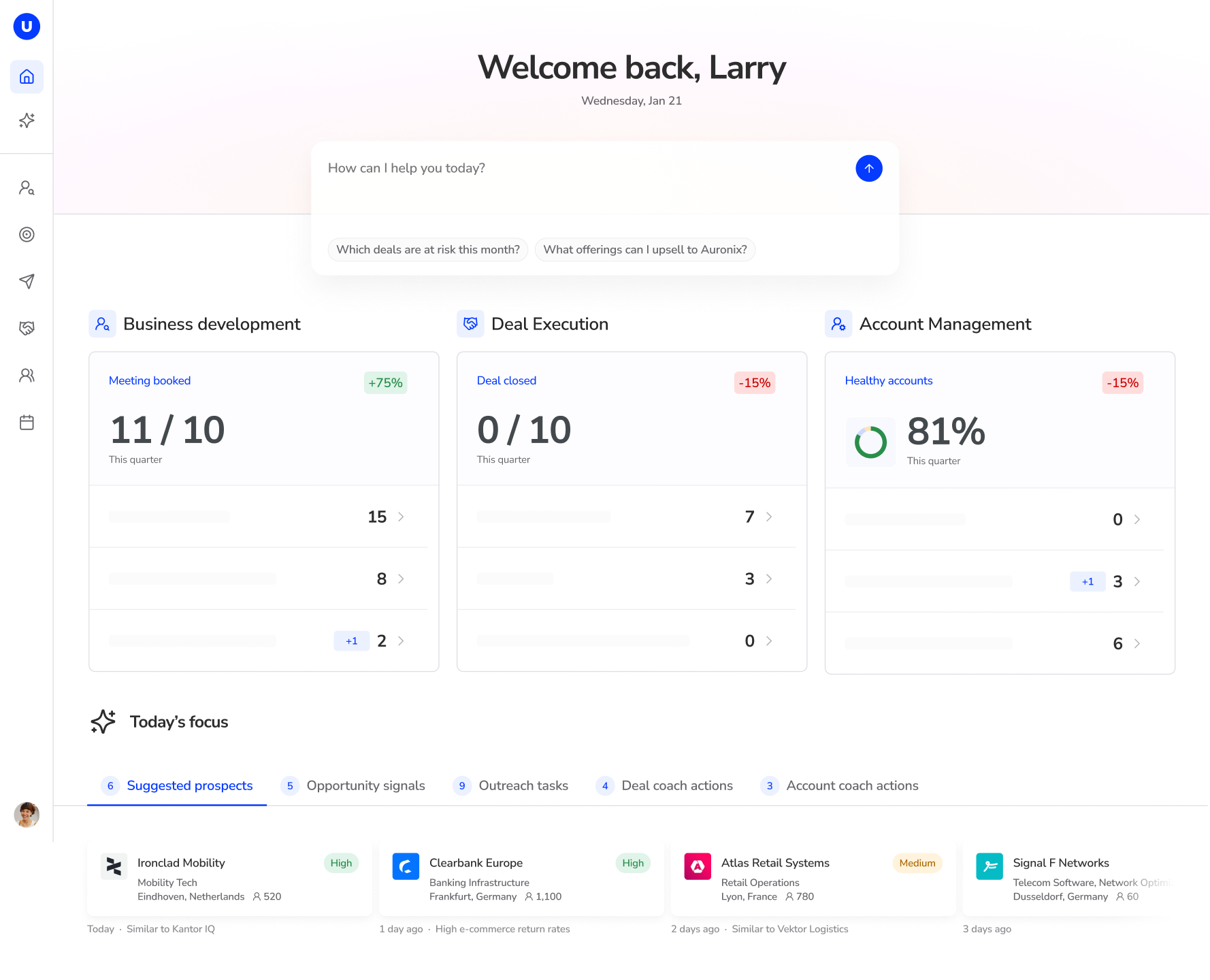
- Showing account health at a glance
Instead of working from memory, you have a system that keeps you informed.
Conclusion
Proactive account management is not just a nice idea. It is the best way to protect renewals and grow revenue.
If you want to see how uman helps teams move from reactive to proactive, book a demo today.
Prep like a machine, sell like a human
Let AI handle the research and prep work — you focus on building relationships and closing deals.