%20(1).png)
How to automate prospecting: boost sales efficiency 30%
Learn how to automate prospecting with AI while maintaining relationship quality. Proven strategies for B2B sales leaders to boost efficiency and response rates.
Sales leaders know the frustration of watching talented reps spend 40% of their week on manual prospecting tasks instead of closing deals. Traditional prospecting methods drain resources while delivering inconsistent results across your team. AI automation offers a proven path to transform this bottleneck into a competitive advantage. This guide walks you through implementing hybrid AI-human prospecting strategies that maintain relationship quality while dramatically improving efficiency. You’ll discover how to prepare your organization, execute automation effectively, and measure results that drive revenue growth in complex B2B environments.
Table of Contents
- Key takeaways
- Understanding the prospecting challenge and preparing for AI automation
- Executing a hybrid human-AI prospecting model effectively
- Verifying results and optimizing your AI prospecting process
- Enhance your prospecting with Uman’s AI platform
- How to automate prospecting: frequently asked questions
Key Takeaways
PointDetailsHybrid AI human balanceA blended approach speeds prospecting while preserving relationship quality.Train AI on sales processesTraining AI on your actual sales processes improves relevance and outcomes.Avoid full AI outreachCompletely automated messaging reduces response rates and creates robotic impressions.Governance and pilot programsEstablish approval workflows, data rules, and a small pilot to identify challenges before scaling.
Understanding the prospecting challenge and preparing for AI automation
Manual prospecting forces your sales team into a grinding cycle of research, list building, and personalized outreach that limits how many quality conversations they can start. Each rep can only reach 20 to 30 prospects per week when doing everything manually, creating a ceiling on pipeline growth. Your best performers burn hours gathering intelligence on accounts when they should be strategizing deal approaches.
Full AI outreach presents an equally dangerous trap. Companies that switched to completely automated messaging saw their reply rate dropped from 4.2% to 1.1% with fully AI-driven outreach, risking robotic spam perceptions. Prospects immediately recognize generic AI-generated messages, damaging your brand reputation and triggering spam filters. The pendulum swings between manual inefficiency and automated ineffectiveness.
Successful automation starts with honest AI readiness assessment of your sales organization. You need clean CRM data, documented sales processes, and clear ideal customer profiles before introducing AI tools. Without this foundation, automation amplifies existing problems rather than solving them. Your team must understand which prospecting tasks genuinely benefit from automation versus those requiring human judgment.
Establish governance frameworks before deploying any AI prospecting tools:
- Define approval workflows for AI-generated content to protect brand voice
- Set compliance boundaries for data usage and privacy regulations
- Create quality benchmarks for automated outreach messages
- Document escalation procedures when AI outputs require human review
Selecting the right tools matters enormously. Look for platforms that integrate with your existing CRM and allow customization based on your sales methodology. The best solutions learn from your top performers’ approaches rather than imposing generic templates. Training data reflecting your actual sales conversations produces far better results than off-the-shelf models.
Pro Tip: Start with a pilot program involving your most adaptable reps. Their feedback will reveal integration challenges and workflow adjustments before rolling out automation across the entire team.
Executing a hybrid human-AI prospecting model effectively
The hybrid approach positions AI as your research assistant and draft creator while keeping humans in control of relationship building. This model delivers the efficiency gains you need without sacrificing the personalization that drives response rates. Implementation follows a clear sequence that balances automation with human expertise.
Begin by defining which prospecting tasks AI should handle:
- Account research and intelligence gathering from public sources
- Lead scoring based on fit criteria and engagement signals
- Initial outreach message drafts personalized to prospect context
- Follow-up sequence suggestions based on response patterns
- Meeting scheduling and calendar coordination
- CRM data entry and activity logging
Your reps then focus on high-value activities AI cannot replicate. They review and customize AI-generated drafts, adding specific insights about the prospect’s business challenges. They conduct actual conversations, build rapport through multiple touchpoints, and adapt messaging based on subtle cues AI misses. This division of labor typically saves 12 hours per week per rep while improving message quality.

Training AI models on your internal playbooks produces dramatically better results than generic tools. Feed the system examples of your highest-performing cold emails, discovery call notes, and successful deal patterns. The AI learns your company’s value propositions, industry-specific language, and the nuances that resonate with your ideal customers. This customization separates effective hybrid AI sales automation from robotic spam.
ApproachResponse RatePersonalizationScalabilityCompliance RiskFull AI outreach1.1%LowVery highHighManual prospecting4.2%Very highLowLowHybrid human-AI3.8%HighHighLow
The data reveals why hybrid human-AI prospecting delivers optimal results. You achieve 90% of manual prospecting’s response rate while tripling your team’s outreach capacity. AI amplifies but doesn’t replace human judgment, supporting long-term compliance and relationships through this balanced approach.

Implement continuous monitoring of AI outputs to catch problematic patterns early. Review a sample of generated messages daily during the first month, checking for tone consistency, factual accuracy, and appropriate personalization. Your team should flag any messages that feel generic or miss the mark, feeding this feedback back into the training process. Most issues surface in the first two weeks and resolve quickly with proper oversight.
Integrate business development automation into your existing workflows rather than creating parallel processes. Reps should access AI assistance within the tools they already use, minimizing friction and training time. The best implementations feel invisible, enhancing rather than disrupting established routines.
Pro Tip: Create a shared library of AI-generated messages that performed exceptionally well. This crowdsources best practices across your team and accelerates the learning curve for new hires.
Verifying results and optimizing your AI prospecting process
Measuring effectiveness separates successful AI adoption from expensive experiments that fail to deliver ROI. You need clear metrics that connect prospecting automation to actual revenue outcomes, not just activity volume. Track these key performance indicators weekly to spot trends and problems quickly.
Monitor reply rates as your primary health metric for message quality. Calculate this separately for AI-assisted versus purely manual outreach to understand automation’s true impact. Conversion rates from reply to meeting and meeting to opportunity reveal whether AI helps or hurts deal quality. Compliance incidents, including spam complaints and unsubscribe rates, signal when automation crosses into problematic territory.
Regular comparison of AI-driven versus human-only prospecting outcomes keeps your team honest about what works:
- AI-assisted outreach volume per rep per week
- Time saved on research and message drafting
- Response rates by message type and prospect segment
- Meeting conversion rates from initial outreach
- Pipeline value generated from automated versus manual efforts
Common mistakes sabotage even well-designed automation programs. Over-reliance on AI-generated messages without human customization produces the robotic tone prospects instantly reject. Neglecting to update training data as your offerings and messaging evolve creates a growing gap between AI outputs and current strategy. Failing to segment prospects appropriately leads to mismatched personalization that feels creepy rather than relevant.
MetricManual BaselineHybrid AI TargetImprovementProspects contacted per week2575200%Reply rate4.2%3.8%-10%Meetings booked per week38167%Hours spent prospecting166-63%
Implement feedback loops that continuously refine your AI models and messaging templates. Schedule monthly reviews where top performers share which AI suggestions they accepted versus rejected and why. This qualitative insight reveals patterns quantitative metrics miss. Adjust training data and prompt engineering based on these conversations to steadily improve output quality.
Generative AI boosts sales process effectiveness and administrative efficiency when properly supported by upper management. Leadership involvement signals that automation is a strategic priority, not just another tool. Executives should review automation metrics in pipeline reviews, celebrate wins, and allocate resources for ongoing optimization. This top-down support drives adoption far more effectively than bottom-up enthusiasm alone.
Real-world results validate the hybrid approach. Companies implementing AI-assisted prospecting typically see 25% to 30% increases in qualified meetings within the first quarter. The AI sales effectiveness case study demonstrates how proper implementation transforms prospecting from a bottleneck into a competitive advantage. These gains compound over time as AI models improve and reps develop better collaboration patterns with automation.
Expand successful prospecting automation into adjacent areas like account management automation once you’ve proven the model. The same principles of hybrid human-AI collaboration apply to cross-sell identification, renewal conversations, and expansion opportunities. Your investment in training data and governance frameworks pays dividends across the entire customer lifecycle.
Pro Tip: Create a monthly automation scorecard that tracks both efficiency gains and relationship quality metrics. This balanced view prevents optimizing for speed at the expense of effectiveness.
Enhance your prospecting with Uman’s AI platform
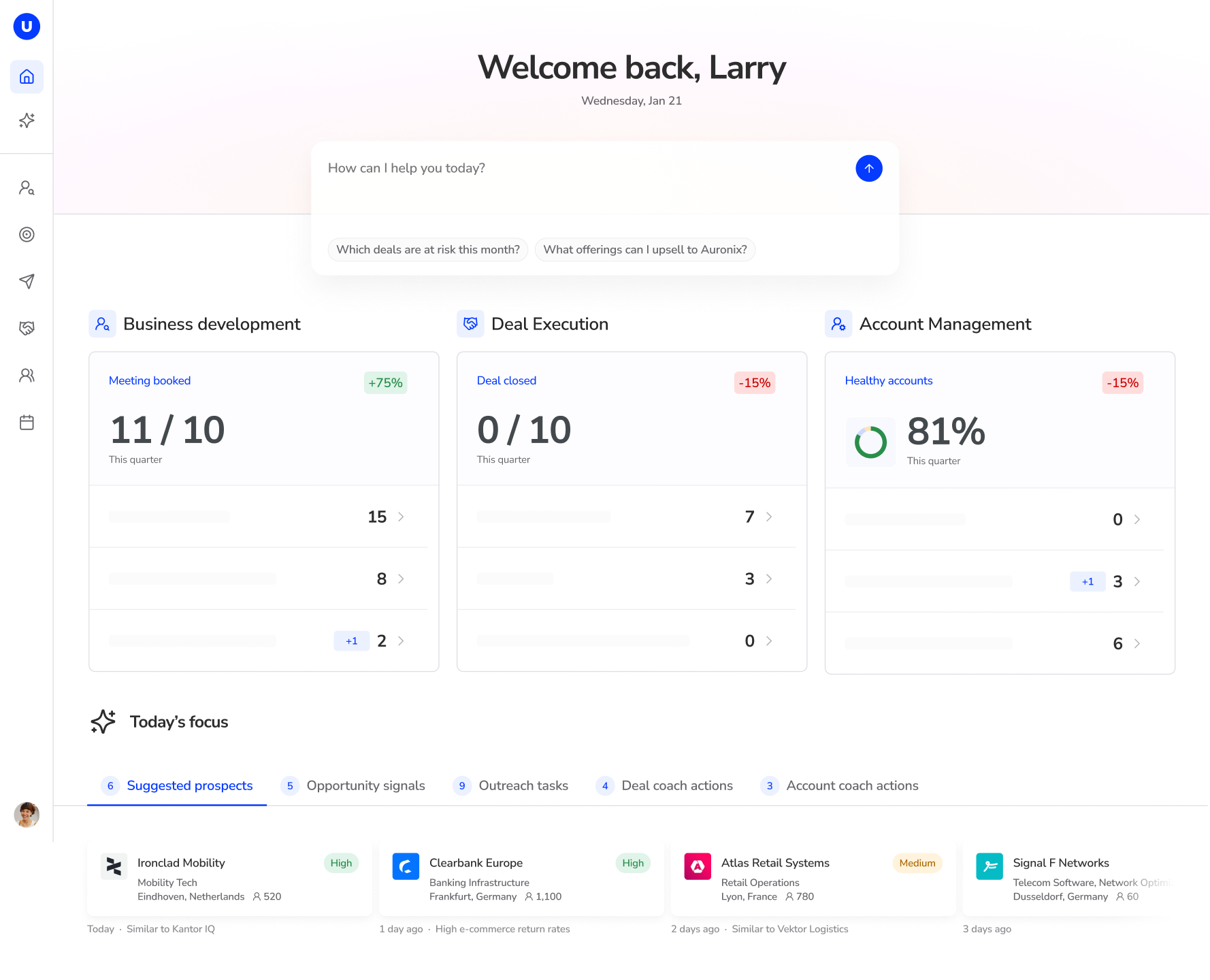
Transforming prospecting theory into practice requires tools built specifically for complex B2B sales environments. Uman’s AI sales platform delivers the hybrid automation approach this guide recommends, combining AI efficiency with human expertise. The platform learns your service portfolio, sales methodology, and ideal customer profiles to generate truly relevant outreach.
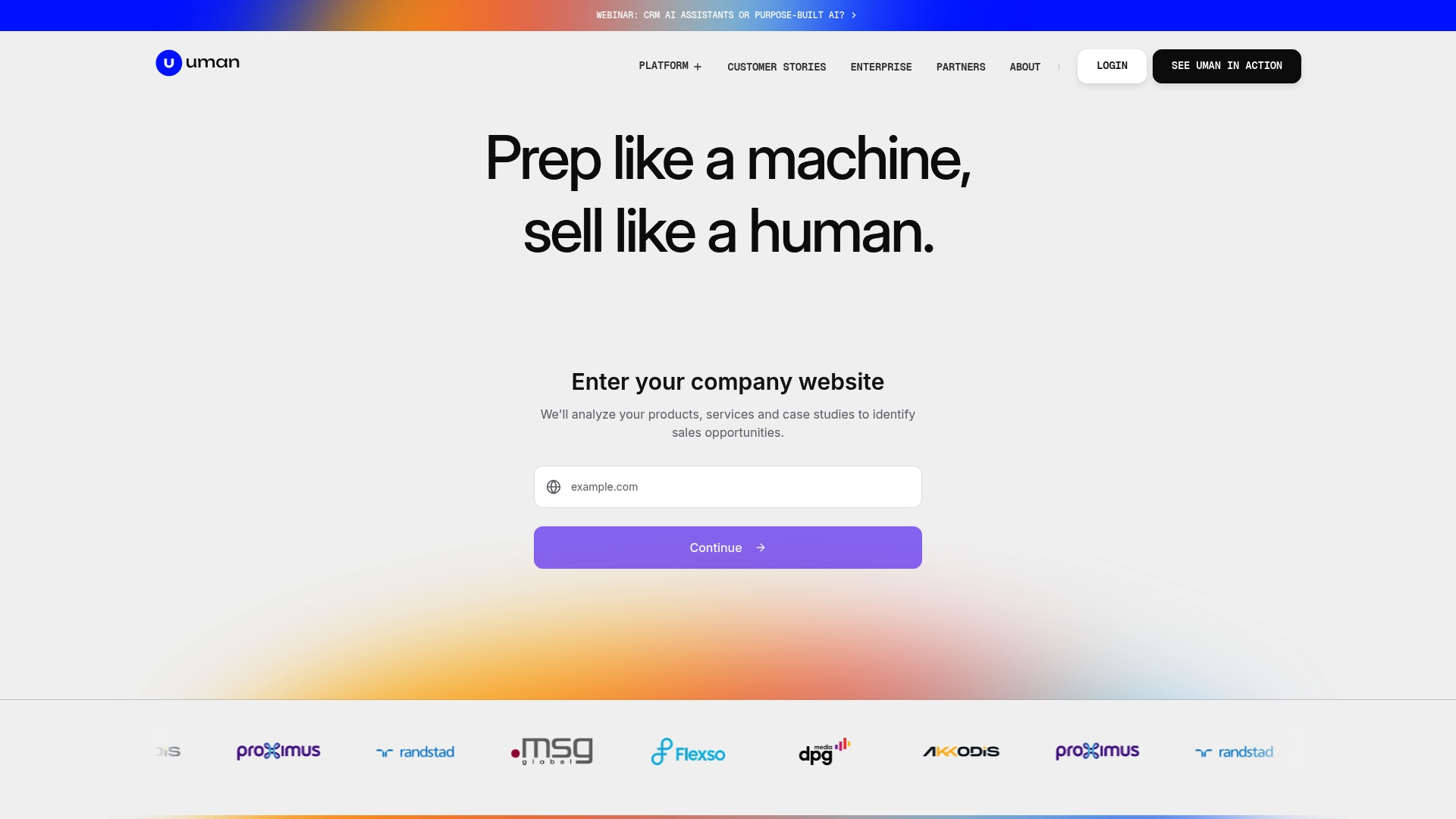
Unlike generic AI tools, Uman integrates deeply with your existing CRM and content systems to provide context-aware assistance throughout the sales cycle. Deal execution automation extends beyond prospecting to support meeting preparation, proposal generation, and account strategy. This comprehensive approach addresses the full range of administrative tasks that pull your team away from selling.
Customer success stories across IT services, consulting, and telecommunications demonstrate measurable results in environments similar to yours. Sales teams report 10% to 30% revenue increases within 18 months while dramatically reducing time spent on manual tasks. Explore how Uman can implement the prospecting strategies covered in this guide with enterprise-grade security and compliance.
How to automate prospecting: frequently asked questions
Will AI replace sales reps in prospecting?
AI augments rather than replaces sales professionals by handling research and drafting tasks. Human judgment remains essential for relationship building, strategic thinking, and adapting to complex buyer situations. The most successful teams use AI to eliminate administrative work so reps can focus on high-value conversations.
What are the risks of fully automated outreach?
Fully automated prospecting creates spam perceptions that damage your brand and trigger low response rates. Prospects easily recognize generic AI messages, leading to reply rates dropping to 1.1% compared to 4.2% for personalized approaches. Compliance risks also increase when humans aren’t reviewing automated communications.
How do I start training AI for prospecting with my data?
Begin by collecting examples of your highest-performing prospecting emails, call notes, and successful deal patterns. Feed these to your AI platform along with ideal customer profiles and value propositions. Start with a small pilot group to refine outputs before scaling across your team.
What compliance considerations apply to AI prospecting?
You must ensure AI-generated outreach complies with data privacy regulations like GDPR and industry-specific rules. Implement approval workflows for automated messages, maintain opt-out mechanisms, and document your AI governance framework. Understanding limitations of AI in sales helps you build compliant processes from the start.
How long before I see results from prospecting automation?
Most sales teams observe measurable improvements within 4 to 6 weeks of implementing hybrid AI prospecting. Initial gains come from time savings and increased outreach volume, while response rate optimization takes 2 to 3 months as AI models learn from your feedback. Sustained revenue impact typically appears in quarter two after launch.
Recommended
Prep like a machine, sell like a human
Let AI handle the research and prep work — you focus on building relationships and closing deals.