%20(1).png)
How to qualify B2B leads: boost sales efficiency in 2026
Learn proven B2B lead qualification frameworks that increase conversion rates by 68% and cut sales cycles by 67%. Boost efficiency with BANT, MEDDIC, and scoring strategies.
Qualifying B2B leads effectively separates high-performing sales teams from those stuck in endless cycles of unproductive conversations. When your reps chase prospects who will never buy, you burn time, budget, and morale. Poor lead qualification can waste up to 70% of your sales capacity on deals that were never going to close. This guide walks you through proven frameworks and strategies that help you identify, prioritize, and close the right leads faster. You’ll learn how to build repeatable qualification processes that align your teams, shorten sales cycles, and increase deal values without adding headcount or complexity.
Table of Contents
- Preparation: Understanding What You Need To Qualify B2B Leads
- Execution: Implementing Effective Lead Qualification Frameworks
- Verification: Optimizing And Avoiding Common Lead Qualification Mistakes
- Boost Your Lead Qualification With Uman’s Sales Platform
- What Is The Best Lead Qualification Framework For Complex B2B Sales?
- How Does Lead Scoring Improve Sales Team Performance?
- How Strict Should Lead Qualification Criteria Be To Avoid Losing Revenue?
- What Metrics Should I Track To Measure Lead Qualification Effectiveness?
Key takeaways
PointDetailsFrameworks drive scalable revenueWell-designed qualification processes create repeatable systems that grow revenue predictably and eliminate chaotic pipeline management.Effective qualification boosts performanceCompanies see 68% higher conversion rates and nearly 67% shorter sales cycles with strong qualification practices.Balance prevents revenue lossOverly aggressive filtering can eliminate 50-70% of future revenue, so smart qualification nurtures trajectory rather than rushing disqualification.Lead scoring sharpens focusStructured scoring models improve sales efficiency, increase conversion rates, and help teams prioritize high-value opportunities.Simplicity wins adoptionTop performers use streamlined forms and selective qualification criteria to book more meetings with quality leads.
Preparation: understanding what you need to qualify B2B leads
Before you implement any qualification framework, you need three foundational elements in place. First, define your Ideal Customer Profile with precision. Failing to establish a clear ICP leads to inconsistent pipeline quality, longer sales cycles, and lower win rates. Your ICP should specify industry verticals, company size, technology stack, buying committee structure, and pain points your solution addresses. Without this clarity, your team wastes effort on prospects who look promising but lack the characteristics that drive successful deals.
Second, choose a qualification framework that matches your sales complexity and velocity. A well-designed framework gives B2B sales teams a consistent, repeatable way to identify sales-ready leads, align with marketing, and scale revenue without scaling chaos. BANT works well for transactional sales where budget and timeline drive decisions quickly. MEDDIC suits enterprise environments with multiple stakeholders and long evaluation cycles. CHAMP prioritizes challenges and authority over budget. Many teams blend elements from multiple frameworks to fit their unique go-to-market motion.
Third, align your sales and marketing teams on qualification criteria before launching any new process. When marketing generates leads using different standards than sales uses to accept them, you create friction, wasted handoffs, and missed revenue. Regular calibration sessions keep both teams synchronized on what constitutes a qualified lead. Document your criteria clearly so new hires and existing reps apply the same standards consistently.
Simplicity and flexibility matter more than perfection when building your initial framework. A simple system your team actually uses beats a sophisticated model they ignore. Start with core criteria you can validate quickly, then add complexity as your process matures. Build in regular review cycles to refine your approach based on real conversion data and feedback from reps in the field.
Collaboration between teams prevents the common trap of marketing delivering volume while sales complains about quality. Joint ownership of qualification criteria ensures both groups optimize for the same outcome: revenue. When marketing understands which lead attributes predict closed deals, they can adjust targeting and messaging. When sales provides specific feedback on why leads don’t qualify, marketing can improve lead generation strategies. This partnership becomes even more valuable as you scale, turning qualification from a bottleneck into a competitive advantage. Explore business development strategies and account management approaches that support this alignment.
Pro Tip: Create a one-page qualification scorecard that both sales and marketing can reference during lead reviews. Include your ICP attributes, framework questions, and threshold scores for different qualification stages. Update it quarterly based on win/loss analysis.
Execution: implementing effective lead qualification frameworks
Once your foundation is solid, you can implement frameworks that drive consistent results. Understanding the core qualification methodologies helps you choose the right approach for your sales motion. BANT focuses on Budget, Authority, Need, and Timeline. It works best when deals move quickly and budget availability determines purchase decisions. MEDDIC evaluates Metrics, Economic Buyer, Decision Criteria, Decision Process, Identify Pain, and Champion. This framework suits complex enterprise sales where multiple stakeholders influence outcomes and ROI justification matters. CHAMP emphasizes Challenges, Authority, Money, and Prioritization, putting customer pain points ahead of budget questions to build stronger relationships early.
Implementing your chosen framework requires a structured rollout. Start by defining specific criteria for each element of your framework. For BANT, determine minimum budget thresholds, identify typical authority levels, clarify need indicators, and establish timeline parameters. Train your entire sales team on the framework through role-playing exercises and real call reviews. Pilot the new process with a subset of your team first, gathering feedback on what works and what creates friction. Refine your criteria and training based on pilot results before rolling out company-wide.
Lead scoring models amplify your qualification framework by assigning numerical values to prospect attributes and behaviors. Companies with effective processes see 68% higher conversion rates and 67% reduction in sales cycle length. Build scoring models that weight factors like company size, industry fit, engagement level, and budget authority. Set threshold scores that trigger different actions: automatic routing to sales, nurture campaigns, or disqualification. Update your scoring model monthly based on which attributes actually correlate with closed deals.
FrameworkBest ForKey FocusTypical Sales CycleBANTTransactional B2BBudget availability30-90 daysMEDDICEnterprise dealsStakeholder mapping6-18 monthsCHAMPConsultative salesCustomer challenges90-180 daysHybridComplex portfoliosFlexible criteriaVaries by segment
Form optimization plays a crucial role in lead qualification without overwhelming prospects. Companies converting at 77%+ can have as few as 2 form fields. The key isn’t field count alone but purposeful data collection matched with enrichment tools. Ask only for information you cannot obtain elsewhere. Use progressive profiling to gather details over multiple interactions rather than demanding everything upfront. Test different field combinations to find the balance between conversion rate and data quality for your specific audience.
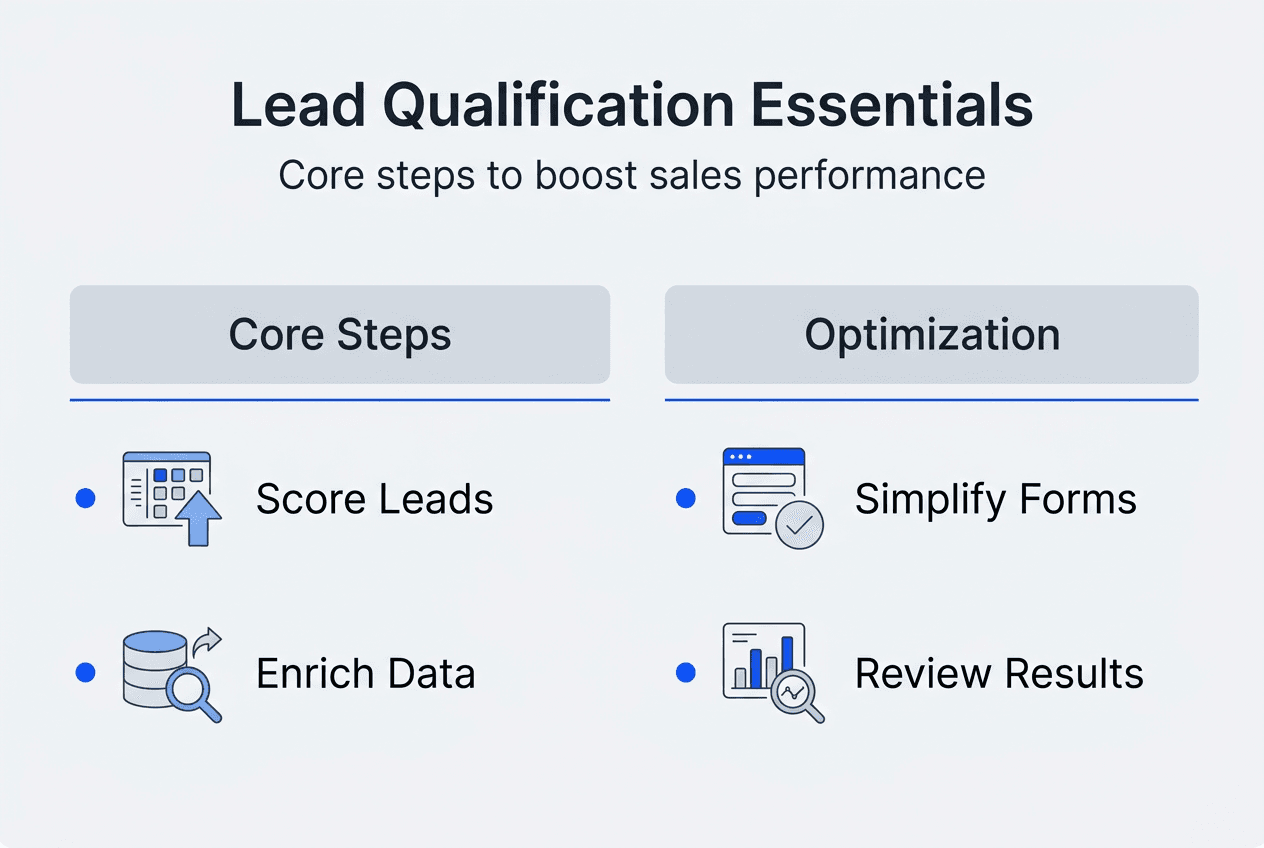
Real-time data enrichment transforms minimal form submissions into rich prospect profiles. When a prospect provides an email address and company name, enrichment tools append firmographic data, technographic signals, and intent indicators. This approach lets you maintain high form conversion rates while still gathering the intelligence needed for effective qualification. Route enriched leads to sales with complete context, enabling more relevant first conversations. Review strategic lead qualification approaches and explore the sales enablement platform that supports these capabilities.
Pro Tip: Create a qualification checklist for each framework element with yes/no questions reps can answer during discovery calls. This standardizes data capture and makes pipeline reviews more objective and actionable.
Verification: optimizing and avoiding common lead qualification mistakes
Even well-designed qualification processes can drift into patterns that hurt performance. The most damaging mistake is applying overly restrictive filters that disqualify valuable leads too quickly. Aggressive disqualification can lead to a loss of 50-70% of future revenue. When you prioritize speed over accuracy, you eliminate prospects who might need more education, different timing, or alternative entry points into your solution. Balance efficiency with patience, especially for leads showing strong fit indicators but unclear immediate intent.

Shift your mindset from fast disqualification to building pipeline momentum. Not every qualified lead closes this quarter, but nurturing the right prospects creates predictable future revenue. Track lead trajectory over time rather than making binary qualify/disqualify decisions after one interaction. Implement lead stages that reflect buying journey progression: early exploration, active evaluation, decision-making, and negotiation. This nuanced approach prevents premature disqualification while still focusing sales effort appropriately.
Rigid frameworks like BANT can turn a discovery conversation into an interrogation, killing rapport and losing deals. When reps mechanically check boxes without adapting to natural conversation flow, prospects feel processed rather than understood. Train your team to gather qualification information conversationally, weaving framework questions into genuine discovery dialogue. The goal is understanding whether you can help the prospect succeed, not completing a checklist.
Measure the right metrics to verify your qualification process actually improves outcomes. Track conversion rates at each pipeline stage to identify where qualified leads stall or drop off. Monitor sales cycle length from first contact to close, segmented by lead source and qualification score. Calculate lead-to-opportunity conversion rates and compare them across different qualification criteria. Review average deal size for leads meeting different qualification thresholds. These metrics reveal whether your process generates the quality and velocity you need.
Common MistakeBetter PracticeDisqualifying leads too quickly based on single criteriaEvaluate multiple factors and track trajectory over timeUsing rigid question scripts that feel like interrogationsWeave qualification naturally into discovery conversationsFocusing only on current budget and immediate timelineAssess strategic fit and nurture high-potential prospectsApplying identical criteria across all market segmentsCustomize qualification for different customer profilesIgnoring feedback from lost deals and stalled opportunitiesRegularly review and refine criteria based on outcomes
Side-by-side comparisons help your team recognize optimization opportunities. Compare your current qualification approach against best practices in your industry. Benchmark your conversion metrics against similar companies to identify performance gaps. Test alternative qualification criteria with A/B experiments to validate which factors truly predict success. This continuous improvement mindset keeps your process sharp as markets and buyer behaviors evolve.
Regular calibration sessions with your sales team surface practical insights that data alone misses. Reps working deals daily notice patterns, objections, and qualification signals that aren’t captured in your CRM. Create monthly forums where the team reviews recent wins and losses, discussing which qualification factors mattered most. Use these sessions to update your framework, adjust scoring models, and share techniques that improve qualification accuracy. Learn from sales operating system optimization and review this case study on qualification impact for practical examples.
Boost your lead qualification with Uman’s sales platform
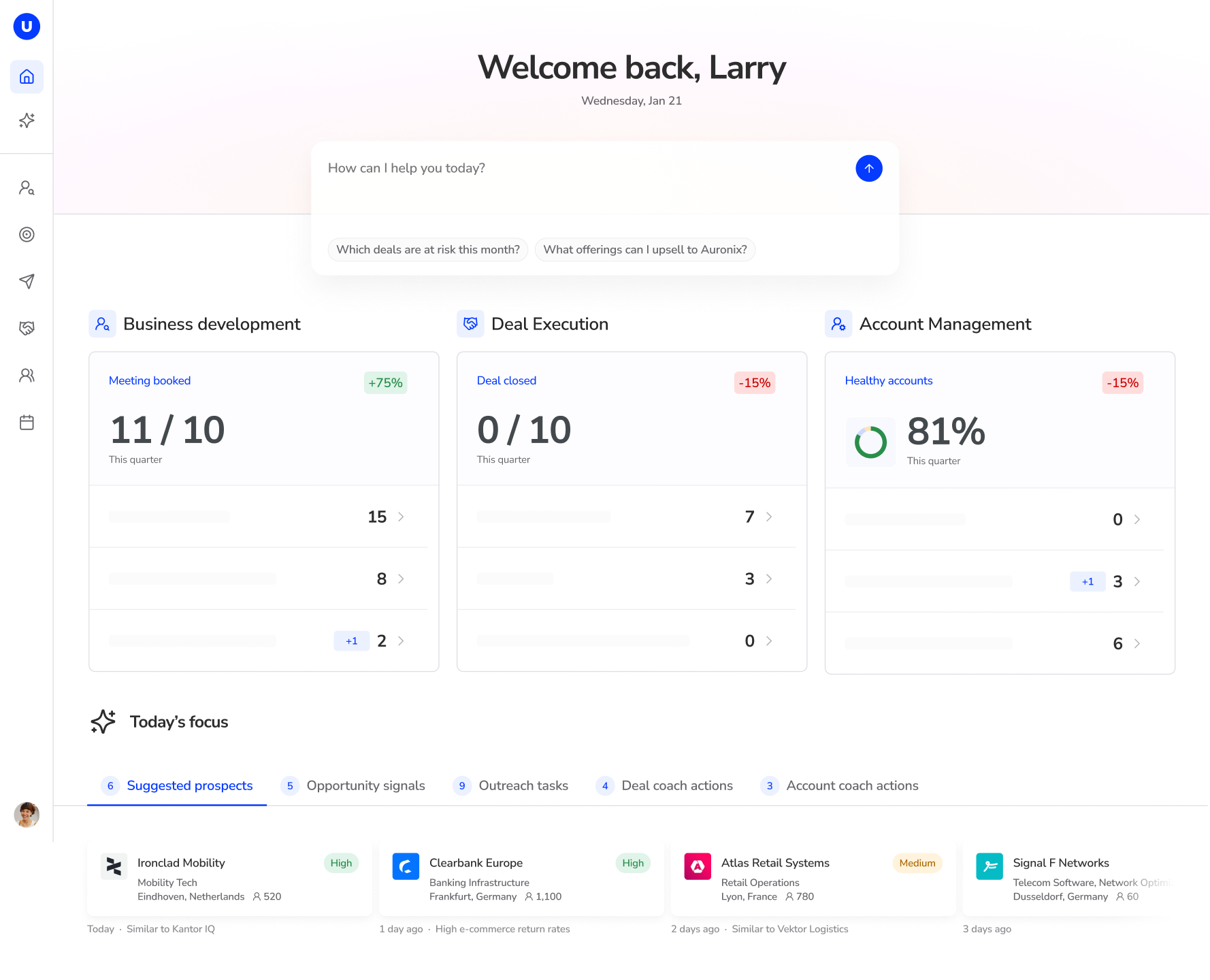
Implementing the strategies in this guide becomes significantly easier with the right technology foundation. Uman’s platform supports flexible, scalable lead qualification frameworks that align your marketing and sales teams around consistent criteria. The system centralizes your product knowledge, customer insights, and qualification standards into a governed data layer that every rep can access instantly.
Real-time data enrichment and intelligent lead scoring enhance your team’s efficiency by surfacing the most promising opportunities automatically. Uman’s sales enablement platform integrates with your existing CRM and document systems, eliminating the need to rebuild your tech stack. The deal execution capabilities streamline meeting preparation and qualification conversations, while business development tools help reps identify cross-sell and upsell opportunities within qualified accounts. Customers report booking more qualified meetings, shortening sales cycles, and increasing win rates after implementing Uman’s structured workflows. Explore how the platform can transform your lead qualification process and drive measurable revenue growth.
What is the best lead qualification framework for complex B2B sales?
The best framework depends on your specific sales process, deal complexity, and buyer journey. MEDDIC suits enterprise environments with long cycles, multiple stakeholders, and significant investment decisions because it maps the complete decision-making landscape. BANT fits faster-moving deals where budget availability and timeline drive purchase decisions more directly. Many successful teams use hybrid approaches, combining MEDDIC’s stakeholder mapping with CHAMP’s emphasis on challenges to balance rigor and relationship building. Your framework should provide clarity and consistency while remaining flexible enough to adapt to different buyer situations. Review strategic qualification frameworks for detailed implementation guidance.
How does lead scoring improve sales team performance?
Lead scoring ranks prospects by quality and readiness, helping sales prioritize outreach toward opportunities with the highest conversion potential. Implementing lead scoring can increase sales efficiency by focusing on high-quality leads, leading to higher conversion rates. Scoring models assign points based on firmographic fit, behavioral engagement, and qualification criteria, creating an objective measure of lead value. This prioritization prevents reps from spending equal time on every inquiry, directing effort toward prospects most likely to close. Teams using lead scoring report 20-30% increases in sales efficiency and significant improvements in average deal size. Explore business development features that incorporate intelligent scoring.
How strict should lead qualification criteria be to avoid losing revenue?
Balanced criteria that assess fit without rushing disqualification produce the best revenue outcomes. Too strict filtering can eliminate 50-70% of future revenue by discarding prospects who need education, different timing, or alternative entry points. Focus on identifying leads with strong ICP alignment and genuine pain points your solution addresses, even if budget or timeline aren’t immediately clear. Build nurture tracks for high-fit prospects who aren’t ready to buy now rather than disqualifying them permanently. Track long-term conversion rates across different qualification thresholds to find the optimal balance between pipeline volume and quality for your business.
What metrics should I track to measure lead qualification effectiveness?
Track conversion rates at each pipeline stage to identify where qualification accuracy breaks down or improves. Monitor sales cycle length from first contact to closed deal, segmented by lead source and qualification score. Measure lead-to-opportunity conversion rates and compare them across different qualification criteria to validate which factors predict success. Calculate average deal size for leads meeting various qualification thresholds. Review win rates for qualified versus unqualified opportunities that entered your pipeline. These metrics together reveal whether your qualification process generates the volume, velocity, and value your business needs to hit revenue targets consistently.
Recommended
Prep like a machine, sell like a human
Let AI handle the research and prep work — you focus on building relationships and closing deals.