%20(1).png)
Sales cycle explained: optimize complex B2B in 2026
Master sales cycle optimization for complex B2B in 2026. Learn proven methodologies, practical strategies to shorten cycles 20%+, and data-driven measurement techniques.
Most sales leaders believe they understand their sales cycle, yet many struggle to pinpoint why deals stall or how top performers consistently close faster. The reality is that complex B2B sales cycles involve far more nuance than a simple linear progression from prospect to customer. Understanding the interplay between sales cycle stages, methodologies, and optimization tactics is what separates high-performing teams from those perpetually chasing quota. This guide unpacks the sales cycle framework, explores proven methodologies for complex B2B environments, and delivers actionable strategies to shorten cycles and boost win rates in 2026.
Table of Contents
- Understanding The Sales Cycle: Stages And Challenges In Complex B2B
- Popular Sales Methodologies Explained And Compared
- How To Optimize And Shorten Sales Cycles In Complex B2B Sales
- Measuring And Adapting Your Sales Cycle For Continuous Improvement
- How Uman Helps Optimize Your Sales Cycle In 2026
- Frequently Asked Questions
Key takeaways
PointDetailsSales cycles vary significantlyDeal complexity and stakeholder count directly impact cycle length and require tailored approaches.Multiple methodologies existDifferent frameworks like MEDDICC, Challenger, SPIN, and Gap Selling address specific stages and sales motions.Optimization requires strategic focusCombining qualification rigor, automation tools, and activity measurement drives measurable cycle reduction.Data-driven adaptation is essentialContinuous measurement of KPIs and iterative process refinement sustain performance improvements.Speed without sacrifice is possiblePractical strategies can compress timelines while maintaining deal quality and buyer confidence.
Understanding the sales cycle: stages and challenges in complex B2B
The sales cycle represents the complete journey from initial prospect identification through closing and post-sale activities. In complex B2B environments, this process extends far beyond simple transactional selling. You’re navigating multiple decision makers, lengthy evaluation periods, and intricate approval processes that can stretch cycles from months to over a year.
Typical sales cycle stages include:
- Prospecting and lead generation
- Initial qualification and discovery
- Needs analysis and stakeholder mapping
- Solution presentation and proposal development
- Negotiation and objection handling
- Closing and contract finalization
- Post-sale onboarding and relationship building
The challenge intensifies as deal complexity grows. Cycles lengthen with deal complexity and stakeholder involvement, yet top-performing teams consistently shorten cycles by 20% or more through automation and strategic referral programs. This performance gap reveals a critical truth: cycle length isn’t just about your product or market, it’s about process discipline and execution quality.
Common obstacles plague even experienced teams. Qualification drag occurs when sales reps invest weeks in prospects that never had budget or authority. Stakeholder misalignment creates delays as new decision makers surface late in the process with different priorities. Process inconsistency means your team executes deals differently, making it impossible to identify what actually works.
Structured workflows and data-driven management become non-negotiable at scale. Without clear stage definitions and exit criteria, reps waste time on low-probability deals while high-potential opportunities languish. An account management platform that centralizes customer intelligence and automates routine tasks allows your team to focus energy where it matters most: advancing qualified deals and nurturing strategic relationships.
The stakes are high. Every extra week in your sales cycle represents delayed revenue, increased customer acquisition costs, and compressed growth trajectories. Understanding these dynamics positions you to implement targeted improvements rather than generic best practices that may not fit your specific sales motion.
Popular sales methodologies explained and compared
Sales methodologies provide structured frameworks for navigating complex deals, but no single approach dominates all scenarios. Understanding each methodology’s strengths and limitations helps you select or blend frameworks that match your sales context.
MEDDICC and its variant MEDDPICC excel at late-stage qualification and deal validation. The acronym covers Metrics, Economic Buyer, Decision Criteria, Decision Process, Identify Pain, Champion, and Competition. This framework shines when you need rigorous qualification criteria to forecast accurately and avoid surprise deal losses. However, MEDDICC excels in late-stage qualification but offers less guidance on early-stage motivation and discovery compared to alternatives like Gap Selling.
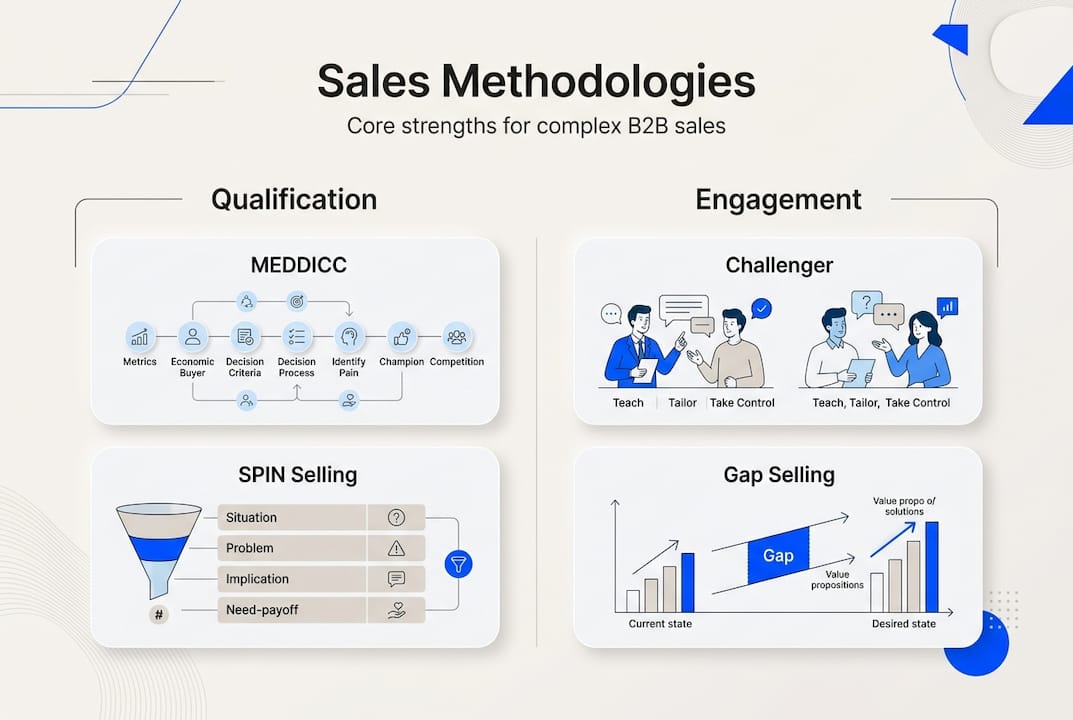
Challenger Sale takes a radically different approach by positioning your rep as a teacher who challenges customer assumptions. This insight-driven methodology works exceptionally well in competitive markets where differentiation comes from reframing the buyer’s problem rather than feature comparisons. Your reps lead with provocative insights that create urgency and position your solution as uniquely capable of addressing newly understood needs.
SPIN Selling focuses on consultative questioning through four question types: Situation, Problem, Implication, and Need-Payoff. This methodology proves valuable during needs discovery and stakeholder engagement, helping reps uncover latent pain points and build consensus around solution value. SPIN’s weakness lies in its limited guidance for later-stage activities like negotiation and closing.
Gap Selling offers a full-cycle framework centered on identifying and quantifying the gap between a prospect’s current state and desired future state. This buyer-focused approach emphasizes understanding customer problems deeply before introducing solutions, creating natural urgency as prospects recognize the cost of inaction. Gap Selling’s comprehensive coverage makes it adaptable across sales stages but requires significant training investment to execute effectively.
Common methodologies each address different aspects of the sales cycle, and smart teams often blend elements based on deal characteristics. A Gap Selling methodology case study demonstrates how focusing on buyer gaps accelerates qualification, while Challenger Sale implementation shows the power of insight-led selling in competitive environments.
MethodologyPrimary Stage FocusKey StrengthIdeal ContextMEDDICCQualification, ClosingDeal validation and forecasting accuracyEnterprise deals with complex buying committeesChallenger SaleDiscovery, PresentationInsight-led differentiationCompetitive markets requiring reframingSPIN SellingDiscovery, Needs AnalysisConsultative questioning and consensus buildingRelationship-driven sales with multiple stakeholdersGap SellingFull cycleBuyer-centric problem quantificationComplex solutions requiring deep needs analysis
Pro Tip: Don’t force your entire team into a single methodology. Map your sales stages to methodology strengths, then train reps to apply the right framework at the right time. A SPIN approach during discovery can flow seamlessly into MEDDICC qualification and Challenger-style presentations.
The methodology you choose impacts everything from rep training to CRM configuration to performance metrics. Select based on your actual sales motion, not industry trends or what competitors use.
How to optimize and shorten sales cycles in complex B2B sales
Shortening your sales cycle without sacrificing deal quality requires surgical precision in three areas: qualification discipline, strategic automation, and activity optimization. Top teams shorten sales cycles 20% or more through automation, inbound lead strategies, and referral programs that bring pre-qualified opportunities into the pipeline.

Ruthless qualification stands as the single highest-impact optimization tactic. Every hour spent on an unqualified prospect is an hour not invested in winnable deals. Implement hard qualification criteria based on budget, authority, need, and timeline, then enforce stage exit requirements that prevent wishful thinking from polluting your forecast. If a prospect can’t articulate a compelling business problem or lacks budget authority, exit gracefully and redirect that energy to qualified opportunities.
Here’s your action plan for measurable cycle reduction:
- Automate repetitive tasks like meeting preparation, CRM updates, and follow-up sequencing to reclaim 10-15 hours per rep per week for actual selling activities.
- Refine qualification criteria by analyzing closed-lost deals to identify early warning signs, then codify these insights into your qualification framework.
- Leverage referrals and warm introductions that compress early-stage cycles by 40-60% compared to cold outreach, as referred prospects arrive with built-in trust and context.
- Invest in inbound marketing that educates prospects before they engage sales, shortening discovery as buyers arrive partially self-qualified and solution-aware.
- Implement sales pipeline automation techniques that trigger next actions based on buyer behavior rather than manual rep follow-up.
Activity optimization requires measuring what matters. Highly productive sales reps allocate 50-60% of their time to Important Pipeline Activities (IPA) like prospecting, discovery calls, and proposal presentations. Compare this to your team’s current allocation. If reps spend more time on administrative tasks than pipeline generation, you’re leaving revenue on the table.
A deal execution platform centralizes deal intelligence and automates workflow steps that typically consume hours of manual effort. When your CRM automatically surfaces relevant case studies, competitive intelligence, and stakeholder insights, reps spend less time searching and more time selling. Pre-sales efficiency strategies that streamline technical validation and proof-of-concept processes can compress evaluation timelines by weeks.
“Top-performing sales organizations achieve 20%+ cycle reduction not by rushing buyers, but by eliminating internal friction, automating low-value tasks, and focusing rep time on activities that directly advance deals.”
Pro Tip: Track your team’s IPA percentage weekly. If it drops below 50%, diagnose what’s consuming time (admin work, internal meetings, tool issues) and eliminate those bottlenecks systematically. Small improvements in time allocation compound into significant cycle reductions over quarters.
The goal isn’t to pressure prospects into premature decisions. It’s to remove every internal obstacle that artificially extends cycles while maintaining the consultative, value-driven approach that wins complex deals.
Measuring and adapting your sales cycle for continuous improvement
What gets measured gets managed, and sales cycle optimization demands rigorous measurement across multiple dimensions. You need visibility into stage duration, conversion rates, activity metrics, and leading indicators that predict deal outcomes before they close or stall.
Start by establishing baseline metrics for your current state. Calculate average cycle length overall and by deal size, measure conversion rates between each stage, and track time spent in each phase. These baselines reveal where deals typically stall and which transitions present the biggest conversion challenges. A deal that breezes through discovery but languishes in proposal review signals a different problem than one that stalls at initial qualification.
Key performance indicators for sales cycle management include:
- Average deal cycle length (overall and segmented by deal size, product line, or market segment)
- Stage-to-stage conversion rates that identify where prospects drop off
- Time in stage metrics that flag deals requiring intervention
- Win rate by methodology, rep, or deal characteristic
- Qualification accuracy measured by comparing forecasted deals to actual closes
- IPA time allocation as a percentage of total selling time
KPIWhat It MeasuresTarget BenchmarkAction TriggerAverage Cycle LengthTotal days from first contact to closeVaries by industry; track trend directionIncreasing trend over 2+ quartersStage Conversion RatePercentage advancing to next stage25-40% for early stages, 60-80% for late stagesBelow-benchmark stages need process refinementTime in StageDays spent in each sales phaseEstablish baseline, then reduce 10-15% quarterlyDeals exceeding 1.5x average timeWin RatePercentage of qualified opportunities won25-35% for complex B2BDeclining trend or below industry averageQualification AccuracyForecasted deals that actually close75-85% for qualified pipelineBelow 70% indicates qualification issues
Your CRM and sales analytics platforms provide the infrastructure for tracking these metrics, but technology alone doesn’t drive improvement. You need a discipline of weekly pipeline reviews that examine not just deal status but the activities and methodologies being applied. No universal sales framework fits every situation, so match your chosen methodology to your specific sales motion and rigorously measure which activities correlate with progression.
Adapt based on what the data reveals. If deals consistently stall during technical validation, invest in better pre-sales resources or proof-of-concept automation. If early-stage conversion rates lag, revisit qualification criteria or discovery methodology. If win rates vary dramatically by rep, identify what top performers do differently and codify those behaviors into training and playbooks.
Iterative refinement beats wholesale process overhauls. Make small adjustments, measure impact over 4-6 weeks, then double down on what works and abandon what doesn’t. Engage your team in this process. Reps closest to customers often spot friction points that data alone won’t reveal. Create feedback loops where frontline insights inform process changes, then track whether those changes improve outcomes.
An account management platform that consolidates customer data, tracks engagement history, and surfaces cross-sell opportunities gives you the intelligence needed to optimize not just new business cycles but expansion and renewal motions that increasingly drive B2B revenue growth.
Continuous improvement requires commitment from leadership to prioritize process optimization alongside revenue targets. The teams that consistently outperform treat sales cycle management as a strategic capability, not a one-time project.
How Uman helps optimize your sales cycle in 2026
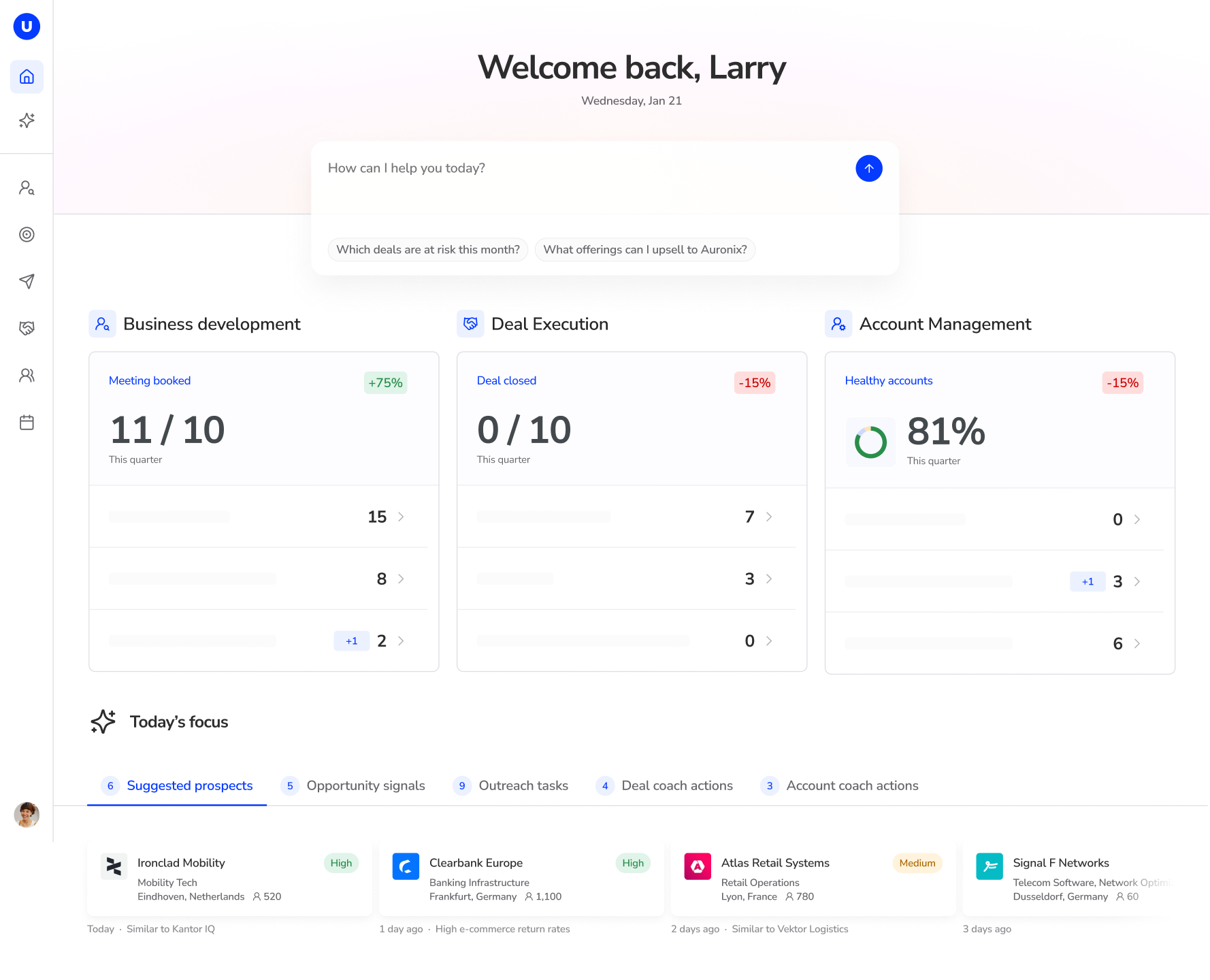
Transforming sales cycle theory into practice requires the right technology foundation. Uman provides an AI-driven sales enablement platform specifically designed for complex B2B organizations managing extensive product portfolios and multi-stakeholder sales processes. The platform acts as your sales brain, centralizing all sales knowledge into a governed data layer that powers structured workflows across business development, deal execution, and account management.
Uman addresses the core challenges that extend sales cycles: time-consuming manual tasks, inconsistent execution, scattered content, and missed cross-sell opportunities. By automating meeting preparation, CRM updates, and stakeholder research, Uman reclaims 10-15 hours per rep per week for high-value selling activities. The platform ensures your team applies proven methodologies consistently while adapting to each deal’s unique context, shortening cycles without sacrificing the consultative approach that wins complex B2B deals.
Frequently asked questions
What are the typical stages included in a B2B sales cycle?
Most B2B sales cycles include prospecting, qualification, needs analysis, proposal development, negotiation, closing, and post-sale follow-up. The specific stages and terminology vary by organization, but these core phases capture the essential progression from identifying prospects to delivering value as a customer. Complex B2B environments often add stages for stakeholder mapping, technical validation, and executive approval.
How do I choose the best sales methodology for my team’s sales cycle?
Assess your sales context including deal complexity, competitive intensity, and typical buyer behavior patterns. No single methodology fits all situations, so consider blending frameworks like MEDDICC for qualification rigor with Challenger for differentiation or SPIN for discovery. Test your chosen approach with a subset of reps, gather feedback on what works in practice, then adapt based on actual results rather than theoretical benefits.
What practical steps can shorten a sales cycle without rushing deals?
Focus first on qualification discipline to avoid investing time in low-probability deals. Leverage automation tools that eliminate manual tasks and free up rep time for actual selling activities. Build referral programs that bring warm leads into your pipeline, as referred prospects typically close 40-60% faster than cold prospects. Measure seller time allocation to ensure reps spend at least 50% of their time on important pipeline activities rather than administrative work.
How long should a typical B2B sales cycle be?
B2B sales cycles vary dramatically based on deal size, industry, and complexity, ranging from 30 days for small transactions to 18+ months for enterprise software or complex services. Rather than comparing to external benchmarks, establish your own baseline and work to reduce it by 10-20% through process optimization and automation. The goal is continuous improvement relative to your own performance, not matching arbitrary industry averages that may not reflect your specific sales motion.
Recommended
Prep like a machine, sell like a human
Let AI handle the research and prep work — you focus on building relationships and closing deals.