%20(1).png)
How to build a sales messaging consistency workflow
Learn how to build a sales messaging consistency workflow for B2B teams. Reduce revenue loss, automate cadences, and improve win rates with proven steps.
Sales messaging inconsistency is quietly draining revenue from B2B organizations at a scale most leaders underestimate. Messaging misalignment costs $1T annually across the industry, yet most sales teams still rely on scattered playbooks, manual follow-up cadences, and rep-driven improvisation. The result is a patchwork of positioning that confuses buyers and stalls deals. This guide walks you through a proven, step-by-step workflow for centralizing your messaging, automating execution, and building the feedback loops that keep quality high. If you are serious about improving win rates and sales efficiency, this is where to start.
Table of Contents
- Understanding the sales messaging consistency challenge
- Preparing your sales messaging workflow: People, process, platforms
- Step-by-step: Building your messaging consistency workflow
- Troubleshooting and optimizing: Solving common workflow obstacles
- Comparing manual and AI-driven messaging workflows
- Take your sales messaging consistency to the next level
- Frequently asked questions
Key Takeaways
PointDetailsCentralize sales messagingA unified and governed messaging repository drives adoption and efficiency.Leverage AI for automationAI-enabled workflows save time, reduce missed follow-ups, and boost response rates.Continuous feedback improves resultsMonthly audits, A/B testing, and field data optimize your sales messaging consistency.Balance automation and human oversightCombine platform-driven guidance with review to maintain authenticity.Track adherence metricsMeasuring CI scores and content engagement ensures workflow effectiveness.
Understanding the sales messaging consistency challenge
The problem is not that your reps are bad communicators. It is that the systems around them are failing. 60 to 70% of deals are lost due to follow-up gaps, and inconsistent timing alone drops response rates by 40%. These are not edge cases. They are the predictable outcome of manual processes applied to complex, high-volume sales environments.
The “busy rep” problem sits at the center of this. When a rep is juggling five active deals, manual cadence steps get skipped, messages get recycled without personalization, and positioning drifts from one conversation to the next. The result is a buyer experience that feels disjointed, even when the underlying product is strong.
Common symptoms of messaging inconsistency include:
- Misaligned positioning across channels, where email says one thing and a demo says another
- Varying tone between reps, making the brand feel fragmented to buyers who interact with multiple team members
- Outdated content being used in the field because reps cannot find the latest approved version
- Missed follow-up windows that let warm prospects go cold
Understanding sales enablement fundamentals is the first step toward diagnosing these gaps. It is also worth noting that AI alone will not fix a broken process. Technology amplifies what is already there, good or bad. That is why workflow design comes before tool selection.
Preparing your sales messaging workflow: People, process, platforms
Before you automate anything, you need to get the foundation right. Effective messaging consistency requires centralized content management, cross-functional governance committees, AI-driven automation, and continuous feedback loops working together. Miss one of these, and the whole system leaks.
Start with people. A cross-functional sales advisory council, typically including sales leadership, marketing, product, and customer success, is responsible for approving messaging, reviewing content performance, and resolving conflicts between what marketing produces and what sales actually uses. This is not a one-time task force. It is an ongoing governance body.
Next, set up your content management infrastructure. This means a single source of truth for all sales content, organized by deal stage, persona, and use case. Without this, reps default to whatever they have saved locally, which is almost always outdated.

Pro Tip: Advisory councils that meet monthly drive over 90% content adoption rates. Quarterly meetings are not frequent enough to keep pace with market changes and rep feedback cycles.
When it comes to platforms, the market offers several strong options. Here is how key features compare:
FeatureHighspotOutreachAllegoContent governanceStrongModerateStrongCadence automationModerateStrongModerateAI-driven guidanceStrongStrongStrongCoaching and trainingModerateModerateStrongCRM integrationStrongStrongModerate
For teams managing broad service portfolios, an AI-enabled sales workflow platform that integrates content governance with deal execution workflows is worth prioritizing. The goal is to reduce the number of tools reps need to switch between, not add to the stack. Explore AI-enabled workflow strategies to understand what integration depth actually looks like in practice.
Step-by-step: Building your messaging consistency workflow
With your governance structure and platform in place, you can build the workflow itself. This five-step framework covers the full cycle from audit to iteration.
- Audit current messaging. Record and review field calls, email sequences, and customer interactions. Identify where messaging diverges from approved positioning and where follow-up gaps occur most frequently.
- Build a unified core narrative. Develop a central value proposition and then create scenario-specific spokes for different personas, industries, and deal stages. This hub-and-spoke model keeps messaging coherent while allowing relevant customization.
- Embed messaging into tools and workflows. Integrate approved content and guided prompts directly into your CRM and sales engagement platform so reps receive real-time guidance without leaving their workflow.
- Measure adherence. Track conversation intelligence (CI) scores, digital sales room (DSR) engagement, cycle velocity, and response lift. These metrics tell you whether messaging is actually being used and whether it is working.
- Iterate using field data. Feed performance data back into the advisory council review cycle. Update messaging based on what is resonating and retire content that is not moving deals forward.
Here is how key metrics shift as the workflow matures:
MetricBaseline (manual)Target (workflow-enabled)Content adoption rate30 to 40%85 to 90%+Follow-up completion rate50 to 60%90%+Response rate liftBaseline35 to 50% improvementQuota attainmentVariableConsistent across team
Pro Tip: Use monthly A/B testing on subject lines, opening value statements, and call-to-action phrasing. Small changes compound quickly when applied across a full team cadence. Learning how AI boosts sales efficiency can help you identify which parts of the workflow benefit most from automation. You can also explore how to automate sales prospecting to extend consistency into the top of the funnel.
The sales messaging workflow does not need to be perfect on day one. It needs to be structured enough to generate data, and flexible enough to improve based on what that data reveals.

Troubleshooting and optimizing: Solving common workflow obstacles
Even well-designed workflows break down. Knowing where the common failure points are helps you fix them before they become habits.
The most frequent issues include:
- Cadences stalling on hot deals, where reps abandon the structured sequence and go off-script, often at the worst possible moment
- Generic later-stage touches, where early personalization fades and messages become templated and impersonal
- Missed follow-ups on accounts that showed buying signals but did not respond immediately
- Channel inconsistency, where email messaging contradicts what was said in a recent call
“Manual cadences fail after three to four touches. AI eliminates six common cadence failures by executing every step on time, every time, while freeing reps to focus on message quality rather than task management.”
The fix is not to remove human judgment. It is to combine AI execution with human oversight. AI handles timing, sequencing, and content delivery. Humans review message relevance, adjust tone for specific accounts, and make judgment calls on when to deviate from the standard path.
For consistent outreach at scale, the hub-and-spoke messaging model is particularly valuable here. When a rep needs to adapt a message for a specific industry or stakeholder, they are working from an approved core narrative, not starting from scratch. This keeps personalization within guardrails.
Monthly optimization routines should include reviewing CI data, checking content usage reports, and running short spaced-learning refreshers for reps on updated messaging. Spaced learning, which means delivering training in short bursts over time rather than in one session, significantly improves retention. You can find practical guidance on how to optimize sales enablement workflows to build these routines into your existing calendar. For teams exploring new approaches, resources on adopting new sales messaging offer useful tactical frameworks.
Comparing manual and AI-driven messaging workflows
At some point, every sales leader faces the same question: is the investment in AI-driven workflow tooling actually worth it? The data is clear.
AI coaching drives 91% quota attainment compared to significantly lower rates in traditional, manually managed teams. AI executes cadences perfectly but still needs human review to ensure messages stay relevant and authentic.
DimensionManual playbooksAI-driven workflowsCadence executionRep-dependent, inconsistentAutomated, always on timeContent deliveryRelies on rep memoryGuided by deal stage and contextPersonalizationHigh effort, low scaleScalable with human reviewPerformance visibilityLagging, anecdotalReal-time, data-drivenOnboarding speedSlow, knowledge-dependentFaster with guided workflows
Features that only AI-driven platforms can deliver at scale include:
- Real-time content recommendations based on deal stage, industry, and stakeholder role
- Automated follow-up sequencing that never misses a touch point
- Continuous content library optimization based on usage and engagement data
- Conversation intelligence scoring that flags messaging drift before it becomes a pattern
Human oversight remains essential. AI surfaces the right content and executes the right sequence. But a rep still needs to read the room, adjust the tone for a specific buyer, and decide when a personal call beats a templated email. Explore how to enable your sales enablement team to build the human skills that complement AI execution. For a direct comparison of approaches, the AI vs manual sales process breakdown is worth reviewing alongside your platform evaluation. You can also compare options directly on the uman platform page.
The future of sales enablement is not about replacing human judgment. It is about removing the manual friction that prevents good judgment from being applied consistently.
Take your sales messaging consistency to the next level
Building a messaging consistency workflow is a significant undertaking, and the right platform makes the difference between a system that holds and one that quietly falls apart after the first quarter.
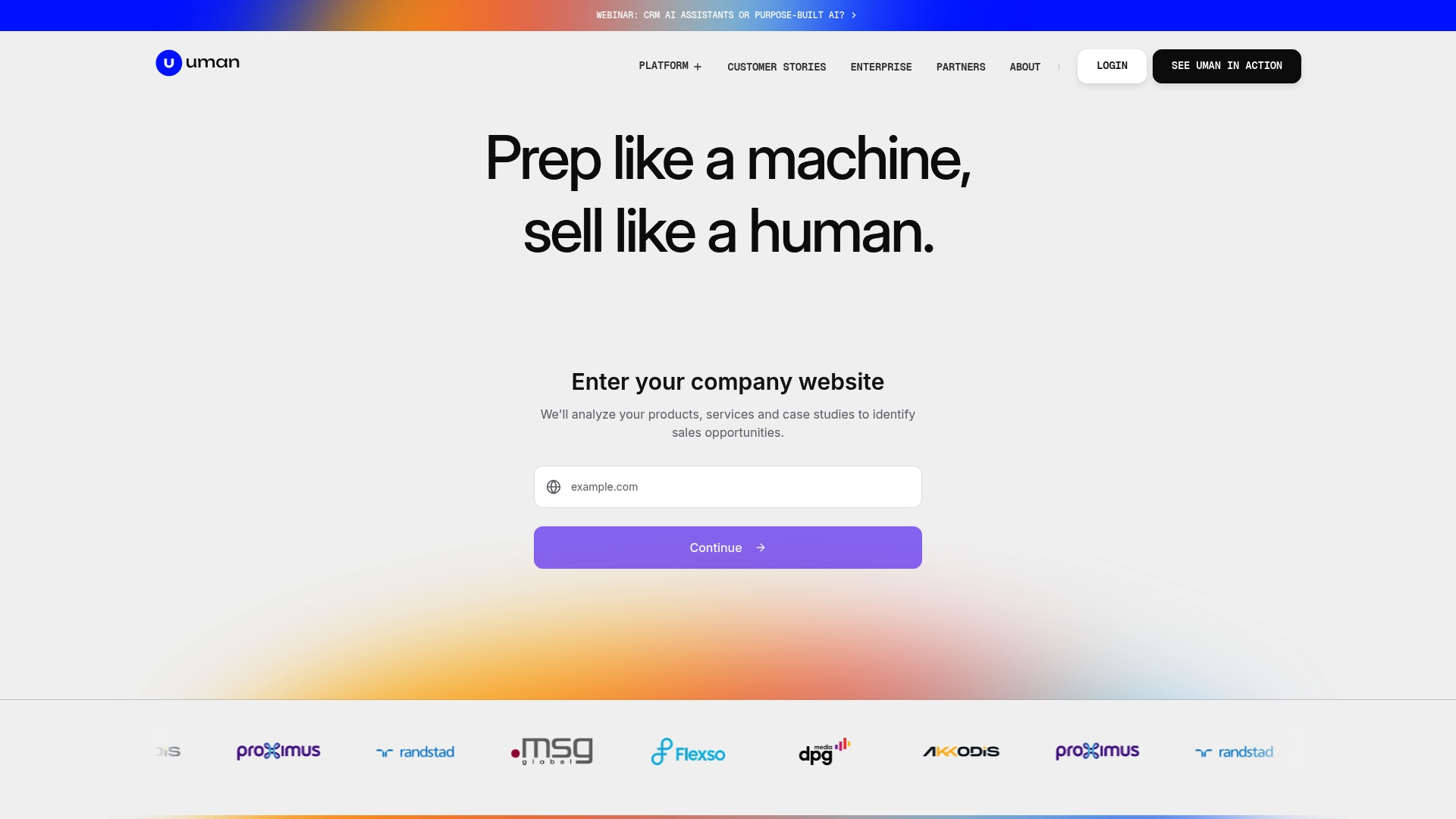
Uman is built specifically for complex B2B sales organizations managing broad service portfolios. The platform centralizes your sales knowledge into a governed data layer and powers structured workflows across deal execution and account management, so your reps always have the right message, at the right moment, without hunting through folders or relying on memory. Real-time guidance, automated workflows, and content governance are built in, not bolted on. If you are ready to move from manual inconsistency to structured, measurable execution, explore the uman platform to see how it fits your team’s specific needs.
Frequently asked questions
What are the top causes of sales messaging inconsistency?
Sales messaging inconsistency is most often caused by siloed content, lack of centralized governance, manual cadence breakdowns, and rep-driven improvisation across channels. Without a single source of truth, every rep effectively runs their own version of the playbook.
How do AI platforms help achieve messaging consistency?
AI platforms automate cadence execution, recommend content by deal stage, and organize libraries by usage patterns, ensuring reps deliver the right message at the right time. Platforms using these approaches save 75% of prep time and boost response rates by 35 to 50%.
Which metrics should sales leaders track to verify consistency?
Key metrics include content adoption rates, CI scores, DSR engagement, and cycle velocity, with response lift benchmarks reaching as high as 35 to 50% in well-optimized workflows. These indicators reveal whether messaging is being used and whether it is actually moving deals.
What are best practices for ongoing workflow optimization?
Leaders should hold monthly reviews, A/B test key messages, and monitor field usage data to iterate continuously. Advisory councils achieving 90%+ content adoption consistently use monthly audits and structured feedback loops to stay ahead of market changes.
Recommended
Prep like a machine, sell like a human
Let AI handle the research and prep work — you focus on building relationships and closing deals.