%20(1).png)
Sales productivity best practices: 18% more revenue for B2B
Discover proven sales productivity best practices for complex B2B teams, covering process design, technology, lead qualification, and coaching to drive measurable results.
TL;DR:
- Establishing a clear, documented sales process boosts revenue growth and predictability.
- Choosing integrated, user-friendly technology and automation reduces friction and enhances productivity.
- Focused lead qualification and continuous coaching significantly improve sales performance and outcomes.
Sales leaders at complex B2B organizations face a familiar pressure: deliver more revenue with the same team, tighter budgets, and an ever-growing list of competing priorities. The market offers no shortage of “productivity hacks,” but most of them scatter your team’s energy without moving the needle. What actually works is a focused, vetted set of best practices that address the real bottlenecks in complex sales cycles. This article gives you exactly that: a practical playbook covering process design, technology selection, lead qualification, and coaching, so you can make confident decisions that drive measurable results for your team.
Table of Contents
- Establishing clear sales processes
- Leveraging technology and automation tools
- Optimizing lead qualification and pipeline management
- Continuous training and performance coaching
- Our take: Why simplicity outperforms complexity in B2B sales productivity
- Boost your team’s productivity with Uman
- Frequently asked questions
Key Takeaways
PointDetailsDocument processesClearly defining your sales stages and playbooks ensures consistency and sets a foundation for improvement.Adopt smart techAutomation tools streamline workflows so teams focus on the highest-value sales activities.Qualify leads rigorouslyFocusing on the right prospects boosts conversion rates and minimizes wasted effort.Invest in coachingOngoing training and coaching leads to higher engagement and sustained productivity gains.
Establishing clear sales processes
Let’s begin by examining why structure matters above all for sustained productivity. Many sales leaders assume their teams already follow a consistent process. In practice, every rep tends to develop their own approach, which leads to unpredictable outcomes and wasted effort.
Organizations with documented sales processes see up to 18% more revenue growth. That gap is not accidental. When everyone follows the same stages, handoffs, and qualification criteria, the entire organization moves faster and with fewer errors.
Here is what a well-structured B2B sales process looks like in practice:
- Define pipeline stages clearly. Each stage should have a specific entry and exit criterion, not just a label. “Proposal sent” is a stage. “Proposal reviewed and next meeting confirmed” is a criterion.
- Document handoffs between roles. In complex B2B deals, multiple people touch each opportunity. Marketing to sales development, sales development to account executives, account executives to solutions consultants: each transition needs a defined protocol.
- Build and maintain sales playbooks. Playbooks capture your best reps’ approaches and make them repeatable. They cover objection handling, competitive positioning, and messaging for each buyer persona.
- Use data to refine continuously. Review win/loss data quarterly. If deals consistently stall at a specific stage, that is where your process needs work.
“A documented process is not a constraint on your team. It is the foundation that frees them to focus on what humans do best: building relationships and solving problems.”
Understanding the sales process importance goes beyond compliance. It is about creating a predictable revenue engine. Harvard Business Review insights confirm that structured approaches consistently outperform improvised ones in complex selling environments.
Once your process is mapped, revisit it every quarter. Markets shift, buyer behavior changes, and your playbook should evolve accordingly. Pairing this with sales cycle optimization techniques helps you identify exactly where time is being lost and where small adjustments create outsized impact.
Pro Tip: Start with your top three performing reps. Interview them about how they actually work, not how the process says they should work. Their real behaviors are often your best source of playbook content.
Leveraging technology and automation tools
Once processes are mapped, the next impact lever is leveraging technology efficiently. The challenge is not a shortage of tools. It is choosing the right ones and deploying them in a way that actually reduces friction instead of adding to it.

B2B teams using integrated digital tools report up to 23% higher productivity. But integration is the key word. Disconnected tools create data silos, force manual data entry, and frustrate reps who spend more time managing software than selling.
Here is a comparison of the core tool categories every complex B2B sales team should evaluate:
Tool categoryPrimary functionProductivity impactCRMPipeline tracking, contact managementCentralizes data, reduces adminSales enablement platformContent delivery, knowledge accessSpeeds up prep, improves consistencyDeal execution toolsMeeting prep, qualification, CRM updatesCuts manual tasks per dealAutomation toolsFollow-ups, scheduling, data entryFrees rep time for selling
When selecting tools, apply these criteria in order:
- Integration with your existing stack. A tool that does not connect to your CRM will create more work, not less.
- Adoption simplicity. If reps need extensive training to use it daily, adoption will stall within weeks.
- Automation of high-frequency tasks. Prioritize tools that eliminate the tasks your team repeats most often: follow-up emails, CRM logging, meeting summaries.
- Data governance and security. Enterprise B2B environments require tools that meet compliance standards, especially when client data is involved.
Automation use cases worth prioritizing include post-meeting CRM updates, personalized outreach sequences, and lead routing. These are high-frequency, low-complexity tasks that consume significant rep time. According to sales automation trends tracked by Gartner, automation adoption in B2B sales continues to accelerate as teams look to protect selling time.
Exploring CRM best practices specific to B2B organizations will help you get more from systems you may already have. And if your team is evaluating purpose-built solutions, deal execution technology designed for complex sales cycles can dramatically reduce the administrative burden that slows reps down.
Optimizing lead qualification and pipeline management
After embracing digital tools, ensuring all activity targets the right prospects becomes critical. Even the best process and the most capable team will underperform if they are spending time on deals that were never going to close.
Firms with rigorous lead qualification see a 35% higher close rate. That is a significant performance gap driven entirely by discipline around which opportunities to pursue.
Effective B2B lead qualification starts with a consistent scoring model. Here is what strong qualification criteria typically cover:
Qualification dimensionWhat to assessWhy it mattersBudgetConfirmed or estimated spend capacityPrevents late-stage surprisesAuthorityDecision-maker access confirmedReduces stalled dealsNeedSpecific pain point identifiedAligns solution to real problemTimelinePurchase decision expected within cyclePrioritizes active opportunities
Beyond initial scoring, pipeline health requires ongoing attention. Stale deals are one of the most common productivity killers in complex B2B sales. A deal that has been sitting in “proposal” for 90 days is not an opportunity. It is a distraction.
Best practices for pipeline management include:
- Set aging thresholds. Define how long a deal can sit in each stage before it is flagged for review or recycled.
- Conduct weekly pipeline reviews. Not to check boxes, but to make real decisions: advance, recycle, or close.
- Actively recycle unqualified leads. Leads that are not ready now can be nurtured and re-engaged later. A structured prospecting workflow ensures they do not fall through the cracks.
Research from McKinsey’s lead nurturing roadmap reinforces that organizations with structured nurture programs convert significantly more leads over time compared to those that simply discard unready prospects.
Statistic to remember: Teams that audit their pipeline monthly close deals 20% faster on average than those that review quarterly. Frequency matters.
Continuous training and performance coaching
Finally, equipping teams for ongoing success revolves around people, not just processes or technology. Training is often treated as a one-time event during onboarding. That approach leaves most of its value on the table.
Teams engaging in regular coaching outperform peers by 27%. The compounding effect of consistent coaching is one of the most underutilized advantages available to sales leaders.
Here is how to structure an effective coaching program:
- Establish a regular cadence. Weekly one-on-ones focused on specific deals or skills, not just pipeline updates. Monthly group sessions for shared learning.
- Use call recordings and deal data. Coaching grounded in real examples is far more effective than hypothetical scenarios. Review actual calls together.
- Blend formal training with mentorship. Pair newer reps with experienced ones for live deal shadowing. Formal training builds knowledge. Mentorship builds judgment.
- Set measurable coaching goals. Each rep should have a development focus for the quarter: improving discovery questioning, shortening proposal cycles, or expanding multi-threaded stakeholder engagement.
- Track impact over time. Compare deal velocity, win rates, and average deal size before and after coaching interventions. This builds the business case for continued investment.
Gartner’s research on sales coaching programs shows that manager-led coaching, when done consistently, has a stronger impact on quota attainment than any other development activity.
Linking coaching to B2B sales best practices ensures your development program stays grounded in what actually drives revenue. And improving pre-sales efficiency through better preparation habits is one of the fastest ways to see coaching results show up in the numbers.
Pro Tip: Ask each rep to self-assess before every coaching session. When people identify their own gaps, they are far more motivated to close them than when a manager points them out.
Our take: Why simplicity outperforms complexity in B2B sales productivity
Here is something many experts overlook: the biggest productivity killers in complex B2B sales organizations are rarely a lack of tools or training. They are a lack of focus and a culture that rewards activity over outcomes.
We see this pattern repeatedly. A team adopts a new CRM, then a new enablement platform, then an AI prospecting tool, then a coaching software. Each addition makes sense in isolation. Together, they create a fragmented environment where reps spend more time navigating systems than selling.
The organizations that consistently improve productivity are the ones that pick a small number of high-leverage levers and track them relentlessly. Process clarity. Qualification discipline. Coaching cadence. These three things, done consistently, outperform any combination of software tools deployed without cultural adoption.
Leadership behavior matters more than most leaders realize. When managers model the process, review the pipeline with rigor, and coach with genuine curiosity, teams follow. When they treat these activities as administrative overhead, so do their reps.
If you want a practical starting point, the complex sales process checklist for B2B leaders is a grounding resource that cuts through the noise and focuses on what actually moves results.
Boost your team’s productivity with Uman
Ready to translate best practices into results? The principles covered in this article, from process clarity to smarter qualification and coaching, work best when they are supported by a platform built for the realities of complex B2B selling.
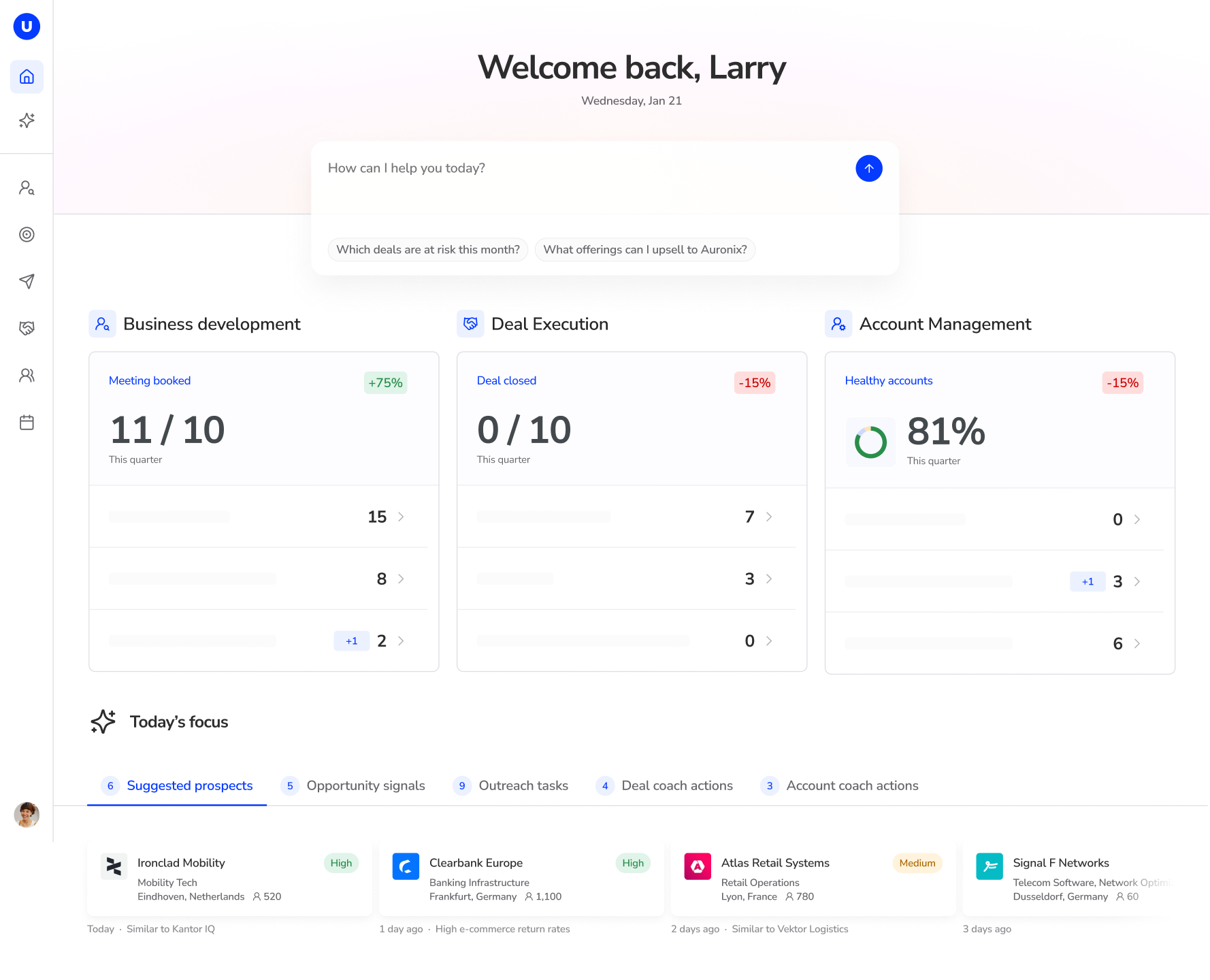
Uman is an AI-driven sales enablement platform that acts as a centralized sales brain for your team. It connects knowledge, automates repetitive tasks, and guides reps through structured workflows across the full sales cycle. From deal execution tools that cut meeting prep time to account management solutions that surface cross-sell opportunities, the Uman platform is designed to make every best practice in this article easier to implement and sustain at scale.
Frequently asked questions
What is the first step to improve sales productivity?
Start by documenting your existing sales process and identifying bottlenecks for targeted improvements. Process clarity is foundational before any technology or coaching investment will deliver its full value.
How can technology tools like CRMs drive B2B sales productivity?
Integrated CRMs centralize data and automate repetitive tasks, freeing reps to focus on high-value activities. Following CRM best practices tailored to B2B organizations ensures you get measurable returns from your investment.
What’s the biggest mistake sales managers make when trying to boost productivity?
The most common error is prioritizing quantity of activity over targeting the right prospects and deals. Stronger B2B lead qualification disciplines consistently boost close rates without requiring more effort from your team.
How do you measure the impact of sales coaching?
Track performance before and after coaching interventions to assess improvements in deal velocity or win rates. Teams with regular coaching outperform peers by 27%, making it one of the highest-return investments a sales leader can make.
Recommended



Prep like a machine, sell like a human
Let AI handle the research and prep work — you focus on building relationships and closing deals.