%20(1).png)
uman’s strategic storyline: why complex B2B sales needs a new operating system
Complex B2B services sales is under real pressure. Leading sales organizations—especially those selling multiple products and services in consultative environments—are being pushed to do more with less. Competition is growing, market demand is shifting, and every team is expected to raise productivity without adding headcount. And in that reality, the cracks in traditional sales enablement are becoming impossible to ignore.
The Pain Points We See in the Market
Across the market, we consistently see four big pains.
1. Ramp-up of new sales reps takes months
New reps don’t just need to learn a new sales pitch. They need to learn entire offering portfolios, industry use cases, segment-specific value drivers, rules per buyer persona, and more.
The result is a 6–12 month ramp-up and low productivity.
2. Reps miss 60% of cross-sell & expansion because they stick to what they know
With broad portfolios, reps default to selling the same products and services. They don’t know the rest well enough to sound confident or challenge customers on them.
The result: only about 10% of customers buy more than one offering, leaving massive growth potential on the table.
3. They lose deals because solution selling & value selling is too hard
Solution selling requires context, relevant case studies, industry proof, discovery questions, persona pain points, and matching value drivers.
Reps who are used to transactional selling drown in this complexity.
The result: win-rates are up to 12% lower between top reps and average reps.
4. They waste enormous time on manual prep & research
Data, content, and knowledge are scattered across slides, SharePoint, CRM, battlecards, tenders, offline docs, website pages, LinkedIn, annual reports… everywhere.
Reps literally lose hours per meeting.
The result: up to 40% of reps’ time goes to non-selling activities.
What Sales Teams Try to Fix This — And Why It Doesn’t Work
Sales leaders aren’t blind to these problems. They’ve tried a lot. But every common fix hits a wall.
CRM
CRM is designed for management, not for sales. It’s admin-first, doesn’t impact win-rates, and offers no context, guidance, or solution-selling support. Reps experience it as an obligation, not a help.
Content libraries (SharePoint, Drive)
With multiple business units and products, content chaos becomes inevitable. Off-brand and outdated materials keep circulating. Sales can’t find what they need, so they copy-paste workarounds. And even when they do find something, it’s not actionable step-by-step for solution selling.
Sales training (Solution, Challenger, MEDDIC)
Training helps in theory, but 90% of knowledge disappears within two weeks. There’s no on-the-job application, so adoption stays low. Training becomes an event, not a system, and behavior doesn’t change without daily context.
Point solutions (prospecting, enrichment, SalesNav, meeting recording…)
Tools don’t talk to each other, so fragmentation increases. Information spreads even further, search time grows, the tech stack becomes complex, and adoption gets harder. More tools don’t equal more productivity.
AI copilots
Copilots fail when data is scattered and incomplete, producing unreliable output. Reps don’t know what to ask, so prompting skills are needed. These tools are built for individual tasks, not for full solution selling. And AI can’t learn across the company because knowledge stays siloed and inconsistent.
Building it yourself with low-code (Agentforce, Copilot Studio)
This comes with very high build and maintenance costs. It requires continuous innovation to stay relevant, becomes too complex for multi-product, multi-sector B2B sales, and ages quickly without delivering strategic advantage.
Meet uman — The All-in-One Platform for Complex B2B Solution Selling
uman exists because none of those fixes solve the real root problem. The market doesn’t need another tool. It needs a unified system that makes solution selling scalable, consistent, and usable every day.
Here’s how.
1. A sales brain that finally unifies all product, service & customer knowledge
uman unifies and manages all product, service, customer, and messaging knowledge in one intelligent system—always correct, up-to-date, and directly usable.
That finally gives AI the right context to answer reliably, on-brand, and consistently.
uman continuously learns from every rep, every conversation, and every customer interaction. It translates that knowledge into best practices that are automatically spread across the whole team—so solution selling is carried by the entire organization.
2. All-in-one guided workflows for every step in the B2B sales cycle
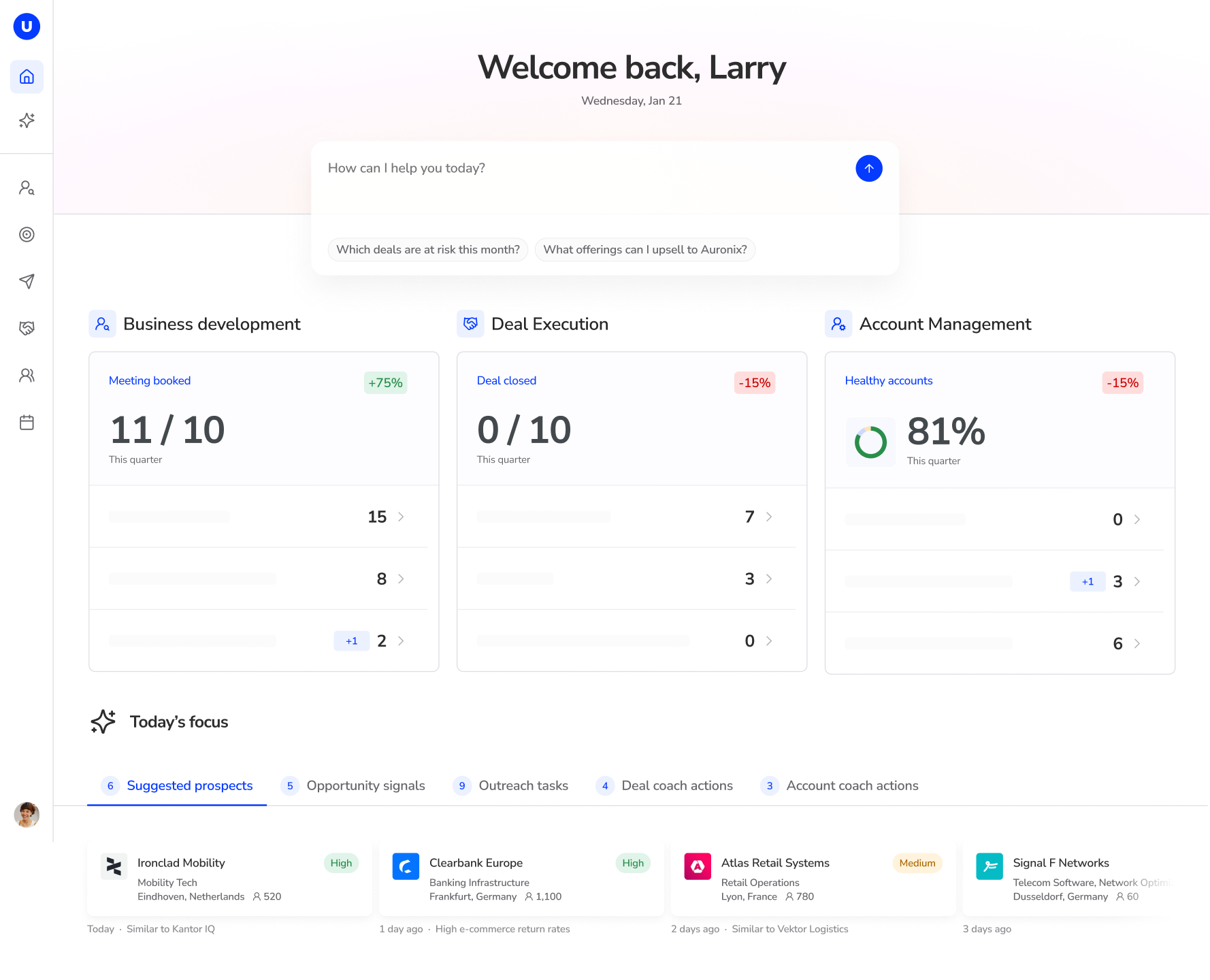
Instead of prompting or patching together separate tools, reps get AI-driven workflows that guide them step-by-step through every phase of the sales cycle—from prospecting and discovery to deal execution, account management and cross-sell.
One platform. One flow. One guidance layer for all sales activities.
That makes uman the only end-to-end solution for modern B2B sales.
3. Deep expertise and services to bring sales transformation to a real finish
Beyond technology, uman also provides the services to deliver sales transformation end-to-end: best practices, training, and partners combined with the uman platform that enables on-the-job adoption across the full B2B sales cycle.
Because transformation isn’t solved by a tool alone.
uman Delivers Measurable Impact Across the Entire Sales Organization
This isn’t abstract. The model is designed to drive concrete, org-wide outcomes.
6–12% higher win-rates
When reps are always better prepared—with the right context, relevant use cases, and persona-specific value drivers—they can finally do solution selling at scale.
Live guidance and on-the-job enablement improves every customer conversation, directly lifting win-rates.
2 months faster ramp-up
New reps become productive much faster because they get immediate access to all relevant product, sector, and customer knowledge exactly when they need it.
No endless learning tracks, but rapid time-to-confidence in every sales phase.
+30% more cross-sell opportunities per rep
Reps automatically discover new expansion opportunities because uman matches solutions to customer needs, updates, and context.
That breaks the comfort zone and makes cross-portfolio selling accessible for every rep—not only the experts.
+80% adoption from week 1
Sales adopts uman quickly because it is:
- all-in-one (no tool switching)
- built on guided workflows (no prompting needed)
- simplifying the complexity of solution selling
Result: massive adoption, so impact isn’t limited to a handful of early adopters but is felt across the whole team.
The Bottom Line
Modern B2B sales teams aren’t failing because they lack effort, training, or tools. They’re failing because solution selling has become too complex to execute consistently in a fragmented system.
uman fixes that by giving sales a shared brain, guided execution across every workflow, and the services to make transformation stick.
One platform. One flow. One guidance layer.
Solution selling—finally scalable.


Prep like a machine, sell like a human
Let AI handle the research and prep work — you focus on building relationships and closing deals.