High-performing sales teams improve results by simplifying how work gets done and by treating AI as part of the commercial operating system, not as a set of individual tools. The goal is repeated customer value creation that converts predictably to revenue and improves over time through learning.
The uncomfortable reality: more activity, stable win rates
Many organizations increase capacity, budget, and pipeline activity, yet win rates remain stable. This points to a system problem rather than a motivation problem. Sales performance depends on how the organization is designed to create value for customers across functions, not on isolated effort inside silos.
In this article, 9 steps to fix it.
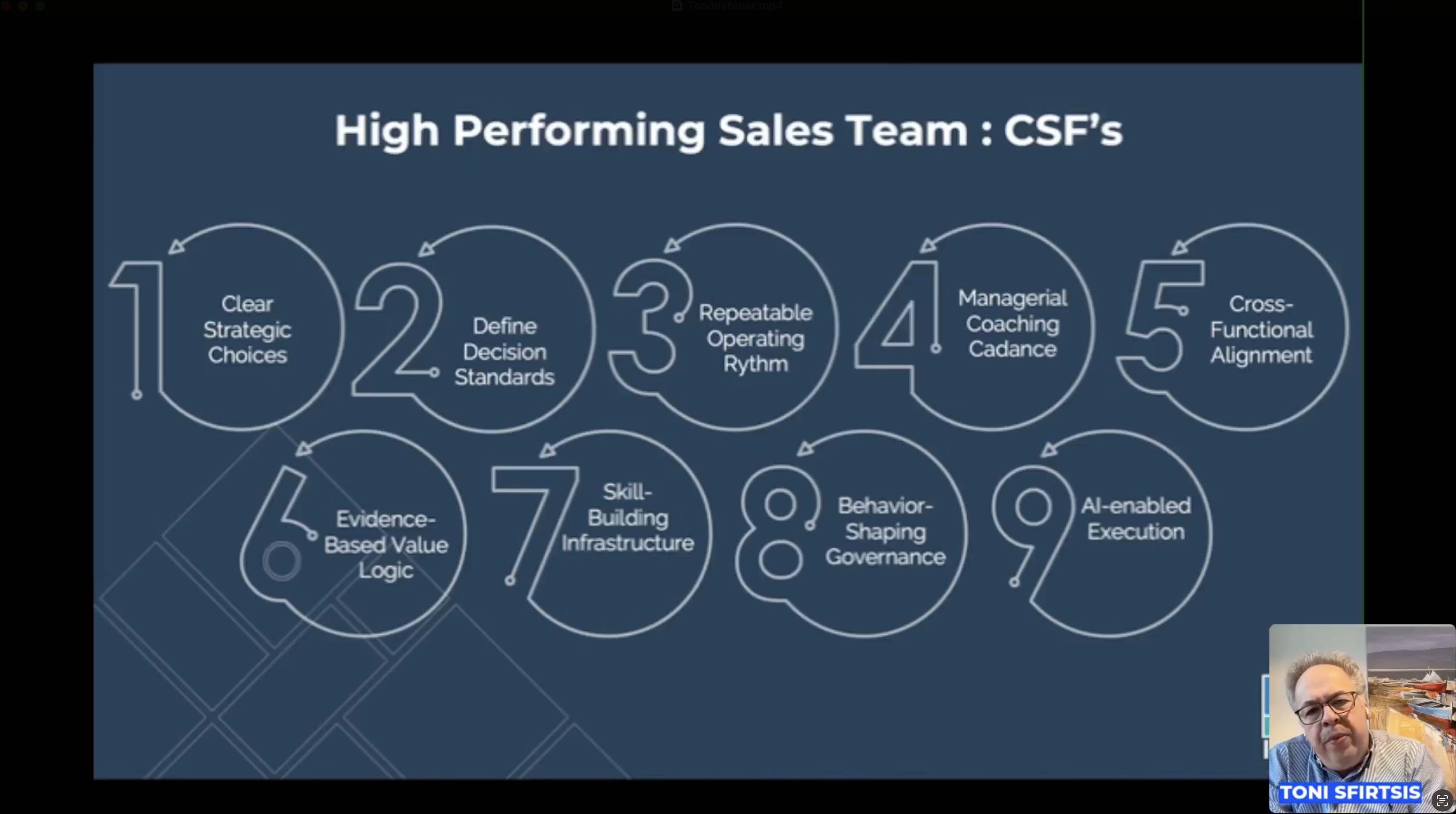
What a high-performing sales team is
A high-performing sales team:
- Repeatedly creates customer value
- Converts that value predictably to revenue
- Improves its approach over time
- Builds learning capacity with customers through continuous co-creation
This shifts performance away from “heroic selling” by individuals and toward a commercial operating system that produces consistent outcomes.
AI as an amplified system, not a set of tools
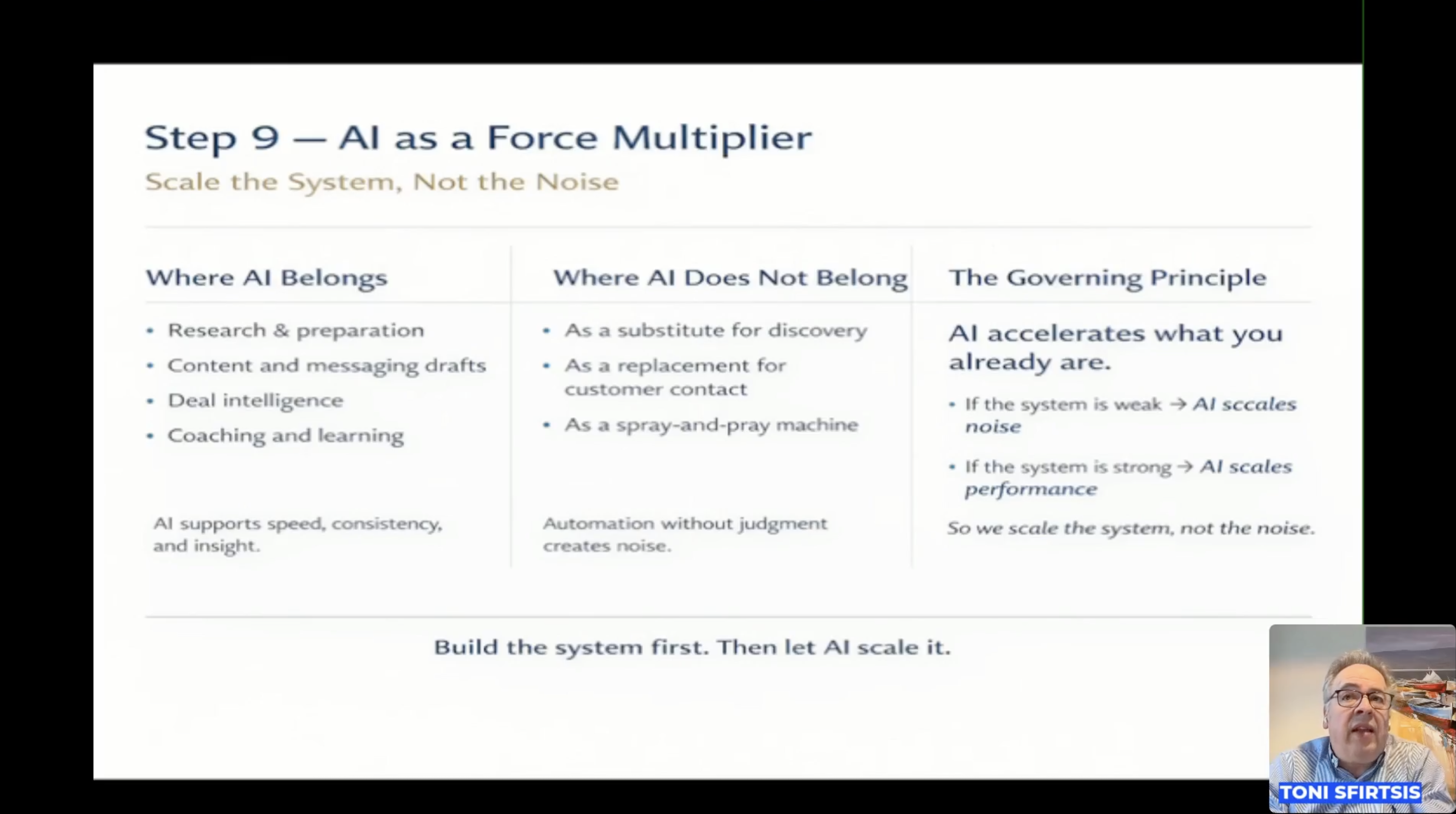
AI can increase productivity, speed, decisiveness, and efficiency in sales. The impact becomes meaningful when AI is scaled from individual or mono-disciplinary use to an organizational level that supports the full commercial process.
A common limitation is that AI applications are used at an individual level rather than helping the whole organization deliver the value proposition. Value creation is not only a sales, marketing, or communication activity; it is a commercial system outcome delivered by the full organization.
A key constraint remains: garbage in, garbage out. Decision criteria and data standards must be defined before AI can improve performance.
The 9 steps to becoming a high-performing sales team
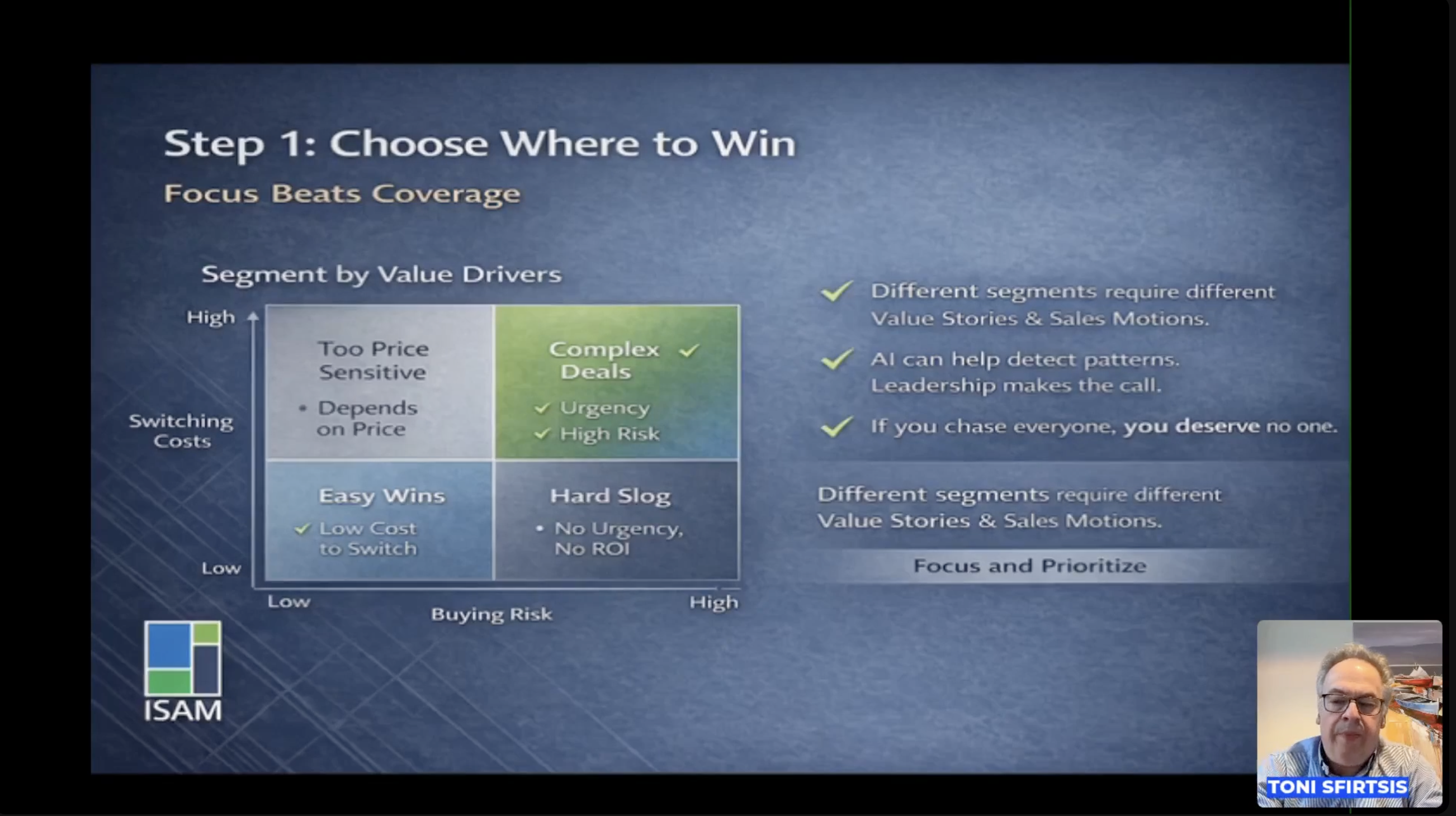
1) Choose where to win
Identify the most valuable customers now and in the future. This requires understanding customer value drivers and how customers compare alternatives.
Customer segmentation based on administrative criteria (big vs. small, long relationship vs. new) misses what matters. Segmentation improves when it reflects:
- Buying risk
- Switching dynamics between competitors
- Value drivers that explain why customers buy and what they value
2) Define the value proposition with proof
A value proposition is the central promise: what a customer can expect. It must include evidence, not abstract statements.
Proof needs to be expressed in outcomes and client results, in a way that is credible to decision-makers such as a CFO.
3) Design sales plays per segment across the organization
Each segment can require a different commercial process. Sales plays define:
- How the process works for that segment
- Which departments participate
- Roles and contributions across functions
- How the organization delivers the promised value
Sales does not end at contract signature. The commercial process runs through the whole organization.
4) Set entry criteria and cost-to-serve choices
Decide which customers to target and which are not worth the cost to serve. Define what “valuable” means, including growth potential.
These criteria must be explicit before AI is used to amplify the commercial process.
5) Build deal excellence through decision architecture and governance
Map decision-making on both sides:
- Internal decision-making: who decides what, based on which criteria
- Customer decision-making: stakeholders, their value drivers, and their decision criteria
With this information, AI can help make the commercial process faster and more productive. Governance clarity is required.
6) Align roles, segments, and management coaching
Commercial professionals must be assigned to segments intentionally (example: “trusted advisor” positioning fits some segments and not others).
Behavior changes when strategy and positioning change. Management must coach, facilitate, and support the new behaviors. Targets drive behavior; the way performance is managed determines what shows up in practice.
7) Redesign workflows end-to-end
Workflows start at the customer and run to the “backside” of the organization that delivers the product, solution, or service. Workflow design clarifies:
- Participants and roles
- Expected contributions
- Output targets across the full commercial process
AI support must be designed around these workflows, not around isolated tasks.
8) Use metrics that reflect the full commercial process
Metrics must connect to the end-to-end workflow and the value being delivered, not only to activity volume. Measurement should reinforce the behaviors required by the strategy and sales plays.
9) Scale AI through learning and change
Scaling AI is primarily a learning and developmental change process. Most barriers are not technological; they are change-related.
Adoption requires:
- Time and space to try new ways of working
- Psychological safety to experiment and make mistakes
- A structured approach to learning while upscaling AI to the organizational level
9 critical success factors for deploying AI to enhance sales performance
- Clear strategic choices for the next 3–5 years
Define where the organization wants to stand, which customers will be most valuable, and how differentiation will be achieved. - Clear decision standards and data needs
Specify criteria and information required to make decisions across the commercial process. - A repeatable operating rhythm built on learning
Implement feedback loops after customer contact, internal meetings, and key moments to review what worked, what failed, and what to optimize. - Managerial coaching and a context of safety
Support behavior change through coaching and a safe environment for experimentation. - Capability to operate in complex, multifunctional environments
Sales teams must work across functions and hierarchies and speak the language of multiple departments on both the customer side and the internal side. - Evidence-based value logic
Define the client result and provide proof of capability to deliver it. - Skill-building infrastructure
Invest in people so they can build digital and AI-related skills as part of a broader learning process. - Performance management aligned with desired behavior
KPIs and targets must reinforce the behaviors required by the strategy. - Execution through pilots and experiments
Start with pilots so teams experience how AI can support and facilitate work in practice.
Watch the video
This blog post stems from a live webinar.
Rewatch it here