%20(1).png)
Pre-sales efficiency to drive productivity
This report looks at why improving pre-sales processes is often one of the fastest ways to improve sales productivity. We combined McKinsey research with examples from our customers that achieved measurable results by reducing internal friction rather than changing sales behavior.
Get the report in PDF
When sales performance needs to be increased, most companies look at their sales teams first.
- They invest in training.
- They roll out coaching programs.
- They hire more experienced sellers.
These actions help of course. But they usually take time, and the results are not always consistent across teams.
Research from McKinsey shows that top-performing sales organizations improve productivity in a different way. They focus on how sales work is done. They reduce time spent on internal tasks, automate repetitive work, and make it easier for salespeople to focus on customers.
“Leading B2B companies have put their foot down on such inefficiencies … leaders have already offloaded as much as 50% of non-selling tasks to these groups and are now automating aggressively … a leap that has opened up 20% more sales team capacity.”

1. Where sales productivity is lost
Sales work includes much more than talking to customers.
In many organizations, salespeople spend a large part of their time preparing proposals, collecting internal information, coordinating with pre-sales teams, and adapting existing materials to each deal.
This work is often necessary, especially in complex sales. But it also takes time away from customer conversations.
McKinsey’s research shows that top-performing sales organizations spend less time on this kind of internal work. They structure sales operations so that sellers can focus on activities that directly support revenue.
When steps are removed, simplified, or automated, the effect is immediate. Waiting times drop. Handoffs become clearer. Work moves faster across the team.
This is why process improvements often deliver quicker and more reliable productivity gains than training on its own.
2. Automation and sales productivity
Automation is often seen as a way to cut costs.
Let’s frame it differently: Automation is mainly a way to give salespeople more time to sell.
“Shared services structures and automation have helped top-quartile companies … improve sales productivity by as much as 30%.”
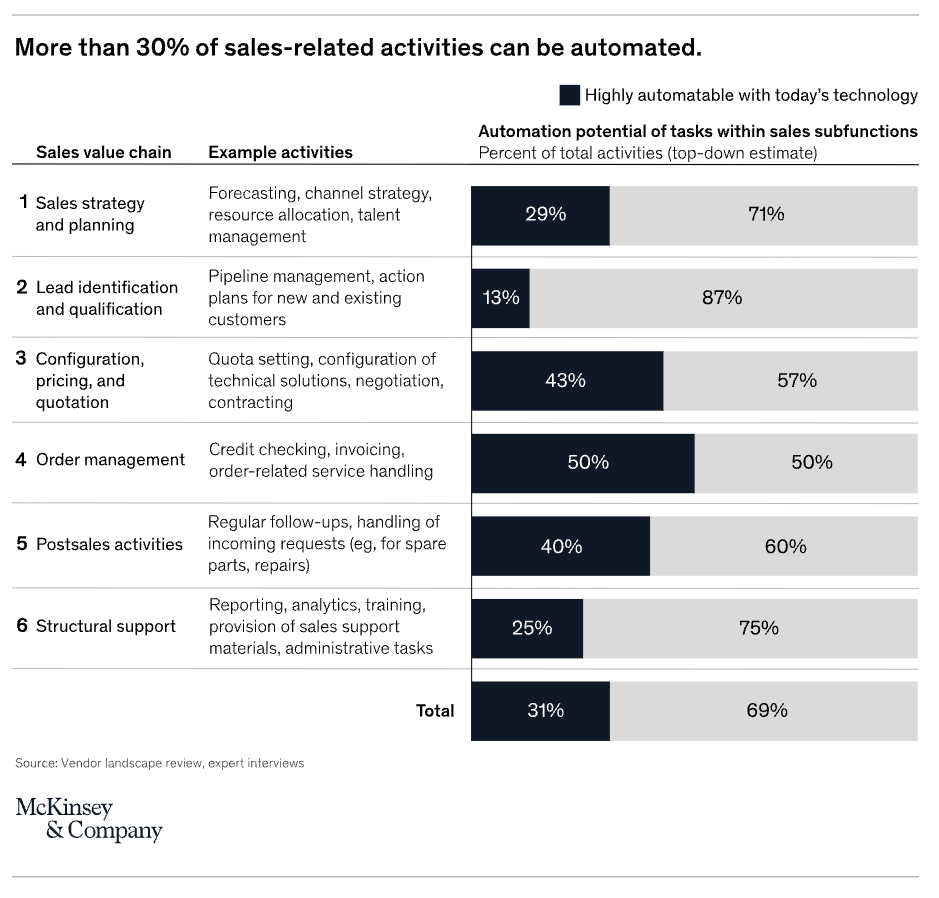
According to them, around 30% of sales activities can already be automated using existing technology. These activities are usually administrative or repetitive, such as preparing documents, updating systems, or reusing the same information across deals.
→ → → Existing technology, like uman.ai
When this work is automated, salespeople spend more time with customers and less time on internal tasks. Productivity improves because time is used more effectively.
3. Remove pre-sales as a bottleneck
Pre-sales teams play an important role in complex sales. They help shape solutions, provide expertise, and support sales teams throughout the deal.
Pre-sales is often where delays start to appear.
- Sales teams depend on pre-sales input.
- Pre-sales teams support multiple deals at once.
- Information moves slowly between teams.
As a result, sales progress can slow down even when customer interest is high.
These issues are usually not caused by a lack of skill or effort. They are more often caused by unclear processes and inefficient handoffs.
When pre-sales processes are clearer and better supported, several things improve at once.
- Sales teams get information faster.
- Proposal work becomes more predictable.
- Fewer revisions are needed.
This helps sales teams keep momentum in deals and spend more time with customers.
Top-performing organizations focus on removing internal friction so that selling time is protected.
4. Case example: Plat4mation
Our customer Plat4mation is a consulting firm with complex sales cycles and solution-driven offerings.
Their sales teams worked closely with pre-sales, but this also created dependency. Sales often had to wait for support, while pre-sales teams managed multiple requests at the same time.
After implementing uman, Plat4mation reduced the time spent transferring work from pre-sales to sales by more than 30%.
This meant fewer internal steps, less waiting, and faster progress on opportunities. Sales teams were able to move forward more independently while maintaining solution quality.
“There was a +30% decrease of time required from non-sales to support the sales people. That is really a big saving.”
An additional effect was increased visibility into recurring customer needs. By analyzing past proposals and pre-sales input, Plat4mation was able to identify common patterns across deals and spot several repeatable offerings. Further reducing preparation time and supporting more consistent sales execution.
“After a meeting, uman tells you there is also offering A, B and C that you didn't discuss but are still an opportunity. That works really well.”
5. Case example: Halifax Consulting
Halifax Consulting faced a different challenge.
Proposal preparation took too long. Creating a single proposal often required a full working day, which limited how many opportunities the team could realistically pursue.
The issue was not sales capability. It was the amount of work involved in preparing proposals.
With uman, proposal preparation time dropped from more than eight hours to around one and a half hours.
“A normal sales proposal took us 1 day of work. Now it’s more like 1.5 hours, and the quality is at least equal, probably better.”
This change freed up significant time for sales teams to focus on customer conversations and opportunity development. As a result, Halifax Consulting also saw a 20% increase in its EAT sales ratio, reflecting higher sales effectiveness alongside reduced preparation effort.
“After introducing uman, the EAT sales ratio has increased by +20%.”
The EAT sales ratio measures how much of a sales team’s time is spent on activities that directly move deals forward.
What this means for sales leaders
For sales leaders looking to improve productivity, pre-sales processes are a practical place to start.
Changes to processes usually show results faster than changes to behavior. They affect the entire team and do not depend on perfect adoption by every individual seller. This makes them easier to implement and easier to scale.
In a market where teams are expected to do more with limited resources, reducing internal friction is a low-risk way to increase sales capacity.
The examples in this report point to a clear pattern. When sales teams spend less time waiting, rewriting, or coordinating internally, they spend more time progressing deals and engaging with customers.
Sales productivity challenges are often treated as people problems. In many cases, they are process problems.
McKinsey’s research shows that top-performing sales organizations focus on how work flows through the organization. The experiences of Plat4mation and Halifax Consulting show how this focus translates into measurable results when applied to pre-sales work.
For sales leaders, the next steps:
- Review where sales teams depend most on pre-sales input and where delays occur.
- Identify tasks that are repeated across deals and could be standardized or automated.
- Focus first on removing friction rather than changing behavior.
Of course, underlying software is the perfect solution to all of these points.
→ → → Software like uman.ai


Prep like a machine, sell like a human
Let AI handle the research and prep work — you focus on building relationships and closing deals.