%20(1).png)
Three years of AI changed consulting more than the last thirty
What AI did to a thirty-year-old business model
The consulting industry is experiencing its most significant structural shift since the 1980s.

For the better part of the last half century, the professional services business model rested on a straightforward premise: A wide base of junior staff handled the research-intensive, document-heavy layer of work. Senior partners provided judgment, relationships, and strategic direction.
The billing structure rewarded hours, and the margin structure rewarded scale.
This pyramid model generated decades of reliable growth and made consulting one of the most profitable professional services categories in the world.
But this model is now undergoing a massive stress test with the rapid integration of AI. The value hasn’t changed, but the cost of providing it has.
And nowhere is that tension felt more acutely than in sales. The people responsible for bringing in new business are caught in the middle. They’re expected to perform at the highest level, while the support structures around them are quietly disappearing.
The consulting pyramid is crumbling

The debate about AI and consulting tends to oscillate between two positions that are both, in different ways, unhelpful.
- AI will replace consultants. This overstates the case and misidentifies where the disruption is occurring.
- AI is simply a productivity tool. This then understates the structural implications. But the consulting pyramid is crumbling.
The more accurate framing is that AI has become highly capable at a specific and economically significant layer of professional services work. Research, synthesis, knowledge retrieval, documentation, and first-draft production are all massively supported with AI. These are precisely the tasks that historically justified large junior teams and high billable-hour volumes.
These are precisely the tasks that historically justified large junior teams and high billable-hour volumes.The Big Four and major strategy houses have collectively invested more than $10 billion in AI infrastructure and tooling since 2023. Graduate hiring across the sector fell between 20% and 44% year-on-year by 2024.
“The research layer that used to sit below your senior sellers is shrinking. The preparation work just moves up, onto the people least able to afford spending time on it.”

Pay a premium for premium expertise
At the firms that restructured most aggressively around AI, top-line performance remained stable or improved. The implication is uncomfortable but worth stating plainly: if revenue held while the headcount doing that work shrank, then clients were not paying for those hours because the work was irreplaceable. They were paying for them because they were the necessary cost of accessing the judgment that came with it.
So in a sense, the consulting premise is moving back to it’s origins from the 80s: pay a premium for premium expertise. Not for the grunt-work.
For sales leaders, this is both a threat and an opportunity.
- The threat: your team is expected to do more with less support.
- The opportunity: the firms that figure out how to free their best people from prep work will outcompete everyone still doing it manually.
A world-wide trend
Complex B2B sales in professional services has always carried its own version of a pyramid. Senior partners and principals manage the relationships. A substantial portion of the supporting work is handled manually, by people whose time is genuinely expensive.
The data on how that time is actually spent is striking.
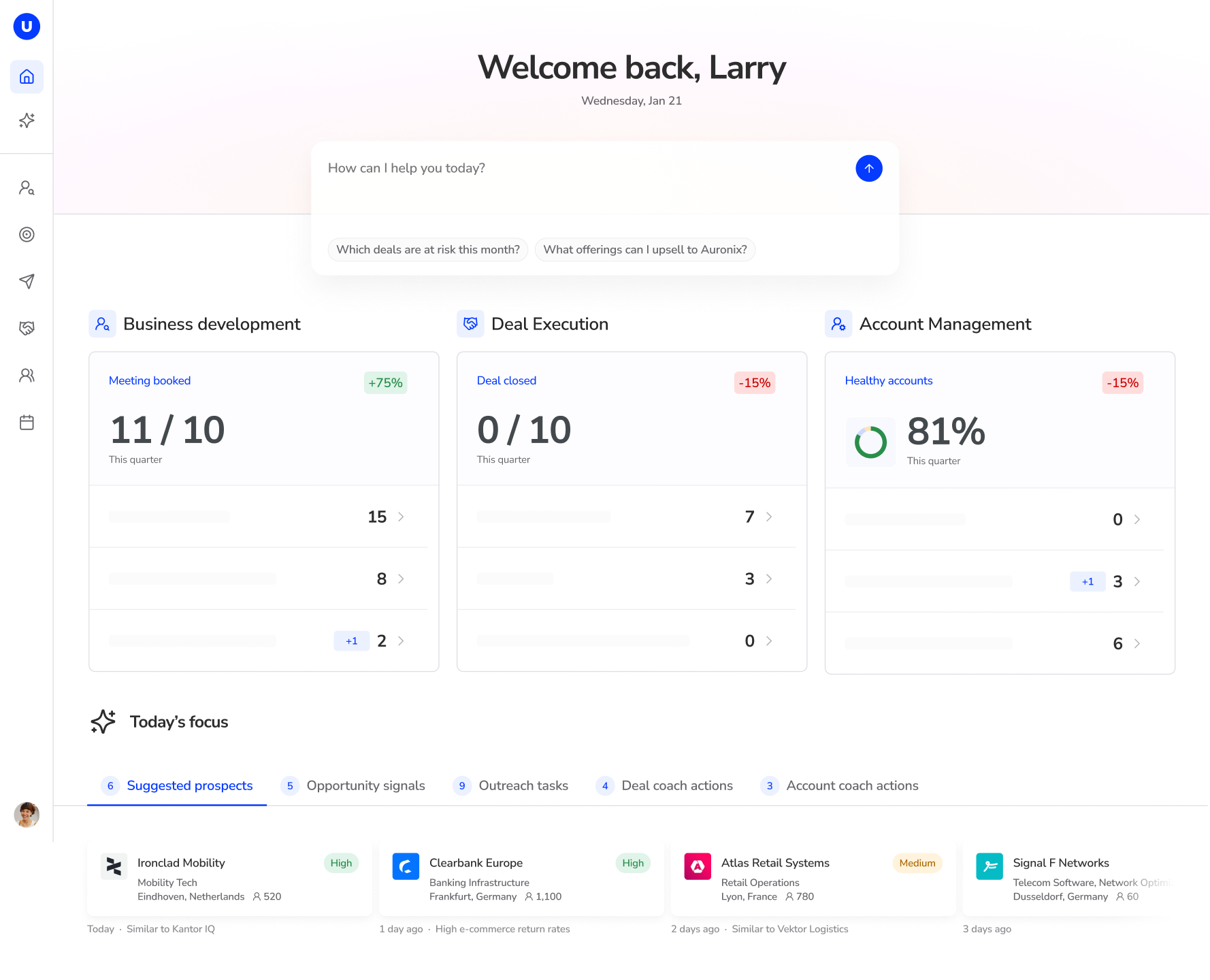
Our own customer reported up to 80% of the “prep work” can be taken care off with the help of AI. The people best positioned to win new business are spending disproportionate amounts of time on the preparation layer of selling. The same layer where AI is now outperforming them.

In August 2025, Gartner projected that: by 2030, 75% of B2B buyers will prefer sales experiences that prioritize human interaction over AI-assisted ones.
But that’s just the reason to integrate AI even more!
Let AI handle the prep so your team can spend more time doing the one thing it can't: human selling.
Buyers want more of you, not less. The question is whether you have the time and headspace to actually show up that way.
Clients demand change
The operational model around the delivery of expertise is changing. And, more slowly but just as importantly, around how it is sold. Columbia Business School professor Rita Gunther McGrath wrote in the Wall Street Journal (already back in december 4, 2025 - 15 months ago):
"The economic absurdity becomes clear when we consider that firms adopting AI most successfully would paradoxically see revenue collapse under hourly billing, even as they deliver superior results more efficiently."(source)
ConsultingQuest's 2025 analysis crystallized the current state as micro-arbitrage.
When a ten-week project can be executed in six, the firm's cost base falls by roughly 30–40%. But because pricing remains anchored in human time rather than technological efficiency, the client continues to pay the ten-week price. (source)
So while productivity goes up, pricing should come down. This is the natural way of the world. But this arbitrage works only as long as clients remain unaware of the gap. And that window is closing.
For sales teams, that closing window creates real pressure. Clients are asking harder questions. Deals that used to close on relationship alone now require sharper preparation, better insight, and faster response times. The bar is going up, while at the exact moment the support structure is going down.
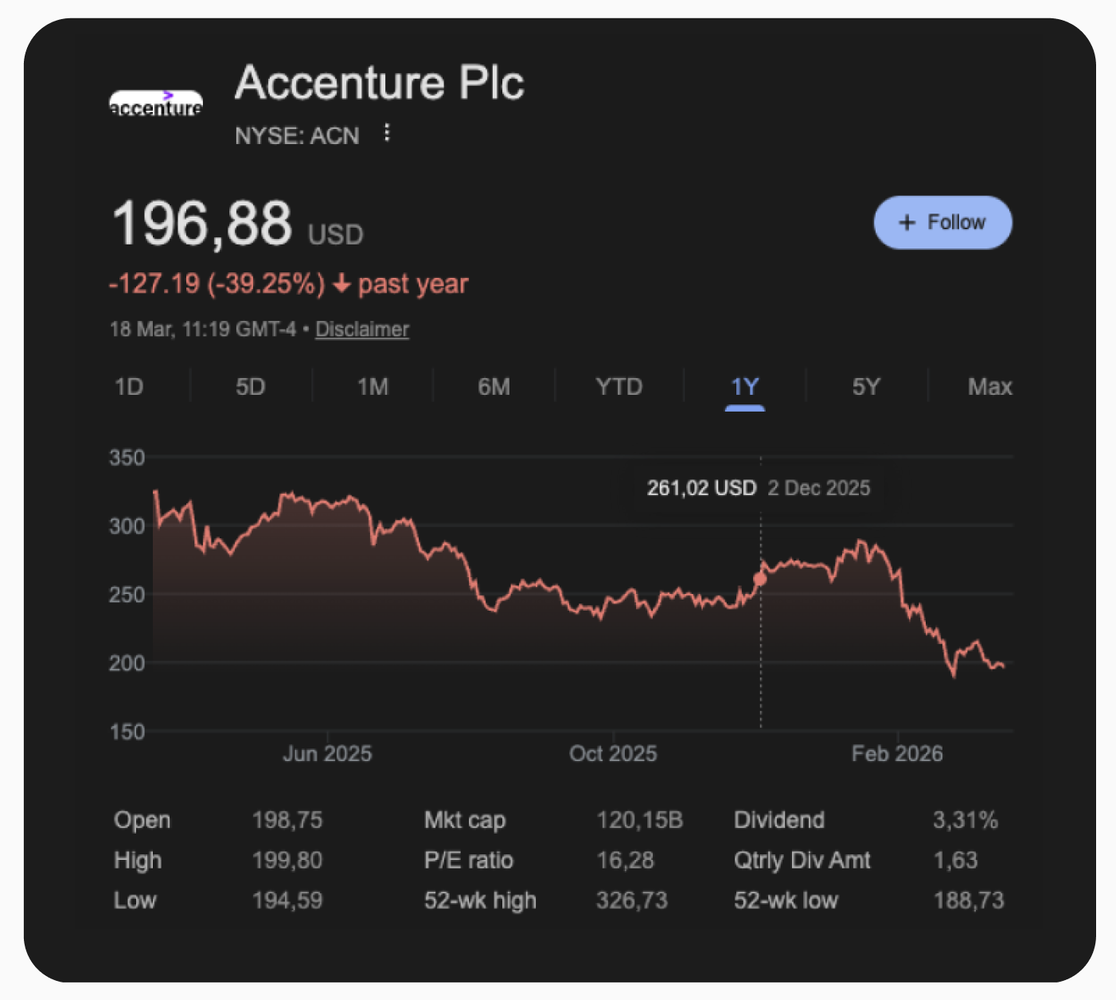
The largest listed consulting firms have seen their shares collapse by up to 30% over two years (data from October 2025). Clients, and the market, is demanding change.
“A project costing $1 million in-house, previously outsourced for $200,000 through a consultancy, could now be done for just $10,000 with AI.”
This is where human judgment becomes non-negotiable. AI handles the preparation. You handle the conversation, the trust, the close.
Conclusion
“Firms that move fastest face a genuine first-mover disadvantage under the old model but a decisive advantage under the new one.”
Firms are currently pocketing AI-driven productivity gains as higher margins while billing clients at pre-AI rates. Client awareness on quality is accelerating and, as always, the firms that move fastest face a first-mover disadvantage under the old model, but a decisive advantage under the new one.
The sales leaders who understand this shift will be the ones still standing when the dust settles.
Firms that give their sales teams the AI infrastructure to prep smarter, and the space to sell more humanly, stand the best chance of sustaining and thriving in these changing times.


Prep like a machine, sell like a human
Let AI handle the research and prep work — you focus on building relationships and closing deals.