%20(1).png)
Bruno's Advice: A 'no' attracts a 'yes'
"A no attracts a yes."
"A no attracts a yes."
That was the line that broke the room in our first Deal Clinic with Bruno Desmet from The House Of Sales who's been closing complex B2B deals for 22 years.
We sat down to pressure-test the scenarios our sales team runs into every week. Champions who ghost, procurement showing up uninvited, deals that slip a quarter and then two. The kind of moments where most playbooks tell you to hustle harder.
Bruno's answer to almost all of them was the same: play hard to get.
Rewatch the full webinar here
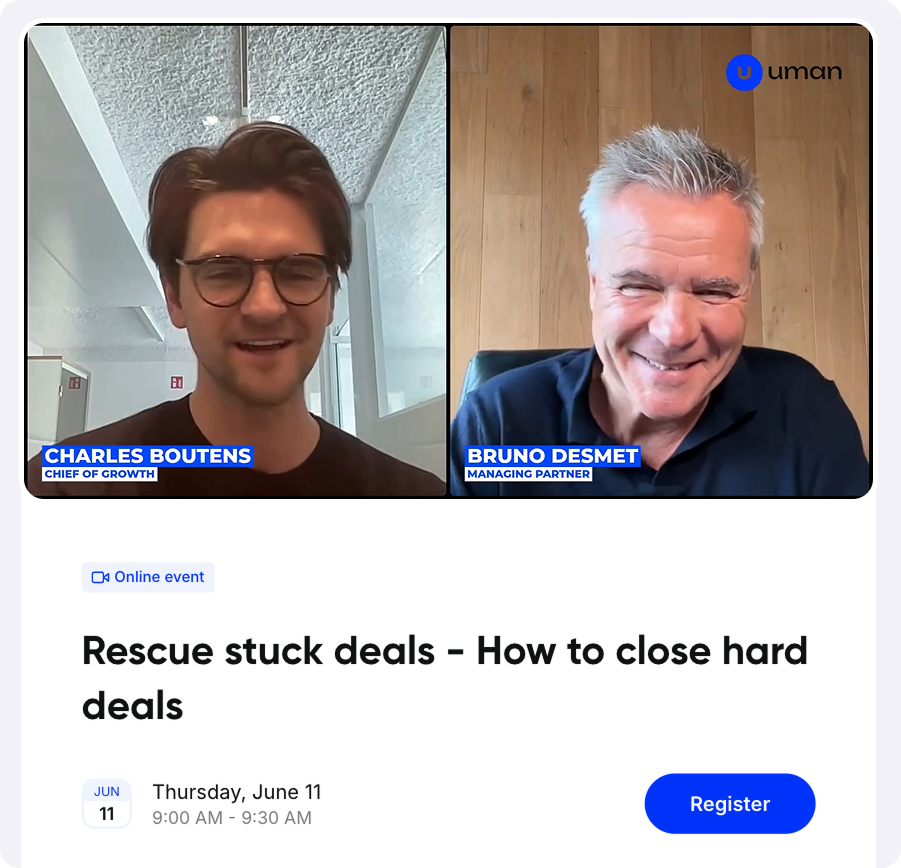
8 takeaways worth stealing:
1. Ghosting isn't rudeness, it's a symptom
When your champion goes radio silent, Bruno doesn't read it as them being busy, rather he reads it as a signal he's lost control. His move is a self-accusation email that opens with "no news is good news, except in business" and then takes the blame on himself. Reasonable people can't sit with that for long.
"If I'm dealing with silence, it's a sign I've failed to make you eager to do business with us."
2. When they push on price, push back harder
Prospects who open with "we have budget, but only X% below list" are testing your conviction. Bruno's response is to flip it — imagine we can prove you'll earn back 100x your investment, are you still capped? If the answer is still no, he walks. A no, said warmly, attracts a yes.
"If people are only concerned about price, walk away. They'll erase your margins today, tomorrow, and in the near future."
3. When they threaten the competition, hand them over
Most sellers panic-discount when a prospect drops the competitor card. Bruno does the opposite! He offers to sit on the same side of the table and advise them, then plants the questions they should ask the other vendor and the clauses they should demand in the contract. Fear, uncertainty, doubt, ... are created from the buyer's chair, not yours.
"Don't be afraid to push them in the hands of the competition."
4. Pre-educate on stakeholder access, before there's a deal to lose
By the time your champion is shielding the CFO, it's already too late. Bruno sets the expectation in the first conversation, saying: "Every solid customer we have today, every stakeholder was in the room from the start, and I'll do the same here." If they push back on that, walk away and blame yourself for the mismatch.
"I do not want you, dear champion, to do my job."
5. Open every diagnostic with the question most sellers skip
Bruno starts the same in the first meeting, every time. You can't lead the buyer's process if you don't actually know what their process is. So say:
"Help me understand (in comparable types of business) how do you guys make your buying decision before engaging with a supplier like us?"
6. Help them buy from you
Bruno once got four contractor quotes to rebuild his house and had no idea how to choose. One of them came over, asked what actually mattered to him, then offered to rank all four proposals, his own included, against those criteria. His proposal landed in second position. The salesperson's dedication and tailored help meant Bruno hired him anyway.
"Help your customers make that complex decision in your favor. They're not used to making that decision."
7. Build the ROI case with them, never for them
The temptation is to deliver a polished spreadsheet that proves the case. Bruno does the opposite again! He sits next to the CFO, asks what template the board signs off on, and co-builds the math in their language. When the buyer owns the numbers, the deal stops being something you're selling them.
"Every decision in a company is based on ROI calculation. If they want a solid one, make it together."
8. A slipping deal is a diagnostic too
When deals slip a quarter, then two, then three, ... Bruno's identifies this as a loss of control. Either you didn't map the buyer's full process and procurement showed up uninvited, or you stopped manufacturing urgency in the back half of the deal. Probably both.
"When a deal is slipping, it's a sign you're not in control."
A fina few things to remember:
Stakeholders:
- SSMB deals → 2–4 stakeholders on average
- Enterprise deals → 6–8+ stakeholders
The seller's job is to lead each one individually into a consensus in your favor
The 20% rule:
- You lose money on 20% of your customer base
Implication: be brutally selective on who you sell to.
The 95% problem:
- 95% of your market isn't conscious they need you today
The seller who makes them feel the pain or the gain first owns the deal, then the competition never enters the picture.
The ROI ladder:
- Reframe an objection: "Imagine we prove you'll earn back 10x, 100x, 1,000x your investment — are you still capped?"
If they say no, walk. They're optimizing for price, not value.
The 4 buckets every value prop must speak to:
- More revenue
- Lower cost
- Risk control
- Benefits to their customers (the one most sellers forget)
Bruno's checklist when enriching a buyer's ROI template.
The self-accusation email:
- Opener: "No news is good news, except in business, isn't it?"
- 3 self-blame bullets:"We probably failed to understand your real needs", "We probably failed to explain the benefits enough". "Maybe there's another reason we're not aware of"
- Close: ask for the chance to talk again
The stakeholder access ultimatum (verbatim framing):
- Said in meeting #1, not month #3
- "Either we meet the CFO together, or I do my homework and report back to you — but we don't skip them."
If the champion refuses? Walk. Blame yourself: "Probably we're not the right party to work with."
The two questions that surface sense of urgency
- "What is the impact of the status quo?"
- "What is the impact of not deciding?"
Urgency decays after the first meeting. You have to manufacture it at every touchpoint, not just at the start.
The champion respect rule:
Never approach other stakeholders behind your champion's back. The moment you do, their internal "champion status" evaporates, and so does your deal. Transparency is the price of multi-threading.
Rewatch the webinar here: https://watch.getcontrast.io/register/uman-rescue-stuck-deals-how-to-close-hard-deals
Prep like a machine, sell like a human
Let AI handle the research and prep work — you focus on building relationships and closing deals.