%20(1).png)
The Sales Performance Pyramid
Why most B2B sales teams are optimizing the wrong layer
Most sales leaders think about performance in two layers:
- Headcount at the bottom
- Revenue at the top
Hire more sales. Expect more revenue.
When it doesn't work, hire more sales again.
In the time of AI, that model is being questioned more than ever.
"Sales professionals who use AI daily are 2x as likely to exceed their targets — yet 69% of reps are still falling short of quota. The tools exist. The architecture to deploy them doesn't."
If the tools aren't the problem, then we need to question the architecture.
We've been thinking about this for a long time at uman, and we built a framework that explains where performance actually comes from, and where most teams are leaking it.
We call it the Sales Performance Pyramid.
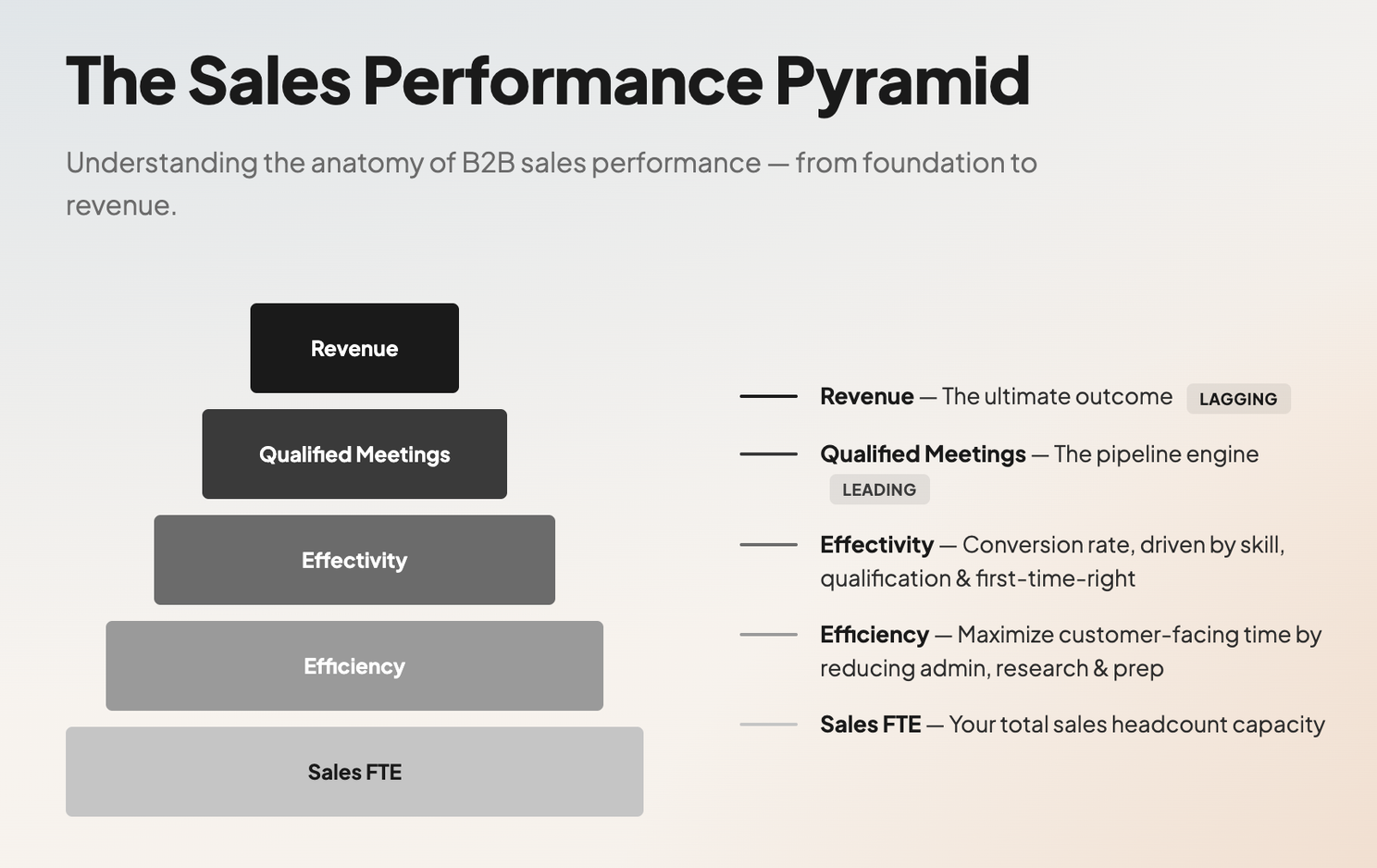
Five layers, bottom to top:
- Sales FTE: Your total sales headcount capacity. The foundation. This is where most organizations start and stop their thinking.
- Efficiency: How much of that headcount actually translates into customer-facing time. Reduce admin, research, and prep work, and reps spend more hours selling.
- Effectivity: The conversion quality of that selling time. Better qualification, sharper skills, first-time-right execution. This is where win rates are determined.
- Qualified Meetings: The leading indicator. When efficiency and effectivity are both strong, qualified meetings compound. This is your pipeline engine.
- Revenue: The lagging indicator. The ultimate outcome. It follows everything below it.
Here's the thing most teams miss:
You can't fix revenue by staring at revenue. Revenue is a trailing output. By the time it shows up in your quarterly report, the decisions that shaped it were made months ago in the layers below.
The Real Problem: Your current model is too costly
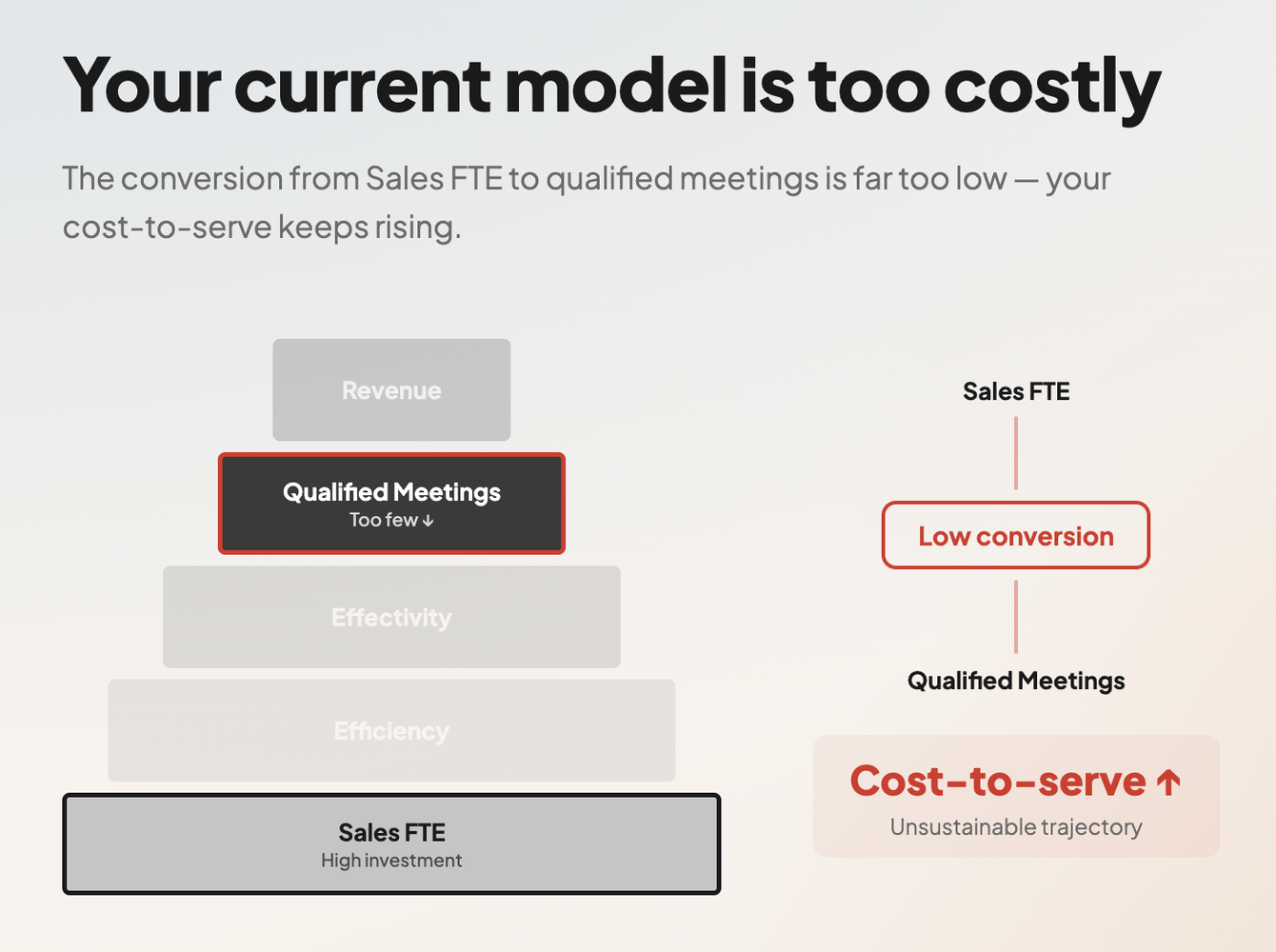
The conversion from Sales FTE to qualified meetings is, for most B2B teams, far too low.
According to Forrester:
"The average sales or consultant spends only 28-30% of their time actually selling. The rest goes to CRM updates, prospect research, meeting preparation, internal alignment, and admin."
Nearly two full days per week. Just preparing and admin.
The cost-to-serve keeps rising. Headcount grows, but revenue doesn't follow proportionally. And leadership responds the only way they know how: by adding more FTE to the base of the pyramid and hoping the top (revenue) grows with it.
Efficiency is not effectivity
This is where the framework earns its weight. Most people use "efficiency" and "effectivity" interchangeably, but they're not the same thing. And confusing them is why so many AI implementations disappoint.
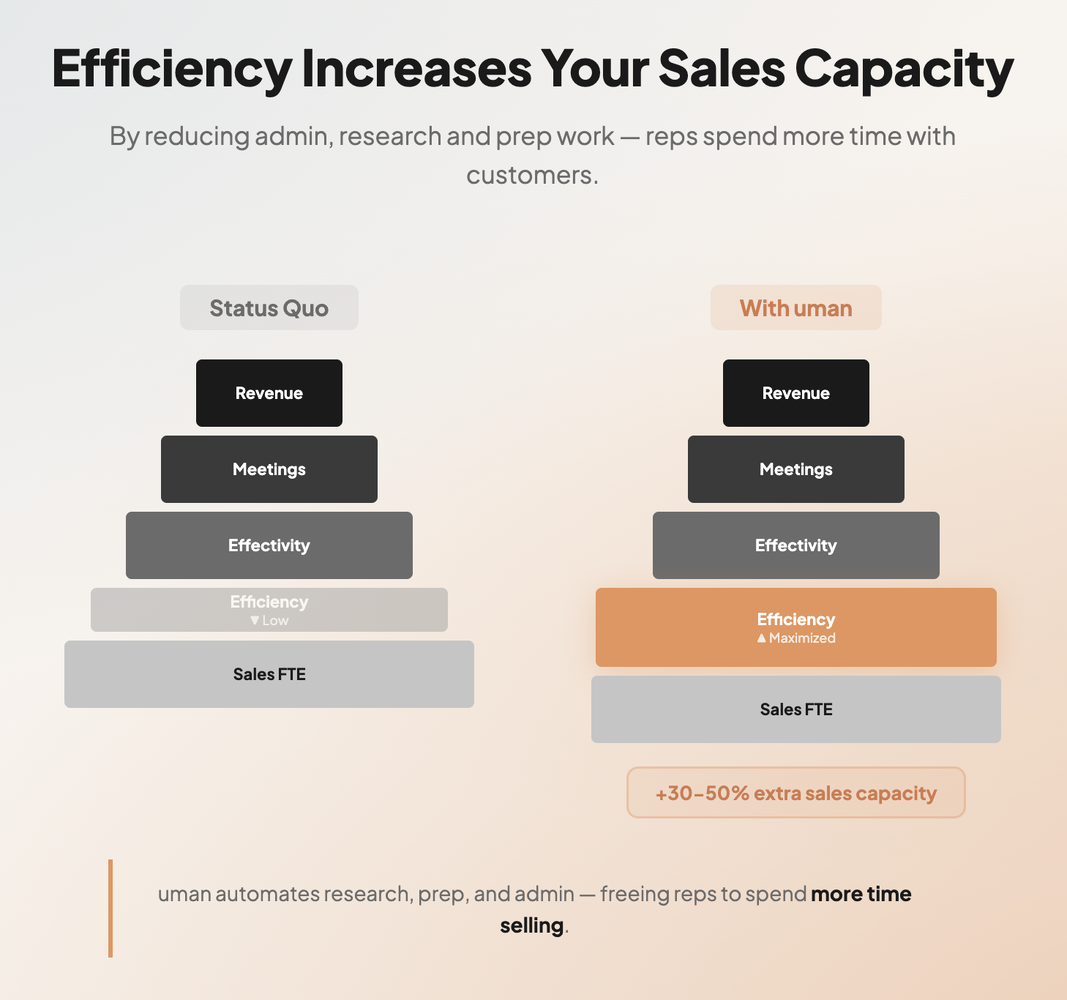
Efficiency is about capacity. Automate the research, the prep, the CRM updates, … and reps get 30-50% more time in front of customers. That's meaningful. But it's only half the picture.
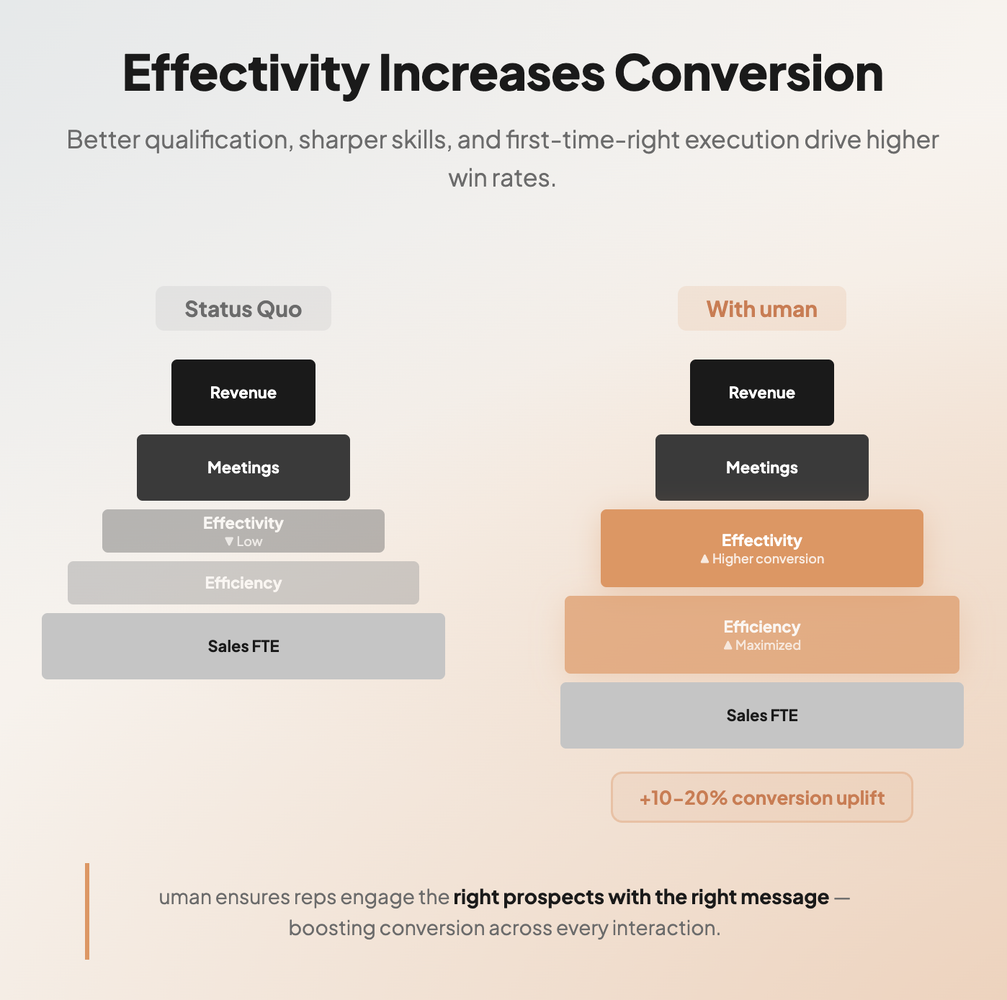
Effectivity is about conversion. Better qualification, sharper positioning, the right case study at the right moment, first-time-right proposals. This is what turns meetings into deals. A 10-20% conversion uplift on top of a capacity increase is where the math starts to compound.
This above is exactly what uman does.
Most AI tools today only touch the efficiency layer. They speed up admin, auto-fill CRM fields, summarize calls. That's useful — but it's optimizing the wrong layer in isolation.
If your AI stack only makes reps faster at low-quality work, you haven't necessarily improved performance. Perhaps you've just accelerated mediocrity.
When you stack efficiency and effectivity
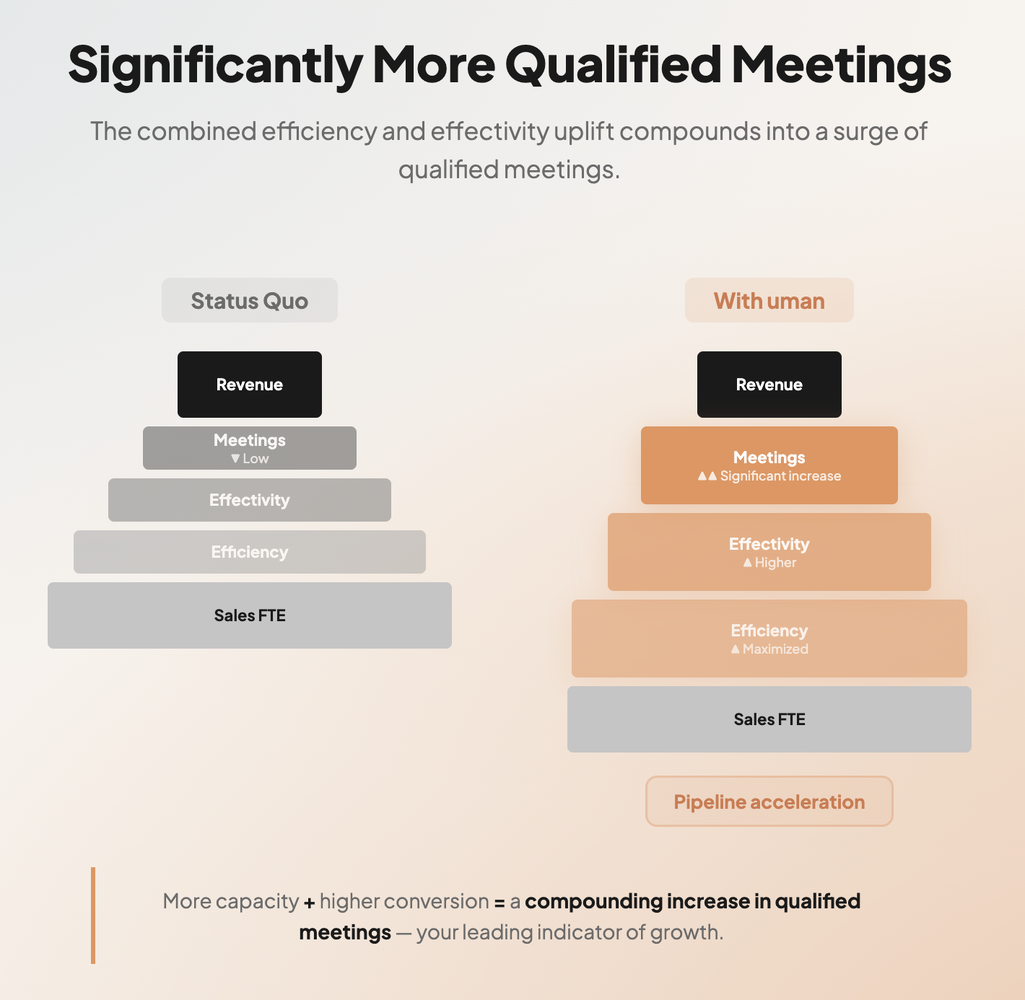
When efficiency and effectivity improve together, the effect is compounding.
More capacity (efficiency) multiplied by higher conversion (effectivity) produces a surge in qualified meetings which can be used as a leading indicator of growth. And qualified meetings, inevitably, drive the lagging indicator.
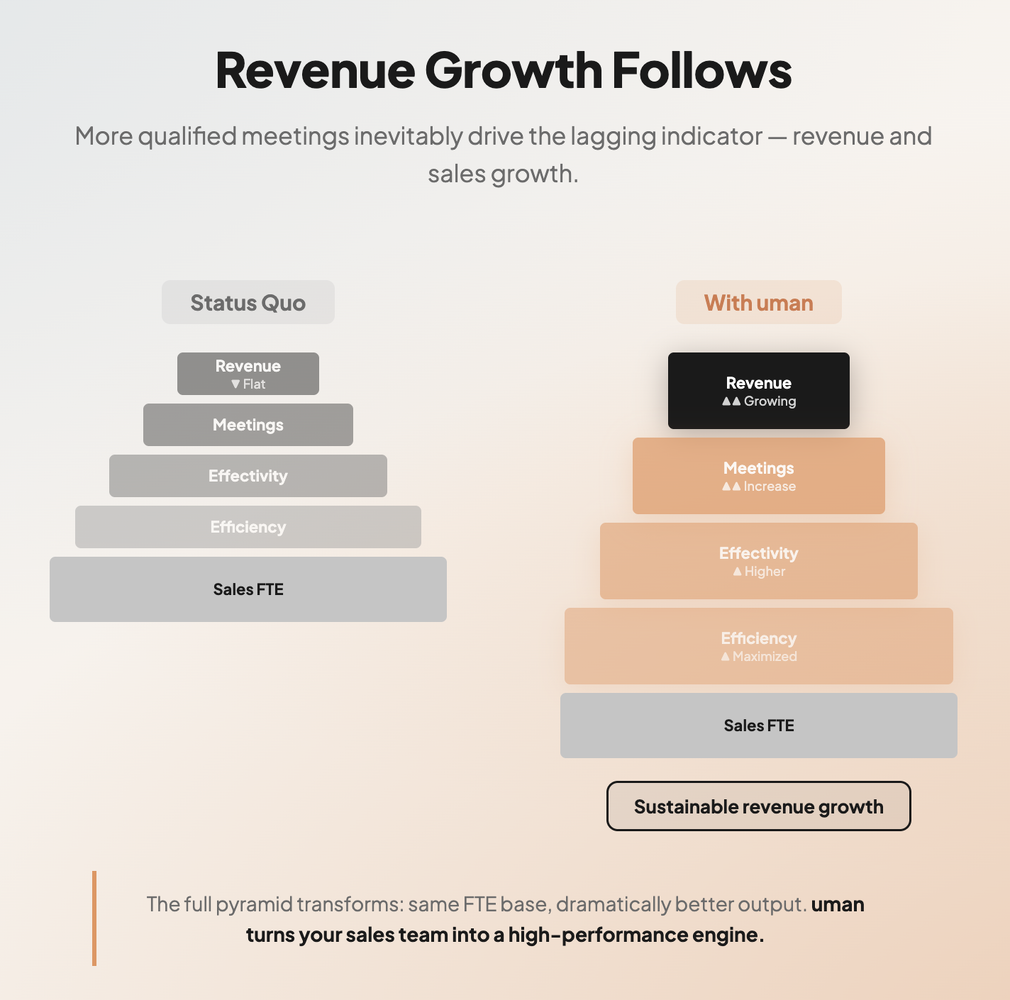
The same FTE base now results in dramatically better output. In this framework, the pyramid doesn't grow from the bottom, it expands from the middle.
This is the structural shift that most sales organizations haven't made yet.
You don't need the tradeoff
There's a related mental model that holds most teams back: the belief that you have to choose between quantity and quality.
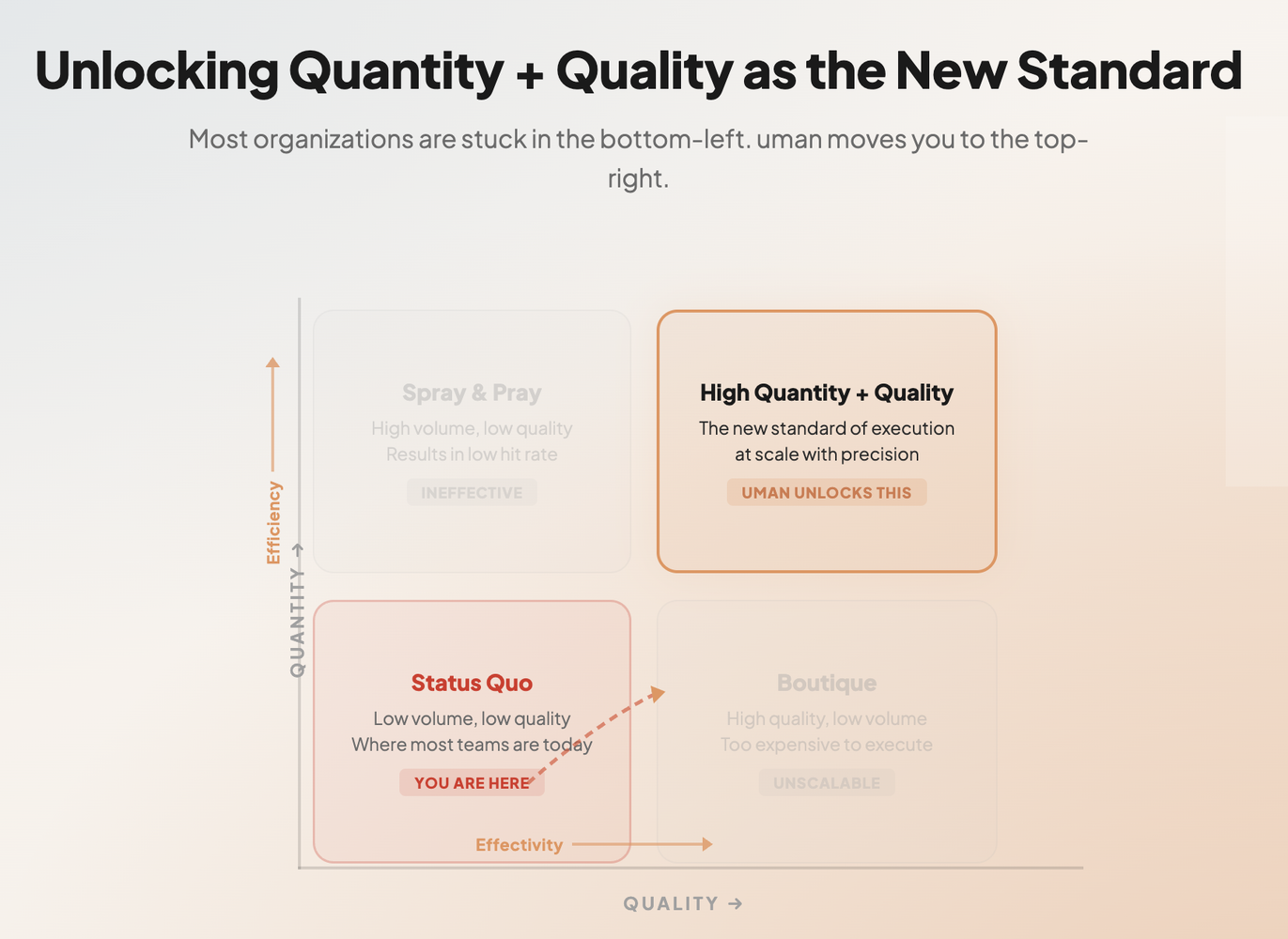
Most B2B sales teams sit in the bottom-left quadrant: low volume, low quality. Status Quo. They know it, but the alternatives always seemed worse.
- Move up to Spray & Pray (more volume, same quality)? Hit rates collapse.
- Move right to Boutique (better quality, same volume)? Too expensive to scale.
The top-right quadrant — high quantity AND high quality — used to be theoretical. You simply couldn't do both with human effort alone.
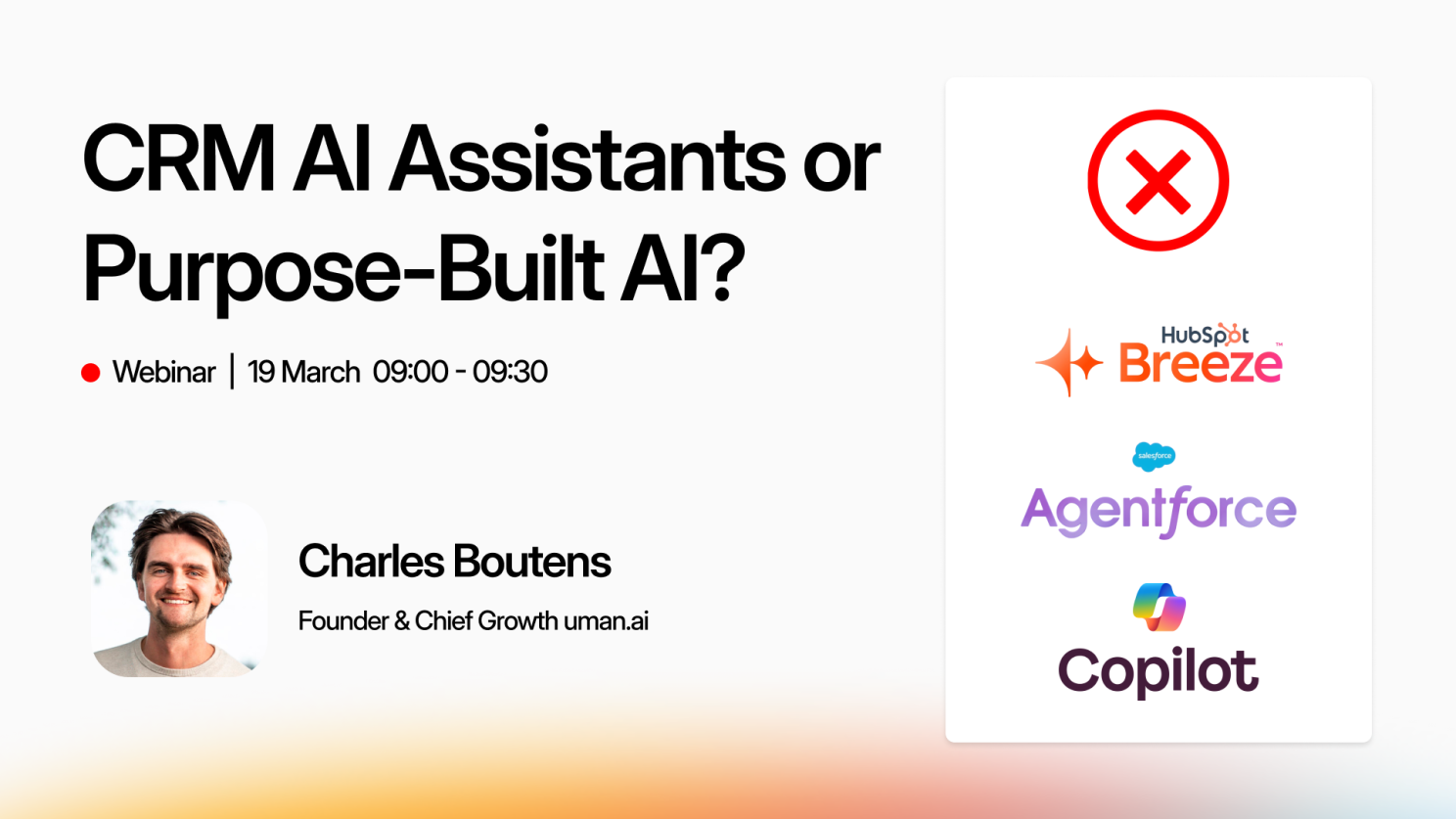
AI dissolved that constraint. Not generic AI, but purpose-built AI that knows your portfolio, your methodology, and your customer context. You can rewatch our webinar on CRM AI Assistants or Purpose-Built AI? to learn more about that.
This is what uman was designed to do: move teams from the bottom-left to the top-right. Execution at scale, with precision.
The cost of not acting
Here's where it gets uncomfortable, but it needs to be said.
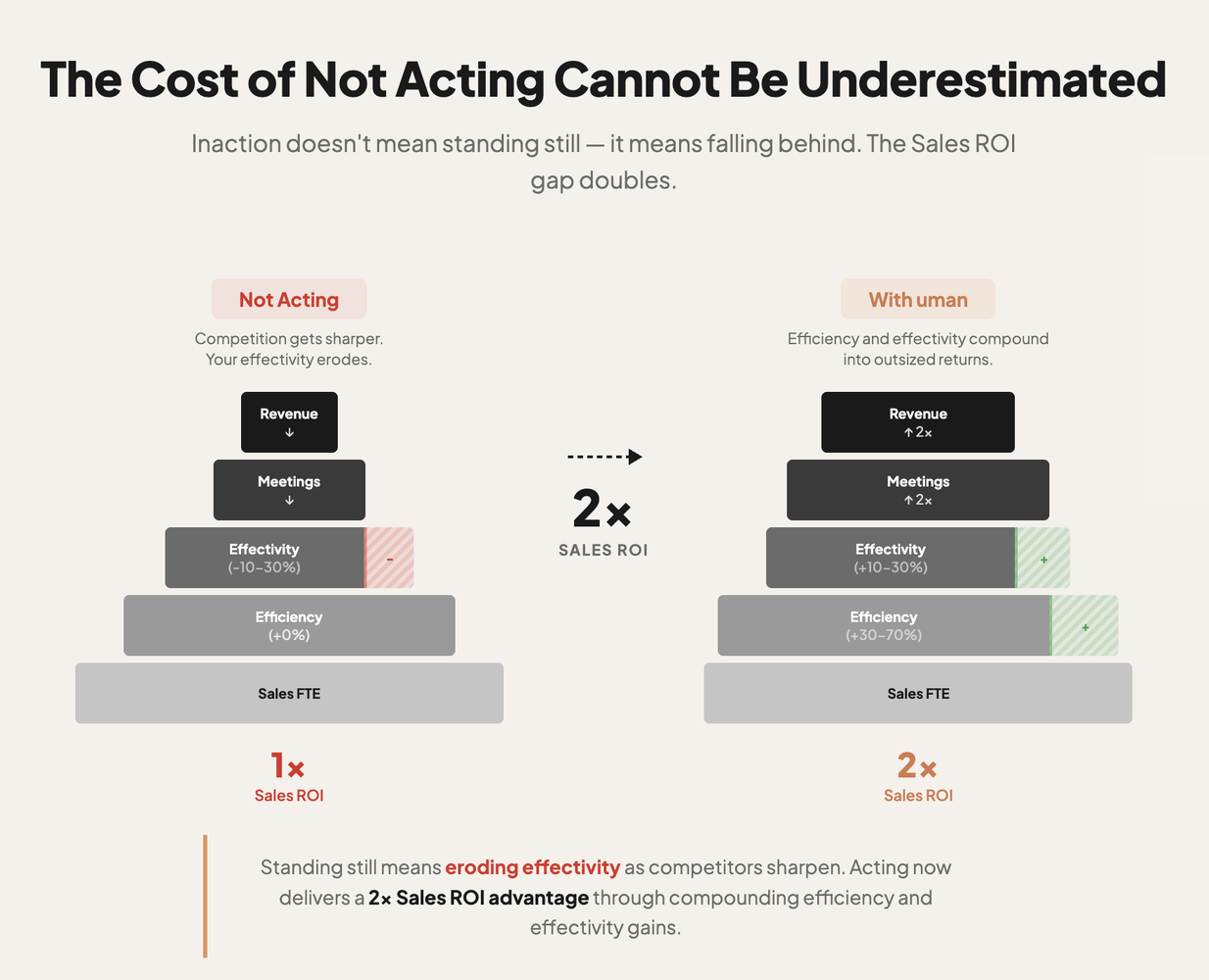
As so often in life and nature, acting doesn't mean standing still, it means falling behind.
While you maintain the status quo, your competitors are improving their effectivity. Their sales are showing up better prepared, with sharper positioning, closing deals you used to win. And your effectivity is at danger to eroding. Gartner projects:
By 2028, AI agents will outnumber sellers 10:1, and fewer than 40% of sales teams will report meaningful productivity gains from their AI investments.
The gap between teams that address both efficiency and effectivity versus those that address neither compounds.
The data from our own customers tells the story:
- Efficiency gains of 30-70%: reps reclaim hours previously lost to research, prep, and admin
- Effectivity gains of 10-30%: better qualification, tailored positioning, and context-rich conversations
The combined effect: a 2x Sales ROI advantage over teams that don't act
Standing still means eroding effectivity as competitors sharpen. Acting now means compounding efficiency and effectivity gains into outsized returns.
Build from the foundation up
Proximus CEO Stijn Bijnens recently argued that:
"AI will force every company to reorganize within the next five years. He views AI as an "exoskeleton" that enhances human capability and automates specific tasks, unbundling traditional roles, and consolidating what remains into new, higher-impact positions."
Proximus NXT (the B2B branch of Proximus) is a proud uman customer.
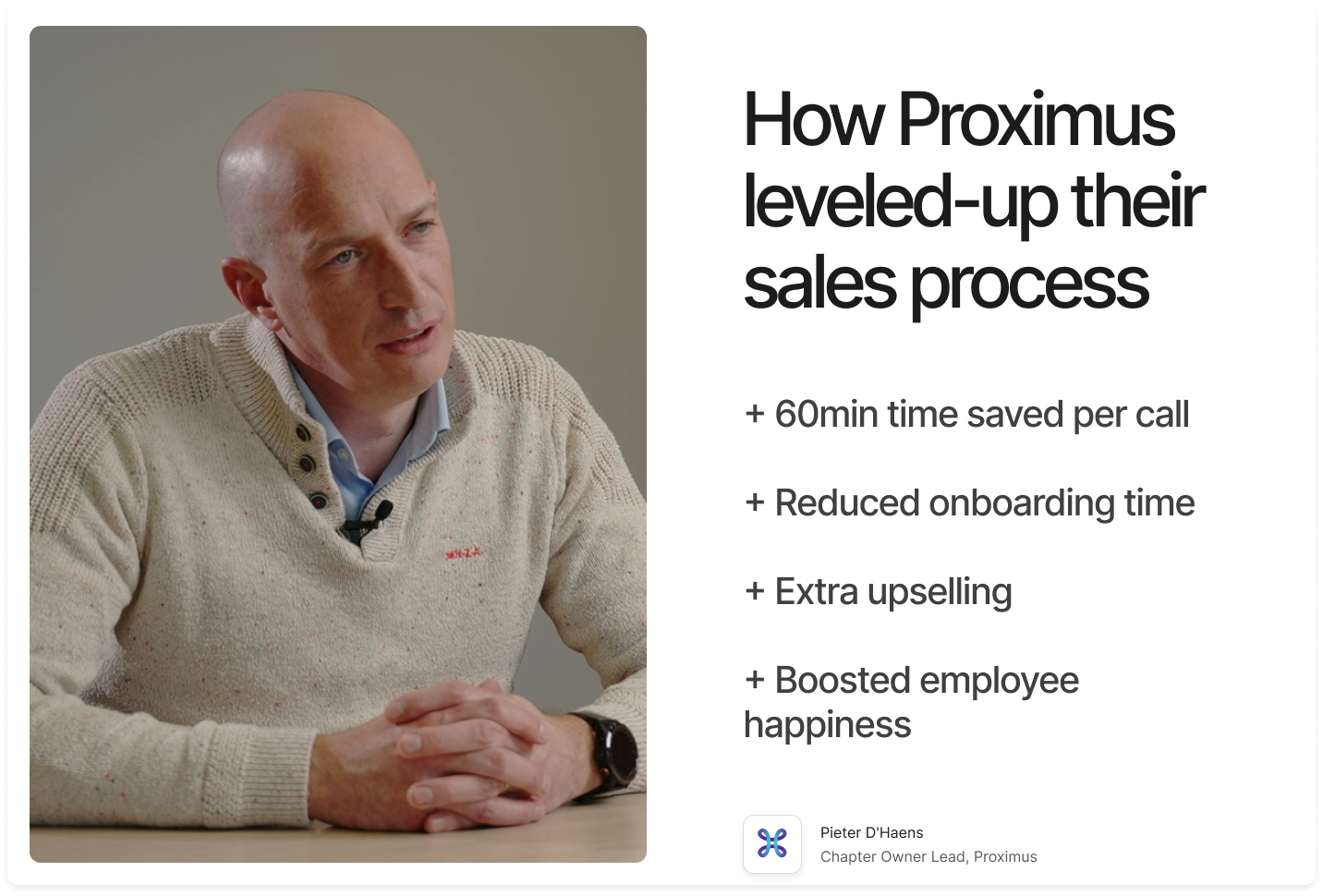
This exactly what we're seeing in B2B sales. The question isn't whether AI will reshape your sales performance. It's whether you're building from the foundation up. Efficiency first, then effectivity, then watching qualified meetings and revenue follow.
At uman, we built a purpose-built sales brain specifically for this: a platform that addresses both the efficiency and effectivity layers simultaneously, grounded in your company's own knowledge, methodology, and customer context. A sales brain that knows what your sales should say, to whom, and when.
This pyramid is like a diagnostic tool.
Look at your own team and ask: which layer needs work?
The answer will tell you exactly where to start.
Want to see how the pyramid applies to your team? Talk to us at uman.ai.

Prep like a machine, sell like a human
Let AI handle the research and prep work — you focus on building relationships and closing deals.