%20(1).png)
Effective prospecting in B2B sales for higher win rates
Discover proven prospecting strategies that deliver 33-41% win rates in complex B2B sales. Learn how proactive approaches drive 19-30% higher revenue and build sustainable pipelines.
Many sales leaders believe waiting for inbound leads is enough. The data tells a different story. Proactive sales opportunities close at 33-41% win rates, compared to 18-25% for reactive deals. That gap represents millions in lost revenue for organizations relying on passive approaches. Mastering prospecting is not optional for sustainable growth in complex B2B sales. This guide explores evidence-based strategies to enhance your team’s prospecting effectiveness, improve pipeline quality, and drive measurable revenue growth through disciplined, proactive outreach.
Table of Contents
- The Impact Of Proactive Prospecting On Win Rates And Revenue
- Key Prospecting Strategies To Build A Sustainable Sales Pipeline
- Comparing Prospecting Approaches And Customizing For Complex B2B Sales
- Implementing And Scaling Effective Prospecting In Your Sales Organization
- Boost Your B2B Prospecting With Uman’s Platform
Key takeaways
PointDetailsProactive opportunities win moreProactive deals close at 33-41% compared to 18-25% for reactive approaches.Consistent prospecting drives revenueSellers with proactive habits generate 19-30% higher annual revenue.Strategic prospecting builds defensibilityMastering prospecting creates sustainable, long-term growth regardless of market conditions.Customization improves effectivenessTailoring prospecting to deal complexity and buyer type increases response rates and deal quality.
The impact of proactive prospecting on win rates and revenue
Proactive prospecting means initiating contact based on research, buyer signals, and strategic targeting rather than waiting for prospects to reach out. Reactive prospecting responds to inbound inquiries, RFPs, or referrals where the buyer controls timing and engagement. The distinction matters because proactive sales opportunities close at 33-41% win rates, compared to 18-25% for reactive deals.
This performance gap exists because proactive sellers shape conversations early, position solutions before competitors enter, and build relationships on their terms. Reactive sellers compete in crowded fields where price often becomes the deciding factor. The difference shows up immediately in your pipeline metrics.
ApproachWin RateRevenue ImpactControl LevelProactive33-41%19-30% higher annual revenueHigh seller controlReactive18-25%Baseline performanceLow seller control
Beyond win rates, proactive prospecting delivers compound benefits:
- Earlier engagement in the buyer journey creates opportunities to influence requirements
- Higher quality conversations focused on business outcomes rather than product features
- Stronger relationships built through value delivery before formal sales processes begin
- Better deal qualification leading to more efficient resource allocation
Pro Tip: Block two hours every morning for prospecting activities before meetings or emails. This protected time ensures proactive work happens consistently, not just when reactive demands allow.
Sellers with proactive habits generate 19-30% higher annual revenue than peers relying primarily on reactive approaches. This revenue lift compounds year over year as proactive sellers build larger networks, stronger reputations, and more predictable pipelines. Organizations embedding proactive account management into their culture see sustained performance improvements across entire teams.
The correlation between prospecting discipline and revenue growth is clear. Sales leaders implementing structured account management strategies report higher team morale alongside better numbers. Sellers feel more in control of their outcomes when they drive pipeline creation rather than waiting for opportunities to appear.
Key prospecting strategies to build a sustainable sales pipeline
Mastering prospecting is key to sustainable, defensible growth in any business climate. The foundation starts with research-driven targeting. Identify accounts matching your ideal customer profile based on firmographics, technographics, and behavioral signals. Layer in intent data showing active buying interest. This targeting precision prevents wasted effort on poorly matched prospects.

Multi-channel outreach amplifies your message across touchpoints where prospects engage. Combine email, LinkedIn, phone, and video in coordinated sequences. Each channel serves different purposes: email delivers detailed value propositions, LinkedIn builds social proof, phone creates personal connection, and video demonstrates expertise. The combination increases response rates significantly compared to single-channel approaches.
Follow this step-by-step prospecting workflow:
- Research target accounts thoroughly using company websites, news, LinkedIn, and industry reports to identify business challenges and strategic priorities
- Identify key stakeholders across buying committee roles including economic buyers, technical evaluators, and end users
- Craft personalized outreach messages connecting your solutions to specific challenges uncovered in research
- Execute coordinated multi-channel sequences with strategic timing and follow-up cadences
- Track engagement metrics and refine messaging based on response patterns and conversion data
- Qualify interested prospects rigorously before advancing to formal sales processes
Implementing a robust sales operating system ensures these workflows execute consistently across your team. Standardized processes combined with individual creativity produce the best results.
Common prospecting pitfalls to avoid:
- Generic messaging that could apply to any company in any industry
- Focusing on product features rather than business outcomes and value creation
- Insufficient research leading to poorly targeted outreach and low response rates
- Inconsistent follow-up allowing warm leads to go cold unnecessarily
- Neglecting to track and analyze prospecting metrics for continuous improvement
- Giving up too early when initial outreach does not generate immediate responses
Pro Tip: Review your prospecting metrics weekly. Track outreach volume, response rates, meeting conversion, and pipeline generated. This regular analysis reveals what works and where to adjust your approach.
These strategies contribute to long-term pipeline health by creating predictable flow rather than feast-or-famine cycles. Organizations building high performing sales teams embed prospecting excellence into hiring profiles, onboarding programs, and ongoing development. The result is defensible growth that persists through market changes.
Comparing prospecting approaches and customizing for complex B2B sales
Three primary prospecting approaches dominate B2B sales. Cold outreach targets prospects with no prior relationship or engagement. Warm outreach leverages existing connections, past interactions, or mutual contacts. Referral-based prospecting activates customer and partner networks to introduce new opportunities. Each approach offers distinct advantages depending on your sales context.
ApproachEffectivenessEffort RequiredResponse RateBest ForCold OutreachModerateHigh volume needed1-3%Building new market segmentsWarm OutreachHighModerate targeting8-15%Expanding existing relationshipsReferral-BasedVery HighLow volume, high quality25-40%Leveraging satisfied customers

Cold outreach requires significant volume to generate results but opens entirely new markets. The low response rates demand excellent targeting and compelling messaging. Warm outreach performs better because prior touchpoints establish credibility. Referral-based prospecting converts highest because trusted introductions overcome buyer skepticism immediately.
Customizing your prospecting approach based on these criteria improves results:
- Deal complexity and average contract value determine appropriate research depth and personalization levels
- Buyer seniority influences channel selection and messaging sophistication
- Industry regulations and procurement processes shape outreach timing and content compliance
- Competitive intensity requires differentiation strategies and unique value articulation
- Existing relationship status dictates whether cold, warm, or referral approaches fit best
Complex B2B sales involving multiple stakeholders, long cycles, and significant investments demand highly customized prospecting. Generic templates fail because sophisticated buyers expect sellers to understand their specific challenges. Technology platforms like the prospect finder platform help sales teams identify relevant targets and surface insights enabling meaningful personalization at scale.
Effective business development tools combine data aggregation with AI-powered analysis to recommend optimal prospects, suggest personalized messaging angles, and track engagement across channels. This technology amplifies human judgment rather than replacing it. Sellers still craft strategies and build relationships. Platforms remove manual research drudgery and surface opportunities humans might miss.
Customization increases prospecting efficiency by focusing effort where it generates highest returns. Teams waste less time on poorly matched prospects and convert more conversations into qualified pipeline. This efficiency boost improves team morale as sellers see their work producing tangible results. The combination of smart targeting, personalized outreach, and technology enablement creates competitive advantage in crowded markets.
Implementing and scaling effective prospecting in your sales organization
Rolling out prospecting excellence across your sales organization requires structured training, clear expectations, and ongoing support. Start by documenting your prospecting methodology including targeting criteria, research processes, messaging frameworks, and multi-channel sequences. This documentation becomes the foundation for onboarding new hires and upskilling existing team members.
Steps for implementing prospecting best practices:
- Conduct workshops teaching research techniques, personalization strategies, and multi-channel orchestration
- Create templates and playbooks providing starting points while encouraging customization
- Assign prospecting quotas ensuring consistent pipeline generation activity
- Implement peer review sessions where team members share successful approaches and learn from each other
- Celebrate wins publicly to reinforce desired behaviors and build prospecting culture
- Provide one-on-one coaching addressing individual skill gaps and performance barriers
Key metrics to track prospecting performance:
- Outreach volume by channel showing activity levels and effort distribution
- Response rates indicating message relevance and targeting accuracy
- Meeting conversion percentages revealing qualification effectiveness
- Pipeline generated measuring ultimate prospecting output and business impact
- Time to first meeting tracking speed from initial contact to substantive conversation
- Win rates on prospected deals validating quality of pipeline created
Pro Tip: Combine human expertise with AI platforms to scale prospecting without sacrificing personalization. Technology handles research aggregation and pattern recognition while sellers focus on relationship building and strategic thinking.
The sales enablement platform approach centralizes knowledge, automates routine tasks, and provides AI-powered insights that help sellers prospect more effectively. These platforms integrate with existing CRMs and communication tools, creating seamless workflows rather than adding complexity. Advanced deal execution solutions ensure prospecting efforts translate into won business through better meeting preparation, content generation, and opportunity management.
Fostering a proactive prospecting culture requires leadership commitment and accountability systems. Sales leaders must model prospecting behaviors, allocate time for prospecting activities, and remove obstacles preventing consistent execution. Regular pipeline reviews focusing on prospecting metrics keep the discipline top of mind. Recognition programs highlighting prospecting excellence reinforce its importance.
Continuous improvement comes from analyzing what works and iterating quickly. Run A/B tests on messaging, timing, and channel mix. Gather feedback from prospects about what resonated and what fell flat. Share learnings across the team so everyone benefits from collective experience. This experimentation mindset combined with disciplined execution creates sustained prospecting performance improvements.
Boost your B2B prospecting with Uman’s platform
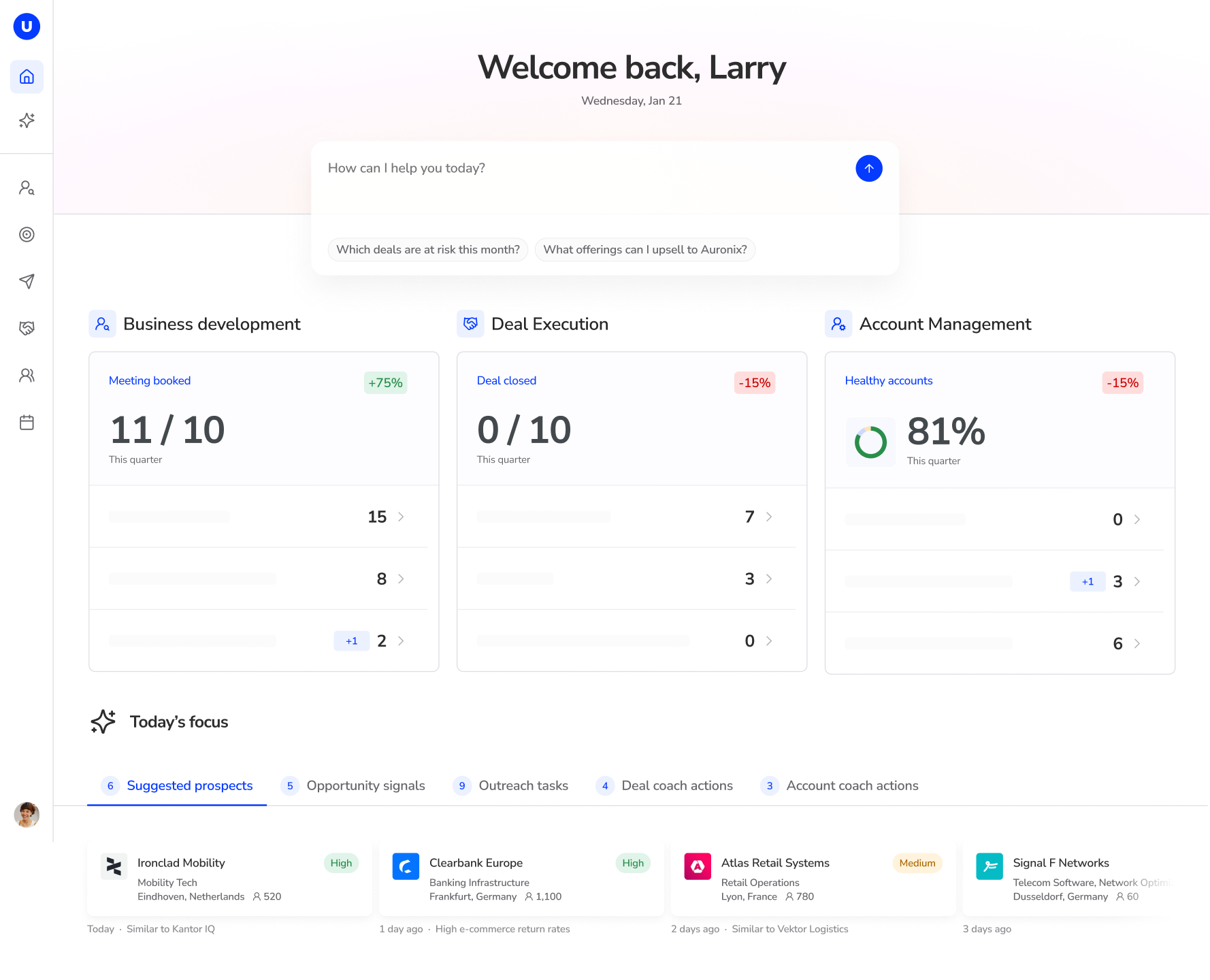
Transforming prospecting from inconsistent activity into predictable revenue engine requires the right combination of strategy, skills, and technology. Uman’s sales enablement platform empowers your team to prospect proactively by centralizing sales knowledge, automating research, and delivering personalized insights at scale. Our AI-driven workflows help sellers identify high-potential prospects, craft compelling outreach, and track engagement across channels.
The platform’s deal execution capabilities ensure prospecting efforts convert into won business through better meeting preparation and opportunity management. Advanced account management tools help teams identify cross-sell and upsell opportunities within existing relationships, maximizing customer lifetime value. Sales organizations using Uman report 10-30% revenue increases within 12-18 months alongside faster onboarding and higher team morale. Explore how our platform can elevate your prospecting effectiveness and drive sustainable growth.
FAQ
What is proactive prospecting and why does it matter?
Proactive prospecting involves initiating contact with potential buyers based on research, targeting criteria, and strategic intent rather than waiting for inbound inquiries. It matters because proactive opportunities close at significantly higher win rates and generate more revenue per seller. Organizations relying primarily on reactive approaches leave substantial growth on the table.
How can sales teams develop effective prospecting habits?
Developing prospecting habits requires dedicated time blocks, clear activity quotas, and regular tracking of leading indicators like outreach volume and response rates. Training programs teaching research techniques and personalization strategies build foundational skills. Sales enablement tools automate routine tasks and provide insights that improve consistency and results across the team.
What metrics should leaders use to evaluate prospecting success?
Leaders should track win rates on proactively sourced deals, annual revenue growth from prospecting activities, and pipeline velocity showing how quickly prospects move through stages. Engagement metrics including response rates, meeting conversion percentages, and time to first meeting reveal execution quality. These indicators together provide comprehensive view of prospecting effectiveness and business impact.
How should prospecting approaches vary for different B2B sales contexts?
High complexity deals involving multiple stakeholders and significant investments require extensive research, highly personalized outreach, and relationship-building across the buying committee. Lower complexity or more transactional sales can leverage higher volume approaches with moderate personalization and automated sequences. Deal value, sales cycle length, and buyer sophistication determine the appropriate balance between customization and scale.
What role does technology play in improving B2B prospecting?
Technology automates time-consuming research, aggregates buyer signals from multiple sources, and delivers personalized insights that would be impossible to generate manually at scale. Platforms analyze engagement patterns to recommend optimal timing, channels, and messaging for each prospect. The prospect finder platform exemplifies how AI-driven tools help sales teams identify high-potential opportunities and execute more effective outreach while maintaining the human touch that builds lasting relationships.
Recommended
Prep like a machine, sell like a human
Let AI handle the research and prep work — you focus on building relationships and closing deals.