%20(1).png)
What is personalized outreach? The B2B leader's guide
Learn what personalized outreach really means in B2B sales, how to execute it at scale, avoid common pitfalls, and measure outcomes that drive real revenue growth.
TL;DR:
- Genuine personalization involves understanding a prospect’s current challenges, priorities, and recent events.
- AI accelerates research but human judgment ensures relevance and authenticity in outreach.
- The most effective teams measure success through pipeline speed, deal size, and win rates, not just replies.
Your sales reps send dozens of messages every week. Prospects read the first line, recognize the template, and move on. It happens constantly in complex B2B environments where decision makers are flooded with outreach that leads with company names and job titles as if that counts as personalization. It does not. Personalized outreach requires more than a prospect’s name and company. Real personalization means understanding what a buyer is actually dealing with right now, and speaking directly to that. This guide breaks down what personalized outreach truly means, how it works mechanically, where teams go wrong, and how to measure whether it is actually moving the needle.
Table of Contents
- What personalized outreach really means in B2B sales
- The core mechanics: How personalized outreach is done
- Common pitfalls and the balance: Robot vs. human
- Personalized outreach in action: Examples and measurement
- Why most B2B outreach still fails—and what elite teams do differently
- Experience next-level personalized outreach with Uman
- Frequently asked questions
Key Takeaways
PointDetailsGo beyond basicsTrue personalization is customized to a prospect’s business—not just their name or company.Leverage AI toolsAI accelerates research and signal detection but still needs the human touch for impact.Balance quality and scaleTier your personalization effort—go deepest for top accounts, use segments for the rest.Measure real outcomesTrack pipeline, deal size, and sales speed to assess what truly works.
What personalized outreach really means in B2B sales
Let’s be direct: most outreach labeled “personalized” is not. Swapping in a first name and a company name is mail merge, not personalization. Buyers in complex B2B environments see through it immediately because they receive dozens of messages using the exact same formula every day.
True personalized outreach in B2B sales means tailoring communication to context, including a prospect’s specific challenges, priorities, tech stack, recent events, and role. It is built on research and data, not basic merge fields. The difference in how a prospect responds is significant.
Here is what genuine personalization actually looks like in practice:
- Company-level signals: Recent funding rounds, leadership changes, product launches, or press coverage that creates a relevant opening.
- Role-specific framing: Understanding what a VP of Sales cares about versus what a CTO prioritizes, and crafting the message accordingly.
- Industry context: Referencing trends, regulations, or competitive dynamics that are specific to the prospect’s sector.
- Individual triggers: A job change, a LinkedIn post, a conference talk, or a public comment that shows you have paid attention.
Following B2B sales best practices means going beyond the surface. Personalization is not a tactic you apply once. It is a research discipline that runs through every touchpoint in the sales cycle.
“Personalization at scale does not mean automating the same generic message a thousand times. It means using technology to do real research faster, so your reps can show up with genuine relevance.”
One important nuance: personalization can scale, but it loses its effect when it feels mechanical. If AI generates a message that references a prospect’s LinkedIn post in a way that reads like a bot wrote it, the authenticity collapses. The goal is relevance, and relevance requires human judgment at the final stage. Teams that invest in prospecting for higher win rates understand that the research layer is where the real competitive advantage lives.
The core mechanics: How personalized outreach is done
Building outreach that actually lands is a structured process. It is not about inspiration or creativity alone. It is about layering the right data at the right time and delivering it through the right channel.
Here is how high-performing B2B teams approach it step by step:
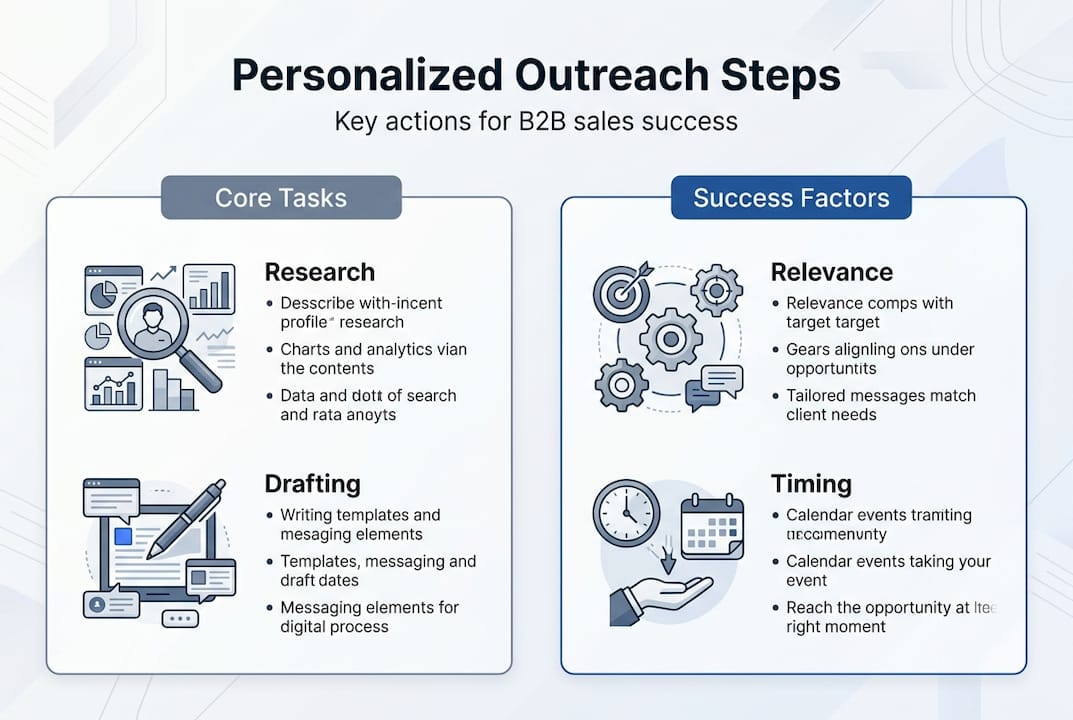
- Build a research stack. Gather company news, hiring patterns, funding activity, tech stack data, and recent executive statements. Tools like LinkedIn Sales Navigator, intent data platforms, and AI research assistants dramatically reduce the time this takes.
- Identify a specific trigger. The best outreach opens with a reason why you are reaching out now. A recent acquisition, a new product line, or a leadership hire all create natural hooks that feel timely rather than random.
- Match the message to the role. A CFO cares about cost reduction and risk. A Head of Sales cares about pipeline and rep productivity. The same value proposition needs to be framed differently for each.
- Choose the right channel. Email works for detailed context. LinkedIn works for warm introductions and visibility. Phone works when timing is critical. The best teams blend all three based on where the prospect is most active.
- Draft, review, and adjust. AI strategies for sales can compress the research and drafting phase significantly, but a human rep must review every message before it goes out.
The table below shows how AI for prospecting changes the time investment across each step:
TaskManual time estimateWith AI assistanceCompany research45 to 60 minutes5 to 10 minutesTrigger identification20 to 30 minutes2 to 5 minutesMessage drafting15 to 20 minutes3 to 5 minutesHuman review and edit10 minutes10 minutesTotal per account90 to 120 minutes20 to 30 minutes
Pro Tip: Do not let AI send messages without a rep reading them first. The time savings come from research and drafting, not from removing human judgment. That final review is where authenticity is preserved.
The mechanics of personalized outreach include deep research across company news, funding, hiring trends, and tech stack, combined with signal-based hooks and persona-based messaging. AI accelerates the process, but the human layer is what makes the message land.

Common pitfalls and the balance: Robot vs. human
With the mechanics in place, it is just as important to avoid common mistakes and know where to strike the right balance. Because personalized outreach can backfire when it is done poorly, and the damage to trust is real.
Here are the most common mistakes B2B sales teams make:
- Referencing personal details that feel invasive. Mentioning that you saw someone’s weekend post or personal milestone crosses a line. Stick to professional and business context only.
- Getting the signal wrong. If AI pulls outdated or incorrect data and your rep does not catch it, the message signals carelessness rather than research.
- Applying deep personalization to every account equally. This is unsustainable and dilutes the effort. Not every prospect warrants the same investment.
- Letting AI output go out unedited. Robotic phrasing, generic transitions, and hollow compliments are easy to spot and erode credibility fast.
The solution is a tiering model. Over-personalization risks like coming across as intrusive or stale are real, and the fix is matching personalization depth to account value.
Account tierPersonalization approachTime investmentTier 1 (strategic accounts)Full research, custom messaging, multi-channelHighTier 2 (mid-value accounts)Segment-based templates with signal hooksMediumTier 3 (volume outreach)Persona-based templates, minimal customizationLow
This framework lets you apply automating prospecting tools intelligently without sacrificing quality where it matters most. The goal is not to personalize everything. It is to personalize the right things for the right accounts.
Pro Tip: Start with a pilot of 15 to 20 Tier 1 accounts. Test two message variants, measure response quality (not just reply rate), and use those learnings before scaling. Reviewing your prospecting workflow tips alongside this pilot will help you spot gaps in your current process.
The teams that get this right audit their approach regularly. They ask whether the personalization is actually relevant to the buyer, or whether it just feels personalized to the sender.
Personalized outreach in action: Examples and measurement
So how does it all come together? Let’s look at examples and see how successful teams measure real impact.
Here is a practical workflow for a Tier 1 B2B account:
- Identify the account and key stakeholders. Map the buying committee, not just the primary contact. Know who influences the decision.
- Gather triggers. The company recently announced a new service line. The VP of Sales joined six months ago. They are hiring aggressively in a specific region.
- Build the message. Open with the trigger. Connect it to a challenge your solution addresses. Make the ask small and specific, like a 20-minute conversation, not a demo request.
- Send via the right channel. LinkedIn for the initial connection, email for the detailed follow-up, phone if there is no response after two touches.
- Track and iterate. Log every interaction in your CRM. Note what resonated and what did not.
Now, the measurement question. Most teams track open rates and reply rates. Those numbers are useful for testing subject lines, but they do not tell you whether personalized outreach is actually driving revenue. The metrics that matter are:
- Pipeline velocity: Are personalized accounts moving through stages faster?
- Average deal size: Are you winning larger contracts from accounts you invested more research in?
- Win rate: Are you closing a higher percentage of opportunities from personalized outreach sequences?
For signal-based personalization in complex B2B, the measurement focus should always be on outcomes beyond replies. And looking ahead, AI agents for context-aware messaging and intent data are becoming central to how leading teams operate in 2026. Poor personalization erodes trust rapidly in this environment, which means the bar for quality keeps rising.
Reviewing sales productivity best practices alongside your outreach metrics gives you a fuller picture of where time is being well spent and where it is being wasted.
Why most B2B outreach still fails—and what elite teams do differently
Despite all the technology available, most personalized outreach still underperforms. Here is our honest take on why.
The problem is not the tools. It is the mindset. Teams adopt AI-assisted outreach and immediately try to scale it before they have proven what works. They automate the research layer but skip the review layer. They call it personalized because a trigger was inserted, but the message still reads like a template.
Buyers in complex B2B environments are sophisticated. They recognize surface-level personalization instantly, and when they do, it signals that the seller did not invest real effort. That is worse than a generic message, because it feels like a pretense.
Elite teams do something different. They treat outreach as a revenue discipline, not a volume game. They tie every outreach sequence to measurable pipeline outcomes. They use AI strategies for personalization to accelerate research, but they never remove the human judgment layer. And they audit their workflows regularly, asking whether the personalization is genuinely relevant or just technically present.
The real competitive advantage is not having the best AI tool. It is building a team culture where relevance is a standard, not an afterthought.
Experience next-level personalized outreach with Uman
Ready to move from theory to impact? Here is how you can get started.
Uman is built specifically for complex B2B sales teams that need to deliver personalized outreach at scale without sacrificing quality. The platform acts as a centralized sales brain, pulling together your service portfolio, client data, and sales content so your reps can generate contextually relevant outreach in minutes, not hours.
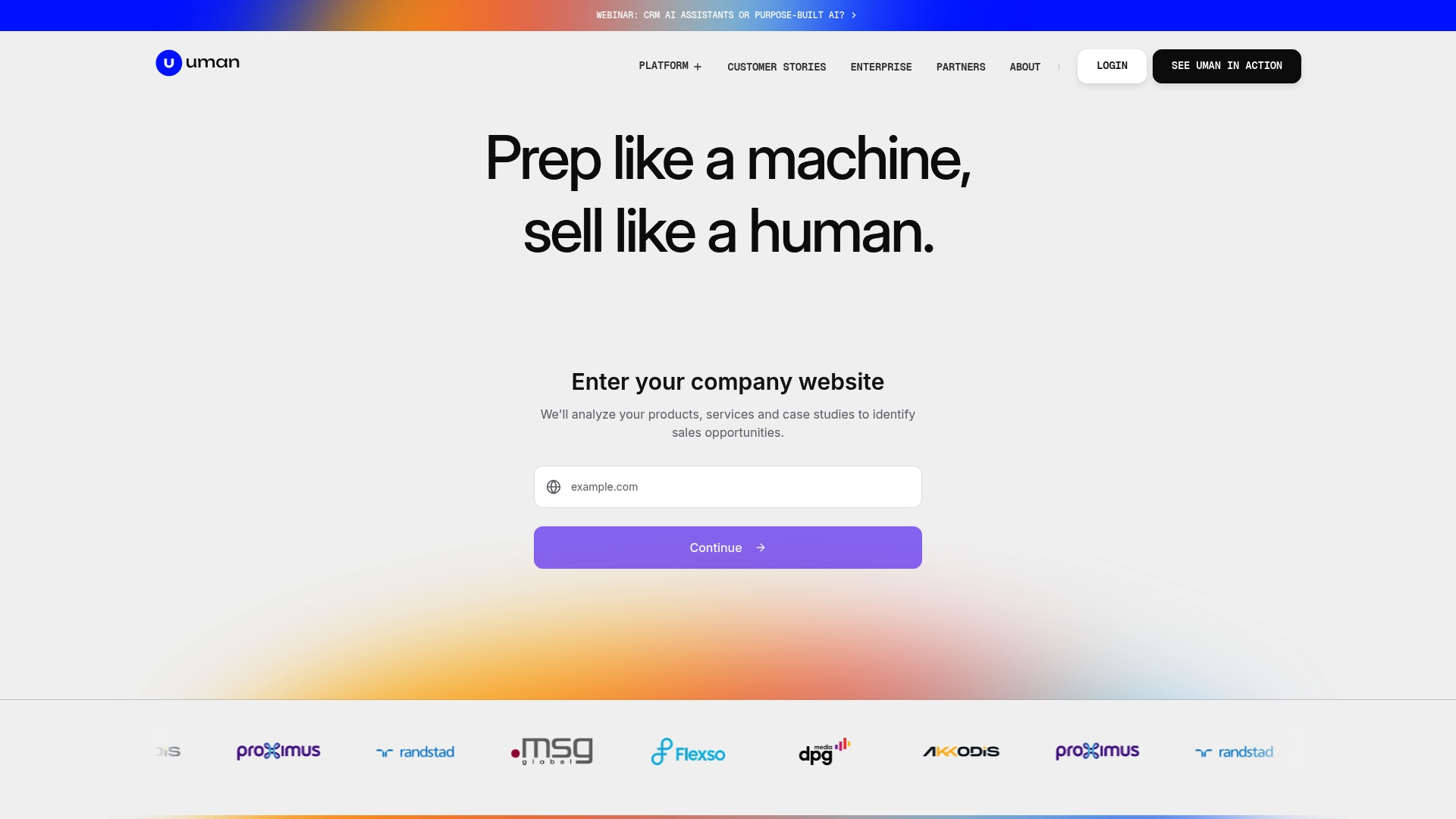
With Uman’s account management capabilities, your team can track account signals, identify cross-sell opportunities, and build outreach grounded in real client context. Explore the full Uman platform to see how it works in practice, or read how Akkodis used Uman to transform their sales execution. The results speak for themselves.
Frequently asked questions
What is considered personalized outreach in B2B sales?
Personalized outreach in B2B sales is communication tailored to a prospect’s context, including their business challenges, role priorities, and recent company events, rather than generic templates with basic merge fields.
How is AI used in personalized outreach?
AI agents enable context-aware messaging by detecting signals like job changes and funding events, then drafting relevant messages, but human review remains essential to ensure authenticity and accuracy.
What if personalized outreach gets too ‘creepy’?
Stick to professional and business context only. Over-personalization risks arise when outreach references personal details or online activity that falls outside the prospect’s professional life.
How can I measure the success of personalized B2B outreach?
Go beyond open and reply rates. Pipeline velocity, deal size, and win rates give you a true picture of whether personalized outreach is generating real revenue impact.
Recommended
Prep like a machine, sell like a human
Let AI handle the research and prep work — you focus on building relationships and closing deals.